- Place
- Šiauliai City Municipality
- Region
- Samogitia
- Type
- an active Catholic parish church occupying a former Russian military garrison Orthodox church
- Address
- 17 Kražių Street, LT-77154 Šiauliai
- Coordinates
- 55.92512, 23.31275
- Visit duration
- 20-40 minutes for the exterior and interior if the church is open; longer for a service or pre-arranged guided visit
- Best time
- daylight for the exterior; see the interior when the church is open outside a service, or attend the liturgy respectfully
Šiaulių Šv. Jurgio bažnyčia, Šiauliai Church of St George the Martyr, former St Nicholas the Wonderworker Garrison Church
Kražių Street is home to a Catholic parish of St George the Martyr
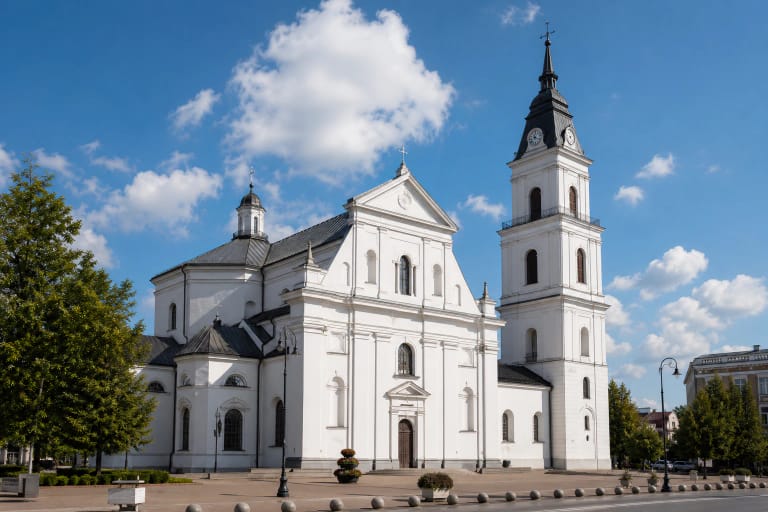
St George's Church stands at 17 Kražių Street in central Šiauliai, close to the railway station. Today it is the active Roman Catholic church of St George the Martyr Parish in the Diocese of Šiauliai, not the city's cathedral and not an operating Orthodox church. Its first purpose explains the architecture, but not its present denominational identity.
The map point at 55.92512, 23.31275 marks the church building, so the metadata use site rather than an exact public-door threshold. Some records show 17-1 or place the mapped building on the opposite street number, but the parish and the diocese both publish 17 Kražių Street for visitors.
The 1907-1909 chronology belongs to a standard military design
Sources differ over the exact construction date. The Architecture and Urban Research Centre notes that architectural historian Algė Jankevičienė dated the building to 1908, while historian Regina Laukaitytė gave 1909. The parish says around 1908, and a published account drawing on the church chronicle records work beginning on 27 May 1907 and consecration on 9 November 1908. The responsible wording is therefore 1908-1909, not a falsely certain single year.
The Orthodox church served the Russian troops stationed in Šiauliai and was dedicated to St Nicholas the Wonderworker. AUTC does not identify a verified individual architect. It says the building followed a standard garrison-church design approved by the Russian military authorities and also used, with variations, in other imperial garrison towns. An architect's name should not be attached to this specific building without additional archival evidence.
The parish history records an unusual land dispute. The church was built on property belonging to Stanislava Venclauskienė without a properly settled legal basis. Her husband, lawyer Kazimieras Venclauskis, won the case, but intervention by the War Ministry led to a settlement and the building remained where it stood.
Neo-Byzantine forms are expressed through red brick
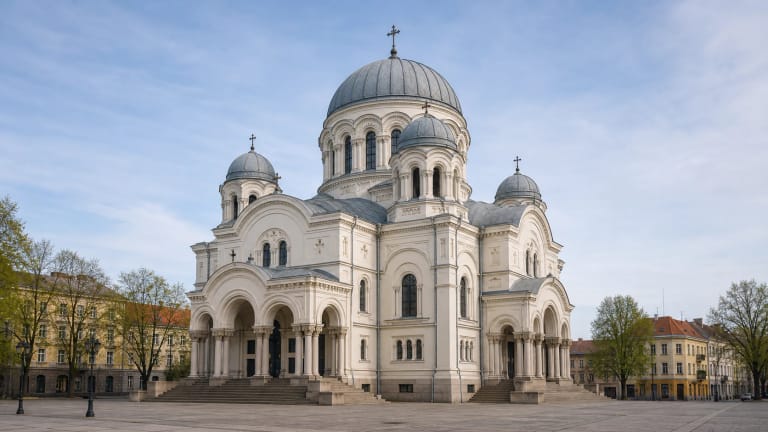
The masonry exterior is dominated by red brick, pale rendered details, and grey metal roofs over the tower and dome. AUTC describes Neo-Byzantine forms combined eclectically with Romanesque and classical-order elements associated with the Renaissance and Baroque. Relief brick bands, arched windows, small gables, and a finely divided silhouette also connect the building with the Russian and brick styles spreading through late nineteenth-century Orthodox architecture.
From the street, the tall front tower with its octagonal upper stage and steep metal roof is the first landmark. A broader onion dome rises behind it, while round-headed windows and relief masonry repeat along the side elevations. The parish history gives pre-fire heights of 29 and 25 metres for the church's two towers. They are architectural verticals, not separate observation towers open to visitors.
A wartime warehouse became the parish church of St George
After the Russian army withdrew during the First World War, the German occupation authorities used the Orthodox church as a weapons store. In June 1919, Lithuanian Army 3rd Infantry Regiment chaplain Martynas Jonaitis oversaw repairs and the building was assigned to the regiment's pastoral needs. That military Catholic phase was brief because the regiment soon left Šiauliai.
On 6 July 1919, Šiauliai dean Julijonas Jasenskis consecrated the former Orthodox church for Roman Catholic use and gave it the title of St George the Martyr. After the principal fitting-out works were completed, it received parish rights on 9 October 1923. The present dedication and parish therefore belong to the Lithuanian period, not to the original 1908 establishment.
The 1976 fire changed the interior without erasing every artistic layer
A major fire in March 1976 destroyed the roof, ceiling, organ, pews, and severely damaged the main tower. The parish says the church was rebuilt within nine months, while AUTC dates the repair to 1977. Further work before the centenary in 2006-2008 renewed the roof, windows, exterior and interior decoration, and installed exterior lighting.
The present interior should therefore not be described as an unchanged Orthodox interior from 1908. AUTC nevertheless emphasises the surviving richly ornamented character associated with an Orthodox church. Inventory-based accounts list works by Jonas Janulis, including a Golgotha composition made in 1922, Petras Kalpokas's painting St Zita, and wooden figures of saints. These are Catholic-period works of different origins, not automatically remnants of the original iconostasis.
Mass times are not tourist opening hours
On 21 July 2026, the parish and Diocese of Šiauliai published the same schedule: Mass on Sundays at 8 am, 10 am, and noon; on Saturdays at 10 am and 6 pm; and on weekdays at 8 am and 6 pm. The parish office listed weekday hours of 9 am-1 pm and 2 pm-6 pm, with weekend and public-holiday service before and after Mass. Schedules can change, so check the official page before making a special journey.
Neither office hours nor Mass times constitute a separate tourist-opening schedule. The official pages do not promise all-day interior access or publish a verified step-free route through the church. If step-free entry, a group visit, or photography matters to you, contact the parish in advance. There is no admission charge to attend worship, but visitors should keep quiet, avoid photographing people without permission, and take part respectfully rather than touring during the liturgy.