- Place
- Smiltynė, Klaipėda City Municipality
- Region
- Curonian Spit
- Type
- resort-history and architecture site
- Address
- Smiltynės g. 17, Smiltynė, Klaipėda
- Coordinates
- 55.70330, 21.11480
Sandkrug Kurhaus
Smiltynė Kurhaus: a sign of the resort's beginnings
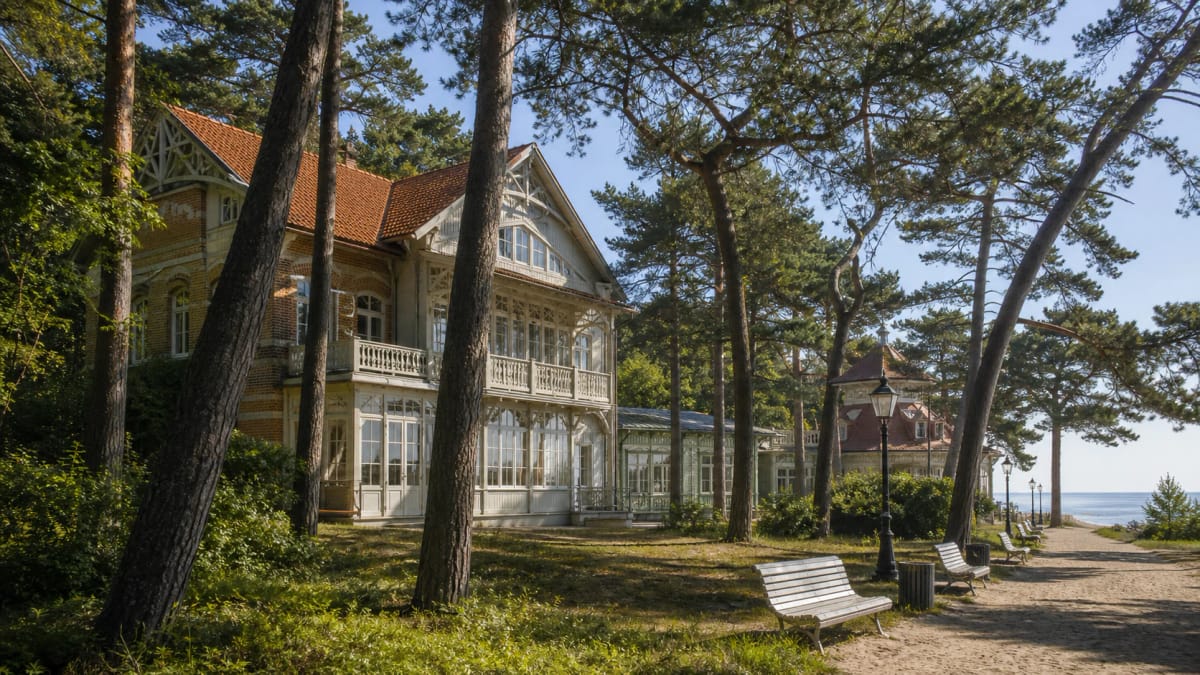
Smiltynė Kurhaus is one of the places that helps you see Smiltynė as more than a route to the Lithuanian Sea Museum or beach. The kurhaus points to the time when the northern end of the Curonian Spit became a place of urban leisure, promenades, and resort architecture.
Curonian Spit National Park information links Smiltynė's history with the name Sandkrug, an inn and postal-road stop. This layer is important: Smiltynė began as a place of travel and stopping, and only later became more clearly a resort environment.
Sandberg, Sandkrug, and the postal road shift
The postal road from Klaipėda to Königsberg across the Curonian Spit is mentioned from 1409. An inn operated along it, and in the centre of Smiltynė, on a dune, stood the Sand Inn, Sandkrug in German, earlier called Sandberg. The whole settlement took its name from this inn, where postal-road travellers rested. In the mid-sixteenth century only about five people lived here, and for a long time the population did not exceed 20: just a few fishing families.
Around 1830, the postal road from Saint Petersburg to Königsberg was laid along a more convenient route through Šiauliai and Tilsit, so Smiltynė lost visitors and income. After the Smiltynė inn burned down, commercial councillor Mason saw business potential here for entertainment, recreation, seaside bathing, and holiday villas. The resort story therefore arose not from nowhere but on an old experience of travel and crossing.
The 1901 kurhaus and Smiltynė resort
Smiltynė became a resort at the beginning of the twentieth century, when a Klaipėda merchants' organization built a resort-entertainment and active-leisure complex here: the kurhaus. According to VLE, the kurhaus, a hotel with a restaurant, was founded in 1901; concerts were held there, and in the 1920s and 1930s children's festivals and competitions took place. From 1900, Smiltynė was gradually attached to Klaipėda.
The kurhaus was not only a building but the centre around which Smiltynė's leisure rhythm formed. Walking paths and promenades led through the forest toward the beaches, with commercial pavilions, arbours, and benches along them. The magistrate and merchants invested in the resort site, and wealthy residents built summer houses on the lagoon shore on both sides of the kurhaus.
Smiltynė villa quarter and Villa Hubertus
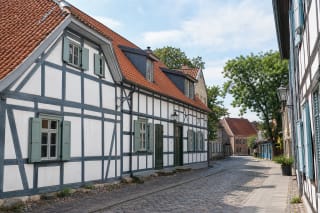
The southern villa quarter began forming around the kurhaus. Of a group of six buildings, four survive today: the houses now numbered Smiltynės g. 19, 20, 21, and 22. The house at Smiltynės g. 20 is especially fine, with interwar-villa architecture: a one-storey building clad in wooden boards, with a mansard, bay window, arched windows, and decorative bargeboards on a shallow roof.
In the northern villa quarter, the former Villa Hubertus, now Smiltynės g. 11, stands out for its decoration: an early-twentieth-century example of German Jugend style with shaped half-timbered wooden parts and decorated gable panels. In the summer season, it houses the Curonian Spit National Park visitor centre with educational activities and tours. When visiting the quarter, look not at one facade only but at the whole tree-shaded scale.
How to visit Smiltynė Kurhaus
Twenty to forty-five minutes is enough for the kurhaus and villa quarter if you are passing through. Give more time if you combine the route with the Lithuanian Sea Museum, Nerija Fort, the seaside path, or a slow walk through Smiltynė. Nearby is Hageno Hill, about 36 m high, with views of the spit.
No permanent public visiting schedule or tickets were found in official sources, so understand this object as a resort-history and architecture environment. Respect private or limited-access spaces and view buildings from public paths.