- Place
- Neringa Municipality
- Region
- Neringa
- Type
- national park visitor centre with an interactive landscape exhibition
- Address
- L. Rėzos g. 8, Juodkrantė, Neringa
- Coordinates
- 55.54225, 21.12128
- Visit duration
- about 1 hour for the exhibition presentation, plus time for the reading room and outdoor space
- Best time
- Tuesday-Saturday before one of the published exhibition presentations; recheck the time before travelling
KNNP Visitor Centre, Juodkrantė Visitor Centre, Kuršių nerijos nacionalinio parko lankytojų centras
The current centre is in Juodkrantė, not at the former Nida address
The current Curonian Spit National Park Visitor Centre operates at L. Rėzos g. 8 in Juodkrantė. Its public exhibition opened here on 4 October 2024. The park directorate works in the same reconstructed complex, but the visitor centre is a distinct public space for interpretation, information, and events rather than merely an administrative reception desk.
Do not confuse it with the former visitor-centre address at Naglių g. 8 in Nida, the Nature Schools in Nida and Smiltynė, or other park facilities. On 15 July 2026, the Google Maps card with place ID ChIJzQ4gDQDD5EYRF87F8DxRLJs pointed to L. Rėzos g. 8 at 55.5422493, 21.1212795 and carried a 4.8 rating. The old Naglių Street card was marked closed.
A six-year journey from school to public visitor centre
The State Service for Protected Areas traces the project to a 2018 decision by Neringa Municipal Council to transfer the former Juodkrantė school building to the park directorate. Reconstruction began in September 2021 after the building's use was changed to a cultural purpose, and the new centre officially opened on 4 October 2024. Its first public open days followed on 5 and 6 October.
UAB JAS designed the building under project lead Jūratė Juozaitienė, and UAB Pamario restauratorius carried out the reconstruction. The MB Baukas team developed and designed the exhibition. The centre was delivered through the Landscape Values Protection and Adaptation for Exploration II project, supported by the European Regional Development Fund.
The scale of Juodkrantė villas and an entrance carved by wind
The former school was redesigned with links to Juodkrantė's early 20th-century villas. Low wings clad in vertical blue-grey boards have steep red-tiled roofs, white-framed windows, and dark structural accents. A recessed glazed entrance sits between them, wrapped in pale flowing bands. The facade carving by Evelina Židelevičienė symbolises the intertwined forces of wind, sand, and water.
The courtyard retains mature planting and introduces native species, a meadow, and elements recalling a dune and seaside path. Benches face the Curonian Lagoon, making the outdoor space an extension of the interpretation rather than just a route to the door.
In 2025 the centre was one of 50 visitor centres presented in the UNESCO Venice office's Deep Surfaces exhibition. This was an architectural and visitor-experience showcase, not a separate UNESCO designation for the building. The World Heritage property is the Curonian Spit as a whole, listed as a cultural landscape since 2000.
The Created by Wind, Sand and Water exhibition
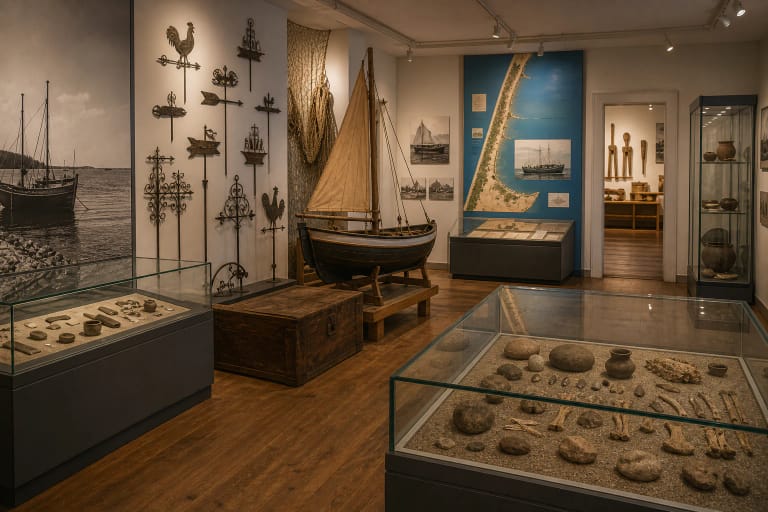
The exhibition explains how wind, sand, and water formed the Curonian Spit, how people learned to live in and stabilise this mobile landscape, and which natural and cultural values are protected today. It is not solely a geological account. Landscape formation is connected to Curonian experience, settlement history, present-day conservation, and responsible ways to explore the park.
Its most distinctive elements include the five-screen Theatre of Natural Phenomena, a sound space using local natural and cultural recordings, a seven-metre oak table engraved with a map, and a light installation representing magnified grains of sand. Interactive routes help visitors choose ways to explore by land or water, while educational and sensory games are designed for children.
At present, the exhibition cannot be explored independently at any point during the centre's opening hours. Park staff introduce it at fixed times, so plan around a particular presentation and arrive a little early.
Reading room, education, and accessibility
The centre has a reading room with the park library, publications about routes and places to visit, workspaces, and a children's play corner. There is an education room, while the third floor contains an event hall for up to 100 people with audiovisual equipment and access to a terrace. Local community meetings and events also use these spaces.
The directorate states that the building and exhibition accommodate visitors with mobility, visual, hearing, or sensory requirements. A paved approach leads to the entrance, and there is one dedicated parking space, a lift, and an accessible toilet. If you need specific assistance or want to confirm an accessible exhibition format, contact the centre before travelling.
The 2026 service tariff lists visitor-centre tours and one-hour themed lessons in Lithuanian and English. The themed lessons require groups of at least ten, so groups should arrange the time, language, number of participants, and price in advance via info@nerija.lt or +370 671 00872.
Opening hours, tickets, and getting there
On 15 July 2026, the newest direct information from the park directorate listed the centre as open Tuesday-Saturday from 10 am to 6 pm and closed on Monday and Sunday. Exhibition presentations took place at 11 am, 1 pm, 3 pm, and 4 pm on those days. Saugoma.lt still displayed a different seasonal timetable, so give priority to the directorate's latest visitor-centre page and recheck changes for public holidays or events.
The published presentation fee on that date was €6 for adults and €3 for school pupils, students, seniors, and visitors with disabilities; children under six were free. This charge is separate from the voluntary state-park visitor ticket, whose proceeds support conservation. Always recheck prices, concession conditions, and availability on the official page.
The centre stands on L. Rėzos Street by the Curonian Lagoon and is easy to reach on foot or by bicycle from central Juodkrantė. Drivers must separately plan the ferry crossing and the entry conditions applying in Neringa at the time. Official information confirms one dedicated accessible space but does not describe a general centre car park, so other vehicles should use only marked legal spaces in Juodkrantė.