- Place
- Palanga City Municipality
- Region
- Palanga
- Type
- historic resort building and cultural events venue
- Address
- Grafų Tiškevičių al. 1, Palanga
- Coordinates
- 55.91596, 21.06467
Kurhaus, Palanga resort kurhaus
Palanga Kurhaus: the oldest resort building
Palanga Kurhaus is more than a beautifully restored building in the town centre. It is the first and oldest resort building in Palanga, marking the place where Palanga began to operate as a modern resort with dining, accommodation, concerts, meetings, and public summer life.
The word kurhaus comes from German and means a resort guest house, the building where the whole resort community gathered. In Palanga, the kurhaus performed that function from the late nineteenth century, becoming one of the main symbols of the resort and a sign of the town's memory.
Count Juozapas Tiškevičius's resort
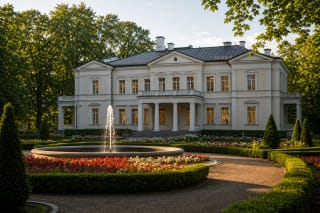
The kurhaus was commissioned by Count Juozapas Tiškevičius, who was developing Palanga's resort infrastructure in the late nineteenth century. According to AUTC and local-history data, the spacious masonry part of the kurhaus was built in 1875-1877, and in 1878 the Casino restaurant opened there. This is treated as the beginning of the modern Palanga kurhaus.
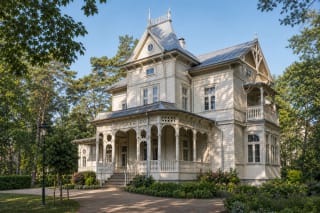
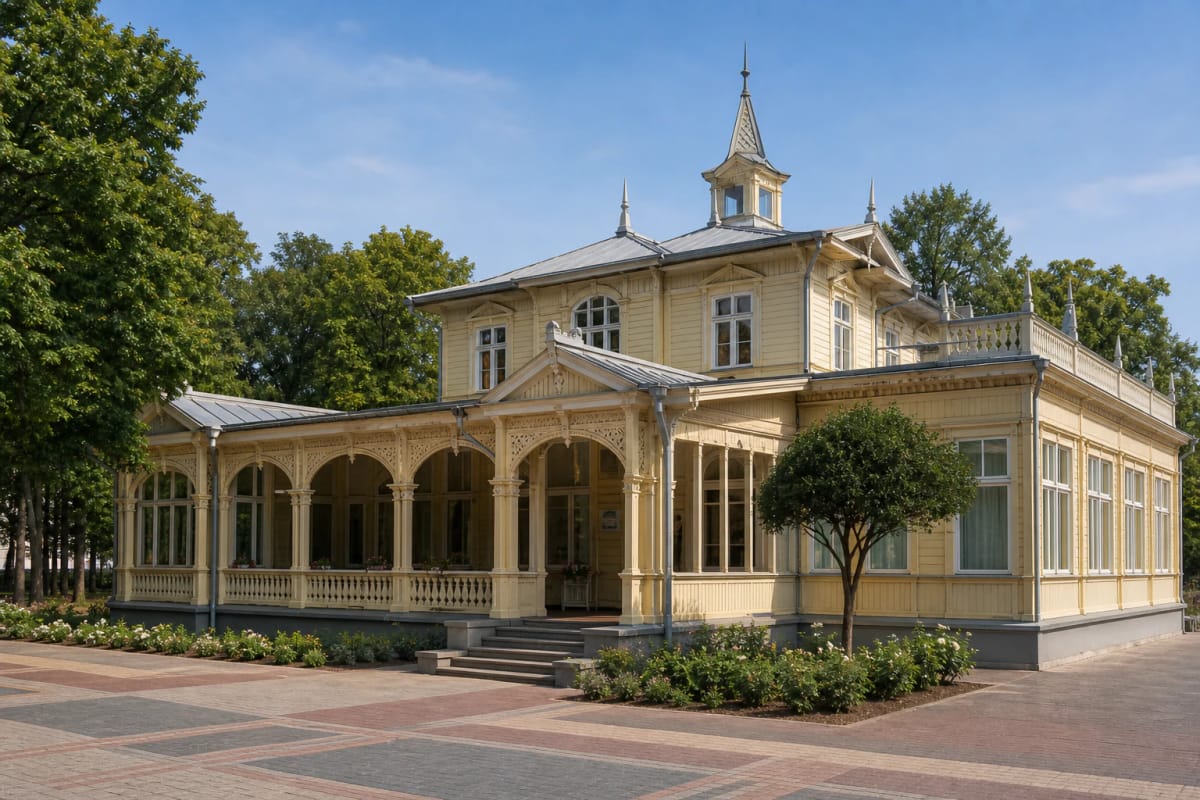
In the first decade of the twentieth century, a wooden part with an open rotunda and a second-floor extension was added to the western side of the masonry building. Near the kurhaus the Tiškevičiai formed a park and linden avenues; today's Grafų Tiškevičių Avenue was one of the earliest resort walking routes.
From restaurant and guest house to culture centre
From the beginning the kurhaus was multifunctional: besides the restaurant, it had a reading room, billiard and games rooms, dances, performances, and concerts, and it gathered holidaymakers. Later it became a hotel and, over time, a place of town representation and culture.
Today the kurhaus is connected with the activity of Palanga Culture and Youth Centre: concerts, exhibitions, and town events take place here. For visitors this means the building can be seen not only as heritage from outside, but also as an active cultural site if your visit matches an event or programme.
The 2002 fire and the long restoration
A key moment in the history of Palanga Kurhaus was the fire of August 25, 2002, which completely destroyed the wooden part and badly damaged the roof and wooden elements of the masonry part. The event turned the kurhaus into not only an architectural issue but also a question of town memory.
The masonry part was restored in 2012-2013, a timeline also confirmed by Visuotinė Lietuvių enciklopedija, and the rebuilt wooden part was opened to visitors in 2020-2021. This chronology shows that restoration was a long process involving not only construction, but also heritage, ownership, and function.
What to notice at Palanga Kurhaus
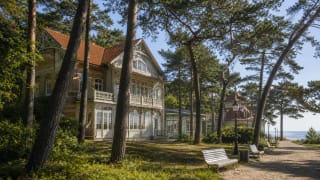
As you walk around the kurhaus, look at the wooden veranda, open rotunda, window rhythm, decorative openwork details, and resort scale. The building is not a massive palace; its strength is an elegant, human-scale summer architecture that combines masonry and wood.
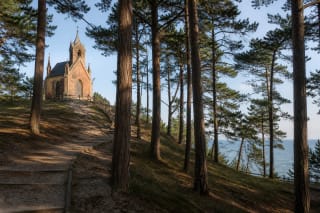
It is also worth understanding its place in the town. Grafų Tiškevičių Avenue, the central walks, the route toward Birutė Park, and the way to the sea show that the kurhaus was a resort movement hub, not an accidental building on the edge.
How to visit Palanga Kurhaus
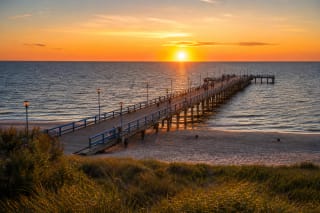
If you are seeing the kurhaus only from outside, 20-30 minutes is usually enough. It is best combined with a walk through central Palanga, the Resort Museum, the Amber Museum in Birutė Park, or the route toward Palanga Pier.
If you want to see the interior spaces, check the event information of Palanga Culture and Youth Centre. The kurhaus is strongest not as a closed monument, but as a place where a historic building is once again used for culture.