- Place
- Saugos, Šilutė District Municipality
- Region
- Pamarys
- Type
- Evangelical Lutheran church
- Address
- Tilžės g. 23, Saugos
- Coordinates
- 55.46610, 21.46702
Saugos Lutheran Church, Saugų Lutheran Church
The centre of Saugos Lutheran parish in Pamarys
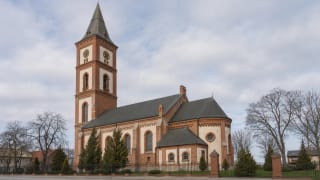
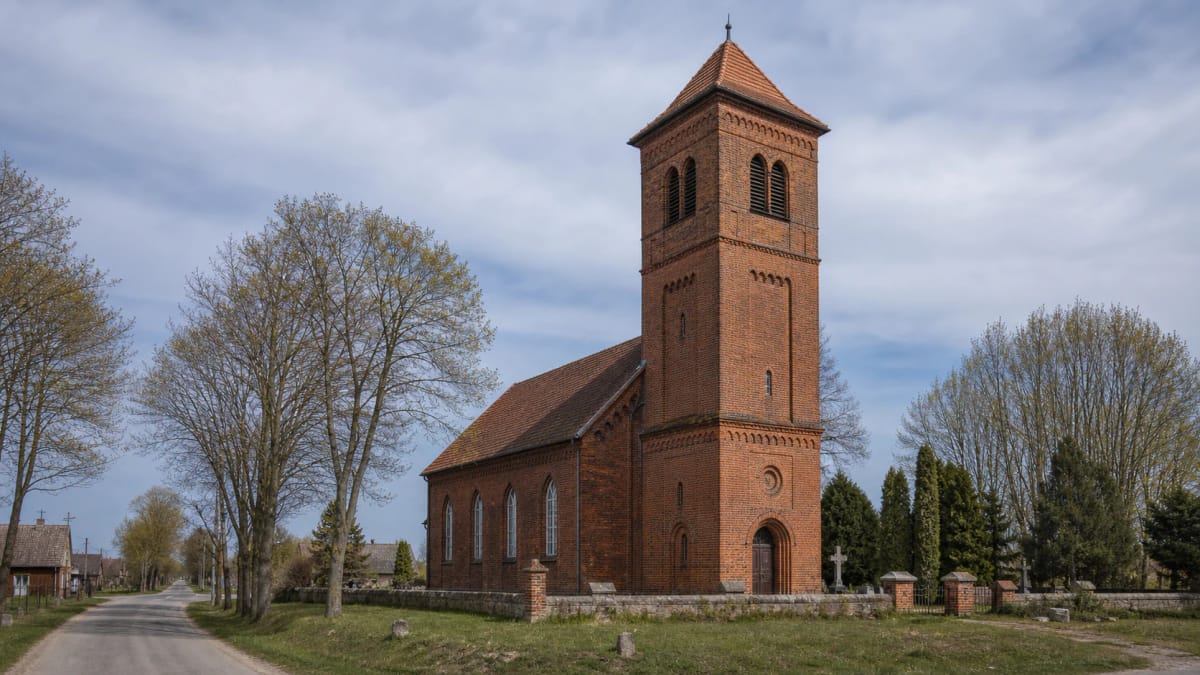
Saugos Evangelical Lutheran Church stands in a town where the history of the Lutheran parish is an important part of local identity. VLE describes Saugos as a centre of Catholic and Evangelical Lutheran parishes about 13 km north of Šilutė; the Lutheran church here was built in 1857, while the Catholic Church of St Casimir followed only in 1947.
This is not a place visited by crowds. Its value opens more fully to travellers who move deliberately through the towns of Lithuania Minor. VLE notes that the Lithuania Minor cultural figures Kristupas Jurkšaitis and Kristupas Sturys served as pastors in this church.
From the Verdainė filial (1815) to a house of prayer of its own
According to the history by Albertas Juška published by the Evangelical Lutheran Church of Lithuania, a parish had been wanted here as early as the start of the nineteenth century. In 1815 the northern villages were separated from the Verdainė parish and the Saugos filial was founded. At first services were held in a school and in farmers' houses, in summer even in barns, and a permanent pastor, Georg Morgen, was appointed in 1844.
Now that it had its own clergyman, the Saugos filial was assigned a further 10 villages that had previously belonged to the Priekulė church. Over time the community grew to 31 villages and about 4,300 members, so a spacious house of prayer of its own became necessary.
The 1854-1857 construction with Prussian treasury funds
The cornerstone was consecrated on 30 August 1854 by the filial's second pastor, Kristupas Sturys (who served here in 1849-1864). The tall, massive rectangular red-brick church with a small towerlet took three years to build, and the consecration took place on 9 October 1857. Notably, most of the construction costs were covered by the Prussian kingdom's treasury - those handling the building managed to have it included in the list of state-funded structures.
The interior has one nave with an apse and was decorated by an artist; it held a combined altar-pulpit, spacious galleries, a 14-register organ, and one bell. It is said that the bell, as if aware of the parishioners' hard lives, rang out repeating: "At Saugos, many woes!"
Pastors and the twentieth-century history
Among the pastors of Saugos, Kristupas Jurkšaitis (1882-1896) stands out - a folklore collector and folk healer who travelled the villages behind a pair of small ponies, treating people and animals and never taking money for nothing. From 1897 the energetic Johannes Kurt Kalankė worked here and founded a savings-and-loan society.
In the interwar years the missionary Friedrich Oks arrived and tried to eradicate Lithuanian identity; when the people resisted, he was expelled from Saugos in 1934. The last interwar pastor, Gottfried Tenikaitis, withdrew to Germany at the end of 1944 together with most of the community.
The Soviet era and visiting
The war damaged the building somewhat, but the people easily repaired it. Unlike many sanctuaries in Lithuania Minor, the Saugos church was not closed - the postwar parish was officially registered on 27 August 1948 (being a member of its council in those days meant risking the deportation lists). Today the Saugos parish is small, about 100 people, and services are led by pastor Mindaugas Žilinskis.
There are no fixed tourist hours, so the church is best viewed in daylight, while interior access is best coordinated with services or parish information. Saugos fits well into a Pamarys sacred-heritage route between Šilutė, Kintai, Katyčiai, and Žemaičių Naumiestis.