- Place
- Šilutė District Municipality
- Region
- Pamarys
- Type
- Evangelical Lutheran church
- Address
- Lietuvininkų Street 21, Šilutė
- Coordinates
- 55.34270, 21.46693
Šilutė Parish, Šilokarčema Lutheran Church, Heydekrug Evangelical Lutheran Church
Šilutė Lutheran Church - a symbol of the Pamarys town
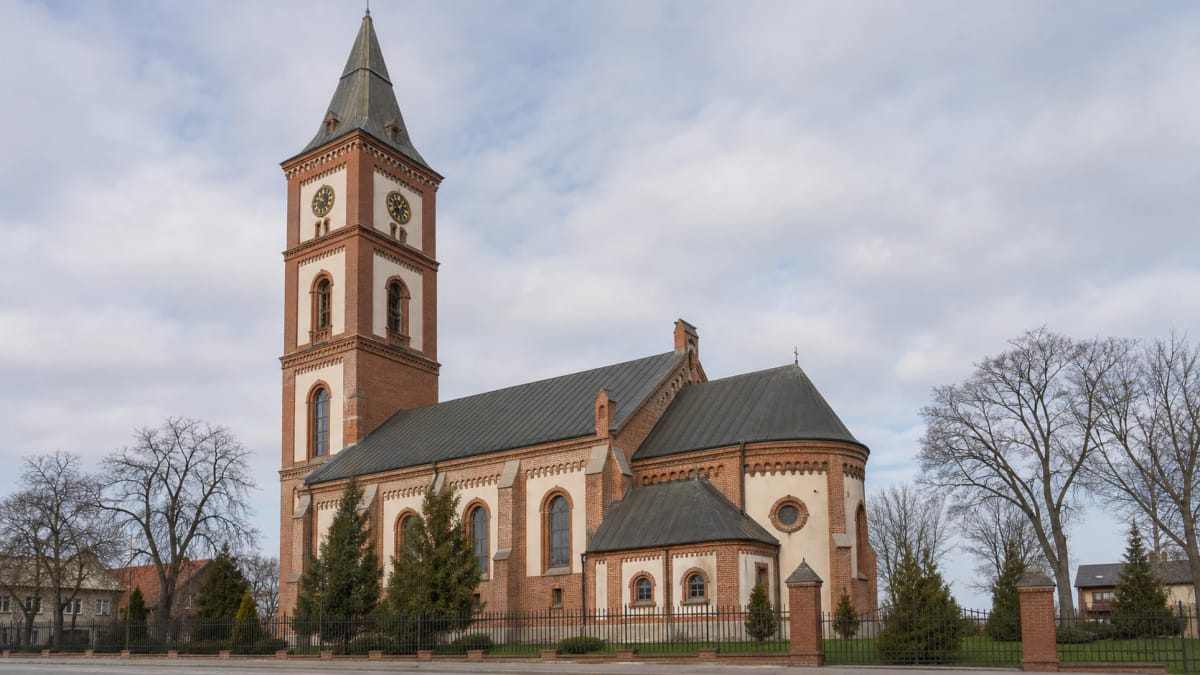
Šilutė Evangelical Lutheran Church is one of the most striking sacred buildings in Pamarys. It stands on Lietuvininkų Street, in a town that historically grew from Šilokarčema (German Heydekrug), Verdainė, Žibai, and other settlements, so the church works here as a node of Lithuania Minor town memory.
In the Register of Cultural Property it is a state-protected object of regional significance (code 16061) that falls within Šilutė's historic town area. The church matters not only for its architecture, but for an exceptionally rich interior programme of images that has no equal in western Lithuania.
The 1913-1926 construction and Hugo Scheu's role
An independent Šilutė parish was founded in 1913 after a long dispute with the older Verdainė parish. The town patron Hugo Scheu (1845-1937) appealed directly to Kaiser Wilhelm II on its behalf and, the same year, donated the church plot free of charge - which is why he is regarded as the sanctuary's initiator and patron.
The cornerstone was consecrated in 1913, but the First World War and post-war inflation halted the work. Construction resumed after the Klaipėda region joined Lithuania, and the church was completed in 1924-1926; a concrete inscription reading "1924-26" survives in the porch. The design is by the local Šilutė architect Curt Gutknecht (1894-1985), who created a neo-Gothic, hall-type, three-nave building with red-brick walls on a split-stone base.
The ~50 m tower, bells, and Lithuania's largest clock
On the south side rises a square, five-tier tower - about 50 m tall and crowned with a large gilded cross. It holds three bells ordered in 1922 from a Thuringia foundry (the Register names Schilling und Lattermann in Apolda): the largest weighs about 1,300 kg, the middle one 620 kg, and the smallest 350 kg.
The tower clock is often called the largest in Lithuania: its dial is about 2.5 m across, the big hand measures 1.10 m and the small hand 0.80 m. Three dials face south, east, and west, so the church served the town both as a place of prayer and as a clear vertical marker of time and space.
R. Pfeiffer's frescoes and the 104-figure altar composition
The interior is distinguished by frescoes on the walls and vaults painted by the artist Richard Pfeiffer (1878-1962), a professor at the Königsberg Academy of Art, together with his family. The centrepiece is the triumphal-arch composition of the presbytery, with 104 human figures symbolically depicting world history from the Creation to modern times.
Among the 104 figures are Adam and Eve, Moses, the reformers Luther, Melanchthon, Calvin, and Zwingli, as well as Dante, Dürer, Rembrandt, Bach, and local people, including Hugo Scheu and pastor Theodor Eicke; the arch is framed by seven scenes of the petitions of the Lord's Prayer. The altar and pulpit are carved from black oak by local masters (the altar from the Zollitsch, the pulpit from the Munk workshop), a window bears E. Krüger's 1926 stained glass "Jesus Christ," and 40-register organs by the Wittek firm of Elbing were installed in 1934. The church seats about 950.
Trials of war and the Soviet era
Unusually for Lithuania Minor, the church survived the Second World War undamaged - it is said that a Soviet commandant, impressed by the building, ordered it merely locked, so the interior was not looted. Unlike many sanctuaries in the region, it was also not closed during the Soviet era: the post-war Lutheran community was officially registered in 1948, and the right to use the building was confirmed in 1949.
A monument to the writer Hermann Sudermann that stood beside the church (1930, demolished in 1945, restored in 1996) is a reminder that Šilutė's sacred setting is tied to a broad story of Lithuania Minor culture, not only to confessional history.
Visiting and what to see in Šilutė
This is an active parish of the Evangelical Lutheran Church of Lithuania (about 1,000 members) that offers tours in Lithuanian, English, and German, as well as a 360-degree virtual tour. No fixed tourist opening hours or ticket price were found during research, so the interior is most reliably visited during services, concerts, or by arrangement with the parish.
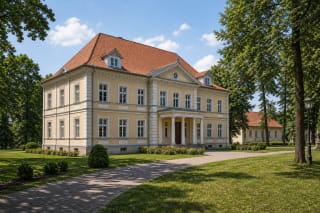
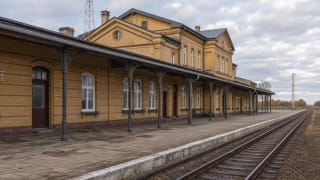
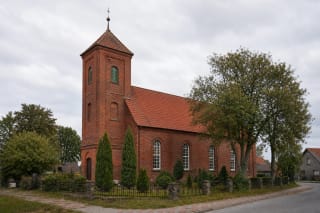
In Šilutė the church is worth combining with the Hugo Scheu Manor and the railway station, and further afield with Rusnė Lutheran Church in the Nemunas Delta. In this way, a single town and its surroundings reveal the layers of manor, church, and transport that shaped the identity of Šilokarčema and Šilutė.