- Place
- Vilnius City Municipality
- Region
- Vilnius
- Type
- bronze literary sculpture in a public space
- Address
- J. Basanavičiaus and Mindaugo streets, Vilnius
- Coordinates
- 54.68064, 25.27298
- Visit duration
- 10-20 minutes
- Best time
- in daylight, when the sculpture and the street corner can be viewed safely
Berniukas su batu, Berniukas su kaliošu, Romain Gary sculpture
A bronze boy at a Vilnius street corner
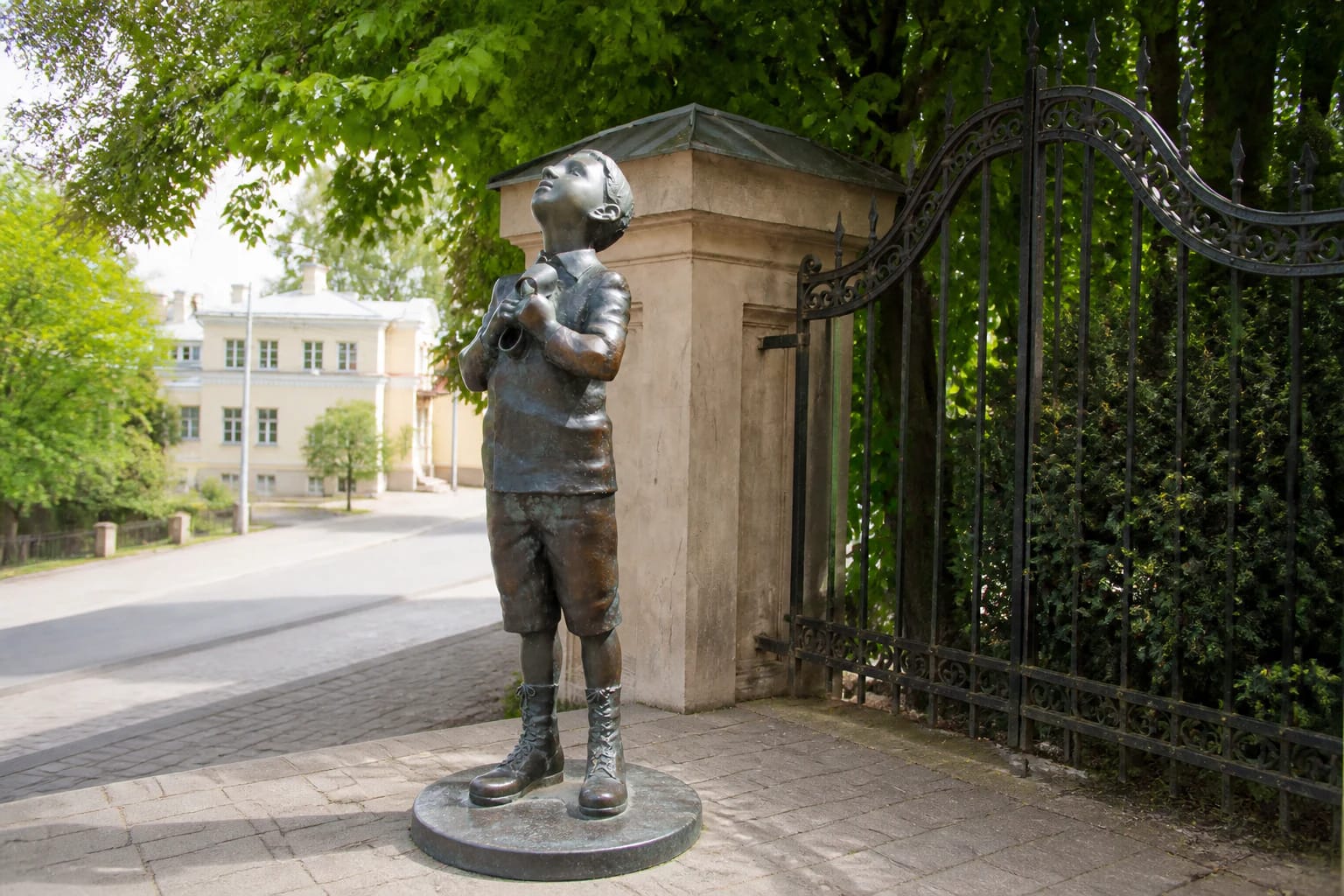
The Romain Gary Monument stands at the intersection of J. Basanavičiaus and Mindaugo streets, in an open city space near places connected with the writer's childhood. The small bronze figure stands on a round stone base, holding one rubber boot and lifting his face towards the sky.
In Lithuanian the sculpture is often called Berniukas su batu or Berniukas su kaliošu, meaning Boy with a Boot or Boy with a Galosh. TARTLE uses the English title Boy with a Rubber Boot, so these names refer to the same work by Romualdas Kvintas rather than to separate monuments.
The setting is part of the experience. An ornate dark gate, a stucco pillar, mature trees, and the pale historic houses beyond frame the child-sized figure, while the nearby traffic means the sculpture should be viewed from the pavement rather than from the roadway.
Roman Kacew and a Vilnius childhood
Romain Gary was born as Roman Kacew in Vilnius on 8 May 1914. He lived in the city from 1917 to 1923, moved to France from 1928, served as a pilot and member of the Resistance during the Second World War, and later became a French diplomat.
Vilnius is therefore more than a line in Gary's biography. The early city, family life, and memory of leaving became part of the imaginative material behind his writing, which is why this sculpture links a precise urban setting with an international literary figure.
TARTLE identifies the house at 18 Basanavičiaus Street as the place where Gary lived between 1917 and 1923. The monument is at the Basanavičiaus and Mindaugo intersection, so the nearby street network helps visitors read the sculpture as a local memory rather than an abstract dedication.
The boot as a literary clue
The monument is connected with the autobiographical novel Promise at Dawn, or La Promesse de l'aube. In the book, a childhood episode about eating a rubber galosh out of love and a desire to impress is condensed into the instantly recognisable object held against the boy's chest.
The raised head matters as much as the boot. TARTLE explains that the pose recalls Gary's account of his mother urging him to look up and admire the sky, giving the sculpture a second layer beyond the comic object in his hands.
You can understand the scene without having read the novel, but its literary context adds depth. The child is not a generic commemorative figure: his pose joins a specific passage, a mother's encouragement, and the memory of Gary's Vilnius years.
Romualdas Kvintas and the two casts
TARTLE's collection record identifies Romualdas Kvintas as the author, gives 2007 as the creation year, and describes a bronze work measuring 128 by 39 centimetres. The Vilnius municipal public-art inventory also records the 2007 date and Kvintas as the sculptor.
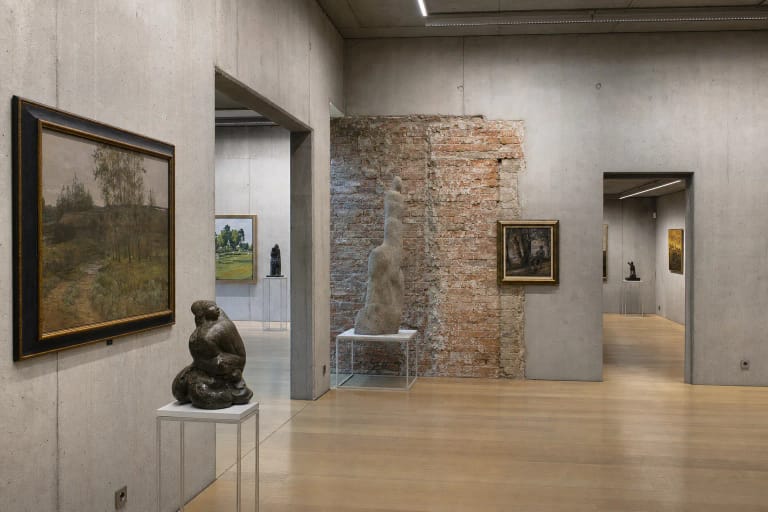
Two casts were made: one stands in Vilnius and the other belongs to the TARTLE collection in Užupis. That makes TARTLE a specific companion stop, not simply a nearby art institution chosen because it has a general connection with Lithuanian sculpture.
Kvintas worked mainly in bronze and wood and often made realistic portraits alongside stylised figurative compositions. The Romain Gary work combines those interests in a compact, readable figure whose gesture carries both portrait-like attention and a story.
A short visit in the public space
The monument needs no ticket or museum opening time because it stands outdoors, but its position is close to an active intersection. View it from the pavement, do not step into the carriageway for a photograph, and leave the gate, base, and surrounding planting undisturbed.
The map point is listed at the J. Basanavičiaus and Mindaugo street corner; coordinates 54.6806367, 25.272978 mark the site rather than a separate entrance. Allow 10 to 20 minutes for the sculpture, or longer if you add the nearby literary and art stops.
Because the monument stands beside a busy intersection, pause on the pavement before approaching the corner and leave room for people moving between the two streets.