- Place
- Rainiai, Telšiai District Municipality
- Region
- Žemaitija
- Type
- nationally significant memorial complex of the Rainiai massacre with the 1991 Chapel of Suffering, integrated art, Memorial Oak Grove, and forest killing site
- Address
- 1 Telšių Street, Rainiai, Viešvėnai Eldership, Telšiai District
- Coordinates
- 55.96422, 22.29489
Rainių Kančios koplyčia, Rainiai Chapel, Rainiai Martyrs Chapel, Rainiai Massacre Memorial
On 10 July 2026 the interior exhibition was closed, and Google's round-the-clock label applies only to the outdoor memorial
The chapel stands in Rainiai beside the Telšiai-Varniai road, at 1 Telšių Street and coordinates 55.9642202, 22.2948885. Outdoors, visitors can see the architecture, Memorial Oak Grove, and nearby forest memorial, but construction barriers and site safety take priority. The 24-hour schedule displayed on Google does not mean that the chapel doors or basement exhibition are unlocked.
The Žemaičiai Museum Alka visitor page, updated on 10 July 2026, states explicitly that renewal work is underway and visitors are not admitted to the interior exhibition. It also says visits are organised only by agreeing a tour time in advance. Call +370 600 60521 or +370 614 15868 to establish whether the available route is outdoors, a special event, or restored interior access.
A listed one-hour guide service in Lithuanian, English, or Russian costs EUR 30 for a group of up to 25; no separate individual admission is published. This is a service price, not a promise of entry to the closed interior. The Mass and night tour held for the 85th anniversary on 24 June 2026 were a special programme, not normal daily hours.
The total of 76 includes 73 prisoners killed at Rainiai and three escapees shot near Džiuginėnai
When war between Germany and the Soviet Union began on 22 June 1941, Telšiai Prison held 162 inmates. LGGRTC reports that 76 were prisoners interrogated by the NKGB. After an evacuation plan failed, personnel of the retreating Soviet repressive structures decided to kill a group of prisoners; the torture and executions took place during the night of 24-25 June.
The Žemaičiai Museum Alka text updated in 2026 breaks down its figure of 76: 73 people were killed in the woodland near Rainiai and three prisoners who escaped from Telšiai Prison were shot near Džiuginėnai. An older LGGRTC research page says that 75 prisoners' bodies were found in Rainiai Forest and treats the three Džiuginėnai escapees separately. The figures 73, 75, and 76 are therefore not safely interchangeable: a citation must say whether it means bodies found on site, the Rainiai group, or the wider remembrance of the persecuted prisoners.
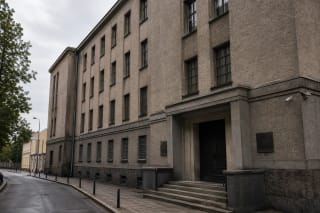
The bodies were found on 28 June, and funerals took place on 1 July. LGGRTC counts 65 buried in a common grave in Telšiai Old Cemetery and ten whom relatives buried in other Žemaitija cemeteries and a family mausoleum. A present-day memorial route consequently has three geographies: Telšiai Prison and cemetery, the killing site in Rainiai Forest, and the chapel erected on a hill in 1991.
The first Jonas Virakas memorial began in Telšiai Cemetery, but Soviet authorities destroyed it
In 1942, while Lithuania was occupied by Nazi Germany, Telšiai held a competition for a memorial to the Rainiai martyrs. Nineteen authors entered, and the young architect Jonas Virakas won. He proposed a masonry chapel whose silhouette would recall the timber chapels and wayside shrines of Žemaitija: a modern interpretation of national architecture rather than a literal copy of an old style.
Fundraising began in 1942, and construction started on the cemetery hill in Telšiai in 1943. That first site is not the hill occupied by today's Rainiai chapel. After Soviet rule returned in autumn 1944, the unfinished Virakas structure was demolished, Rainiai Forest was felled, and the common grave was hidden behind tall thujas while public inscription of the victims' names was prohibited.
Memory nevertheless survived in families, in secretly circulated copies of the 1942 book Žemaičių kankiniai, and in a modest cemetery wayside shrine. This suppression is essential to the memorial's history: the 1991 chapel commemorated both the 1941 crime and the five-decade effort to erase it from public memory.
Algirdas Žebrauskas realised Virakas's idea on a new site, and the chapel was consecrated on 23 June 1991
During the Sąjūdis period, the Žemaitija Cultural Society set out to restore the memorial. The museum's history dates the start of construction to 5 February 1990, before Lithuania's restoration of independence on 11 March. Architect Algirdas Žebrauskas worked from surviving Jonas Virakas sketches but adapted them to a new location, structural system, and integrated programme of contemporary art.
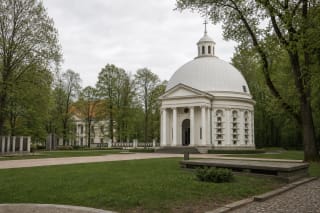
The white masonry chapel stands on a small rise, its stepped dark roof and tall central tower recalling an enlarged Žemaitija wayside shrine. A portico and circular windows mark the symmetrical entrance, while Regimantas Midvikis's four copper martyrs high on the tower face the cardinal directions with arms outstretched and bound by rope.
The chapel opened and was consecrated on 23 June 1991 for the 50th anniversary of the tragedy. It is dedicated not only to the Rainiai prisoners but to all people killed, deported, or lost to Soviet terror. Images of partisans and deportees inside are therefore not a departure from the Rainiai story, but a deliberate expansion of the memorial's meaning.
In the white interior, blood drops, instruments of the Passion, and frescoed figures connect Rainiai to the wider experience of occupation
Algirdas Dovydėnas's stained glass is almost white: red drops of blood and instruments of Christ's Passion - nails, pincers, and a crown of thorns - appear against its pale ground. The restrained palette does not illustrate the killings literally, but connects the martyrs of Rainiai with the Christian theme of the Passion. The 2026 restoration means these windows cannot be assumed visible from inside.
Antanas Kmieliauskas's frescoes interweave the Rainiai victims, Siberian deportees, and partisans with the suffering of Christ and his mother. A white marble cross by Regimantas Midvikis stands at the centre, while his four copper figures on the tower carry the human silhouette into the exterior. Architecture, painting, stained glass, and sculpture thus operate as one programme rather than unrelated decorative objects.
In 1994, Algirdas Žebrauskas, Antanas Kmieliauskas, Algirdas Dovydėnas, and Regimantas Midvikis received the Lithuanian National Prize for Culture and Arts for the Rainiai memorial. The award confirms its artistic importance, but a visit should retain the documentary foundation: the chapel interprets named human deaths and state-directed suppression of memory.
The chapel, oak grove, and forest cross are three stops within one memorial, not a single execution pit
The nationally significant ensemble carries heritage code 21854, the Chapel of Suffering code 21881, and the forest killing site code 21867. VLE records that the killing site, monument, and chapel were declared a nationally significant historical and memorial monument in 1995. Separate codes help distinguish the symbolic chapel from the actual place of killing and first burial.
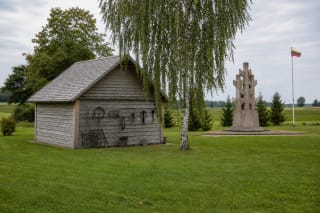
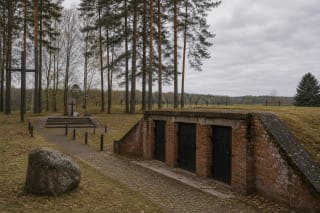
The Memorial Oak Grove was planted across the road in 1991, while a cross monument by Regimantas Midvikis marks the killing site in the woodland. Allow at least 30-45 minutes for the entire route and remain on marked paths. This is a place of mourning: place candles only where fire-safe, do not climb on monuments, and do not interrupt rites or commemorations.
On 13 July 2026, the exact Google Maps listing for Rainiai Chapel of Suffering had 54 reviews averaging 4.8 out of 5. That comfortably clears the 4.5 threshold, but the small review count means each new score can move the average more noticeably. Base access plans on the museum's renewal notice rather than the map schedule alone.