- Place
- Preila, Neringa Municipality
- Region
- Neringa
- Type
- Curonian Spit fishing settlement by the lagoon
- Coordinates
- 55.37670, 21.05750
Preila
Preila by the small bay
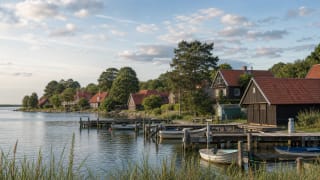
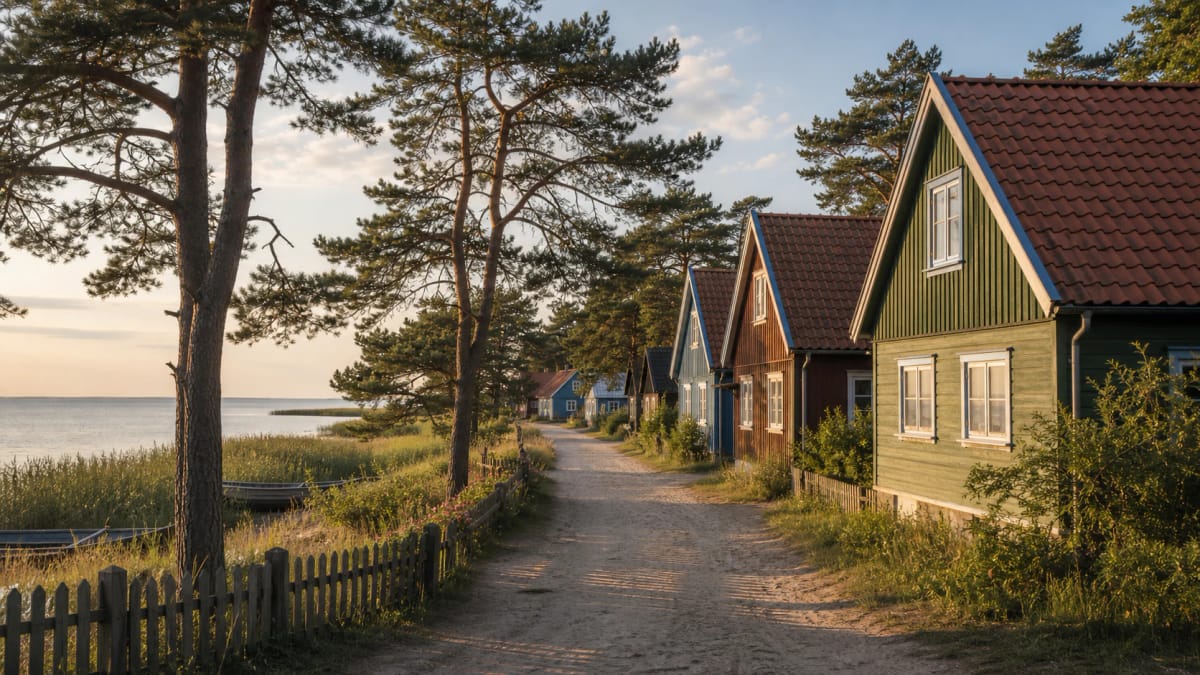
Preila is a Neringa settlement on the Curonian Spit, 6 km northeast of Nida, in the Preila-Pervalka eldership. VLE describes it as a tourism and rest settlement with about 200 residents (2021). It lies by Little Preila Bay, framed by sandy capes - Ožkos Cape to the north and Little Preila Cape to the south.
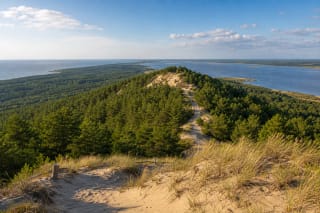
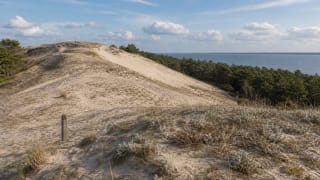
Forested dunes shield Preila from the Baltic Sea; one of them, south of the settlement, is called Preila Hill. Like the whole Curonian Spit, Preila is part of a UNESCO World Heritage site (no. 994). The settlement has a pier and a library (since 1956), but its strength is its slowness.
From Naujieji Nagliai: 1843
Preila was founded in 1843, when residents of the sand-buried village of Naujieji Nagliai moved here. In 1846 there were 12 houses, in 1849 a school was moved from Naujieji Nagliai, and in 1878 a tavern was built. As with Pervalka, this is a continuation of the Curonian Spit's history of villages buried by sand.
When Preila was given summer-resort status in 1933, most homesteads began to be rebuilt: farm rooms were moved out of the dwelling houses, roofs were re-covered with tiles, and fish smokehouses were built. There was a branch of the Lithuanian Fishermen's Society and a border-guard post.
Wooden fishermen's houses
In the southern part of Preila, many single-storey wooden fishermen's houses survive with gabled tile and reed roofs; two were built in 1890, the others in the first half of the twentieth century. Such buildings show that Curonian Spit architecture is not only a style, but an adaptation to wind, sand, lagoon, and small plots.
In the second half of the nineteenth century the German writer Ludwig Passarge wrote about the very poor life of this fishing village, while by the early twentieth century some residents already lived off holidaymakers - there was a hotel, "Preilos briedis" (Preila Elk), and a few guesthouses. German painters were fond of Preila.
Walking routes and dunes
Preila is easy to combine with Curonian Spit National Park walking routes. Nearby rises Preila Hill, and to the south stands the highest dune on the whole spit, Vecekrugas (67.2 m); the routes connect the village with dunes, bays, and forest paths.
For visitors, the main thing is to walk the shore, notice the rhythm of the houses, the lagoon, and the capes, rather than to search for one large monument. Birdwatchers will find the lagoon bays and shore thickets rewarding.
Visiting Preila
The settlement is open and has no entrance ticket, but local fees, parking rules, and protected-area rules may apply on the Curonian Spit. A short walk takes 45-90 minutes, while a walking route takes 2-3 hours.
Visitors should respect the residential setting and private yards: do not photograph them as scenery, and protect the fragile dune and shore vegetation.