- Place
- Preila area, Neringa Municipality
- Region
- Curonian Spit
- Type
- geomorphological natural monument and high dune
- Coordinates
- 55.35460, 21.03840
Old Inn Dune, Vecekrugas Hill, Vecekrugo kopa
Vecekrugas Dune: why it is special
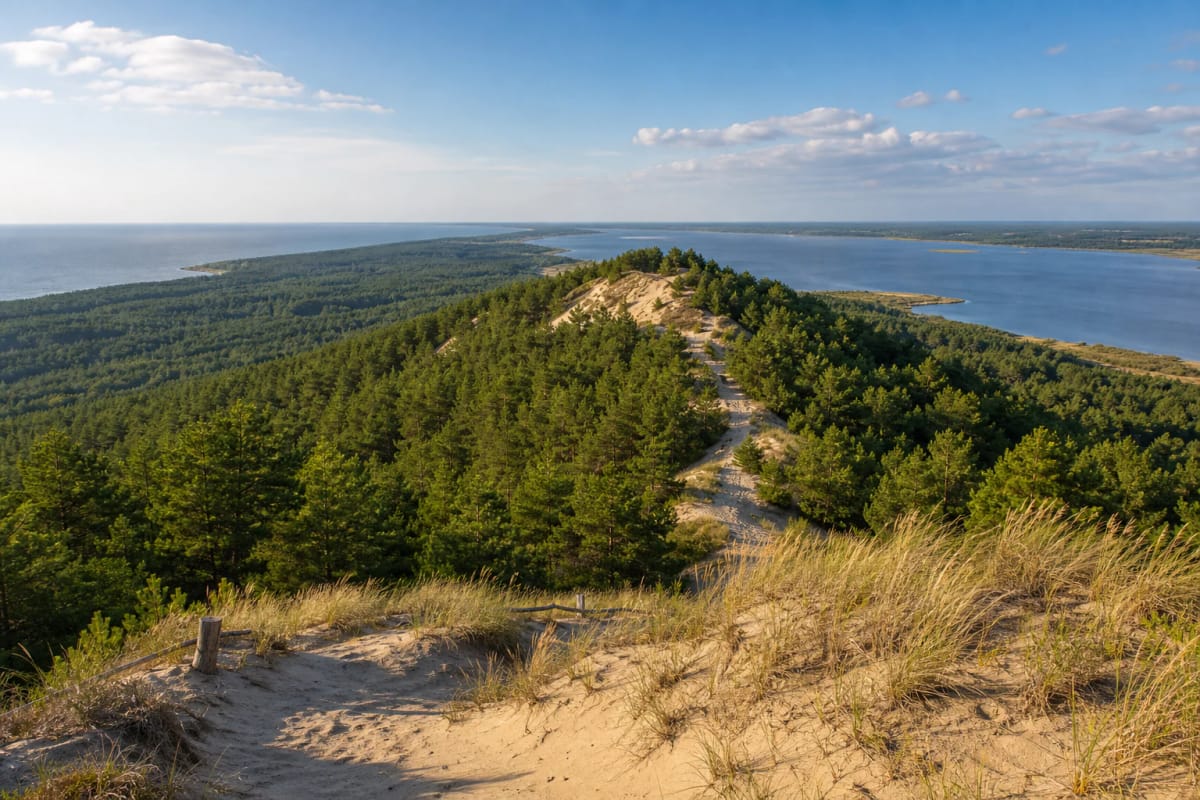
Vecekrugas Dune is in Curonian Spit National Park, in Karvaičiai Landscape Reserve near Preila. The official park source describes it as a 67.2 m geomorphological natural monument, protected since 1995; VLE gives the same 67.2 m height for the Old Inn, or Vecekrugas, Dune and names it as one of the highest dunes of the Great Dune Ridge. Lithuania's protected-area service describes it as the highest dune on the Curonian Spit. It is not only a beautiful viewpoint but one of the clearest forms of the Great Dune Ridge in the Lithuanian part of the spit.
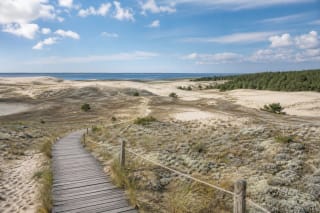
Unlike the open white dunes near Nida or in Nagliai Reserve, Vecekrugas Dune is covered with pines in many places. That gives it a different feeling: a high dune ridge held by forest, sandy paths between trees, and a sudden opening toward the lagoon and spit panorama.
The origin of the name Vecekrugas
Vecekrugas Dune is also called the Old Inn Dune. The park authority explains the name through the Curonian language: 'vece' means old, and 'kruogs' is connected with an inn. That reminds visitors that the Curonian Spit was not only a nature strip but a road with inns, fishermen, travellers, and local communities.
An 1834 map mentions the German name Berg Wetzokrugs. Such names matter because they show the multilingual history of the spit: Curonian, German, and Lithuanian layers are intertwined here no less than sand, forest, and lagoon shore.
Geological and landscape context of Vecekrugas Dune
The official park description connects Vecekrugas Dune with the Great Dune Ridge. In this stretch, the ridge is not one continuous wall: it is broken by broad hollows and ravines, while individual dune masses rise as separate forms. This structure helped wind carry sand eastward and shape capes in the Curonian Lagoon.
The park also gives a geological section: the dune consists of wind-blown feldspar-quartz sand covering older marine and glacial deposits. For visitors, the key point is not the terminology but the realization that beneath their feet lies a thick accumulated layer of sand shaped over time by wind and human activity.
How to visit Vecekrugas Dune
Vecekrugas Dune is easiest to combine with a route through Preila, Pervalka, or the Nagliai Reserve trail. Whether travelling by car or bicycle, follow local signs and official park instructions because parts of the Curonian Spit have visiting restrictions and protected zones must not be trampled.
Allow about an hour for a visit. If you want not only to climb to the viewpoint but to understand what you are seeing, leave time to compare three directions: the pine-covered dune ridge, openings of exposed sand, and the Curonian Lagoon horizon.
How Vecekrugas differs from Parnidis and Nagliai
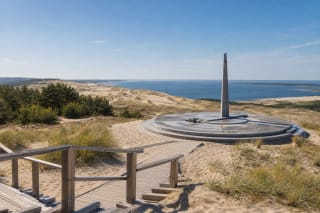
Parnidis Dune is better known for the sundial and the open Nida panorama, Nagliai trail for its regulated walk through grey and white dunes, while Vecekrugas stands out for its height, forested form, and natural-monument status.
If you have time for several Curonian Spit sites, visit all three. Then it becomes clear that the spit dunes are not all the same: in one place open sand dominates, in another a protected habitat, and at Vecekrugas a high, complex form held by both forest and sand.