- Place
- Neringa Municipality
- Region
- Neringa
- Type
- old Evangelical Lutheran cemetery with krikštai tradition context
- Address
- Preilos g. 10A, Preila, Neringa
- Coordinates
- 55.37040, 21.05920
Preila old Evangelical Lutheran cemetery
Preila Ethnographic Cemetery: Curonian memory in the forest
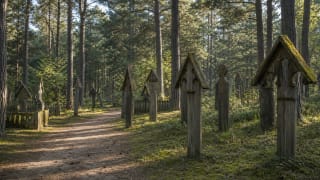
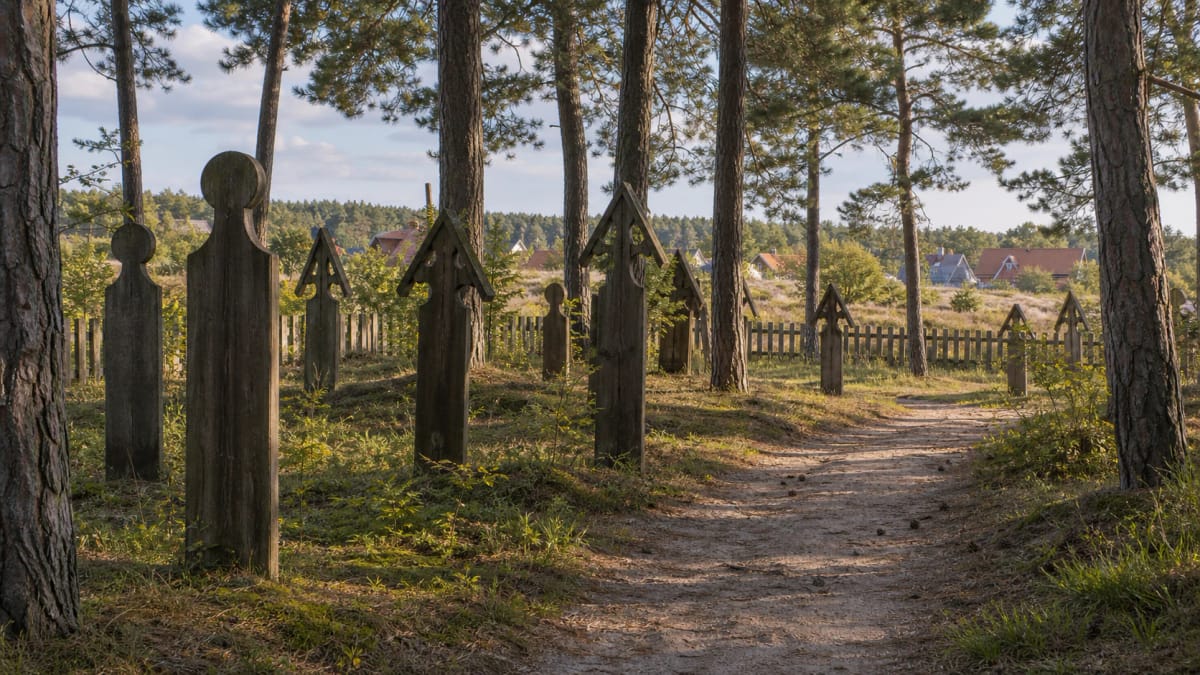
Preila Ethnographic Cemetery is a small but important Curonian Spit place of memory. It lies in forest surroundings, on the opposite side of the village's only street from the old fishermen's houses. The Neringa Municipality cemetery list identifies it as Preila old Evangelical Lutheran cemetery at Preilos g. 10A.
The official list states that the cemetery is of limited burial status and covers 0.1505 ha, about 0.15 ha. That means visitors should behave as in a cemetery, not as in a park exhibition: walk on paths, do not disturb the place, and protect old signs. Preila is considered the only Neringa settlement still recalling a traditional fishing village, so its cemetery is a living sign of village continuity.
Register of Cultural Values and state-protected status
Preila old Evangelical Lutheran cemetery is entered in the Register of Cultural Values; its unique code is 22447, registration date 23 December 1996, and the legal status set by the register is state protected. Until 2005 the object was marked in the register with old code L352K. Registry data says the cemetery is enclosed by a wooden fence.
Neringa Municipality data states that the cemetery was entered in the Real Estate Register on 21 December 2007, unique number 4400-1460-2364, and that limited burial status is linked with Neringa Municipal Council decision no. T1-162 of 15 October 2009. These administrative facts show real protection and management rules.
Preila's origin: a fishing village from sand-buried Nagliai
Preila lies between Preila and Ožkos capes, by Little Preila Bay, at the foot of Preila Dune, or Preila Hill. According to Curonian Spit National Park and VLE, Preila was founded in 1843 when residents moved from the sand-buried village of Naujieji Nagliai. They refused to live by the sea, explaining that they fished nine months in the lagoon and only three at sea. In 1846 there were 12 houses, and in 1849 the school from Naujieji Nagliai was moved here.
At the start of the twentieth century Preila began to grow: in 1906-1907 a new red-brick school was built, still surviving and now housing a library branch; the Preilos Briedis hotel and guesthouses appeared. In 1933 Lithuanian authorities granted Preila summer-resort status. During the Second World War, in January 1945, the old inhabitants were forcibly evacuated; some Preila residents were later deported to Siberia, and after 1958 almost all old inhabitants left for Germany. Nineteen old fishermen's houses were declared architectural monuments, so the cemetery is part of a wider protected fishing-village fabric.
Krikštai: a relic of Baltic burial culture
Krikštai, old wooden grave monuments, were widespread in Lithuania Minor, the Curonian Spit, and western Samogitia until the mid-twentieth century; sources mention them by this name from the sixteenth century. They are sometimes described as the only such Baltic-culture relic surviving to this day in Europe, comparable with sailing-boat weathervanes as a symbol of the Curonian Lagoon ethnocultural area. Krikštai were placed at the foot of the deceased, although Christians usually place monuments at the head, cut from one board, and their shaft had to reach the bottom of the grave: it was believed that at the Last Judgment the soul could grasp it and climb out.
Krikštai symbolism includes gender distinctions: for men they were made from 'male' trees, oak, ash, or black alder; for women from 'female' trees, linden, aspen, spruce, or pine. Motifs also differed: until the seventeenth century, men's krikštai were decorated with horse heads, women's with birds, often cuckoos; later hearts, plants, and, only later still, small crosses appeared. The German Impressionist Lovis Corinth painted these archaic monuments in Nida in 1893, and the artist Olga Dubeneckienė-Kalpokienė left watercolours of them in the interwar period.
Krikštai copies in Preila cemetery
Today copies of authentic krikštai can be seen only on the Curonian Spit; krikštai that once stood on the eastern Curonian Lagoon shore and elsewhere rotted and vanished. These masterpieces of small architecture were preserved by Nida artist Eduardas Jonušas (1932-2014): already in the 1960s he documented the last decaying authentic krikštai in the Nida cemetery, prepared a reconstruction project, and secured the return of reconstructions to grave sites.
Curonian Spit National Park information states that copies of krikštai are also found in the Preila cemetery. They show that local memorial culture differed from the usual Lithuanian crosses and chapel-posts, and that krikštai should be read as a separate Pamarys language of memory. For deeper understanding, the krikštai symbolism article is worth reading.
How to visit Preila Ethnographic Cemetery
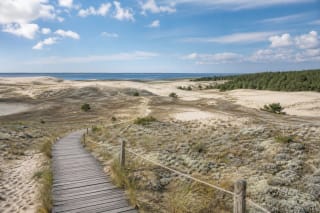
The cemetery itself takes 20-40 minutes, but its setting deserves a slower Preila walk. It combines well with the lagoon shore and cosy quay, Preila's smoked-fish reputation, Preila Street, Vecekrugas Dune, Pervalka Lighthouse, and the pedestrian route through mountain-pine woods known as Kuršių niūrija.
No ticket or visiting schedule was found in official sources. This is an active cemetery, so respectful behaviour matters most: do not touch old signs or krikštai, do not walk over graves, do not photograph intrusively, and leave no litter.