- Place
- Pervalka, Neringa Municipality
- Region
- Neringa
- Type
- Curonian Spit fishing settlement by the lagoon
- Coordinates
- 55.40330, 21.09470
Pervalka, Old Pervalka, Senoji Pervalka, Perwelk
A quiet settlement by the Curonian Lagoon
Pervalka is one of Neringa's quietest settlements. It does not have Nida's intensity or Juodkrantė's tourist flow, so it is best for visitors who want a slow walk along the Curonian Lagoon. VLE describes Pervalka as a part of the city of Neringa on the lagoon shore, 33 km south of Klaipėda, by Pervalka Bay.
Like the whole Curonian Spit, Pervalka is part of a UNESCO World Heritage site (Curonian Spit, list no. 994). The old buildings are arranged along a lagoon street, so the settlement's character is linear and strongly tied to the water.
Moved away from the sand: from Nagliai to today's Pervalka
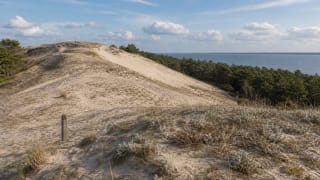
Old Pervalka was founded in 1844 between Žirgai and Pervalka capes; people moved here from the sand-buried village of Naujieji Nagliai. In 1871 there were only 11 houses, and the fishermen bartered fish on the other shore of the lagoon for essential goods.
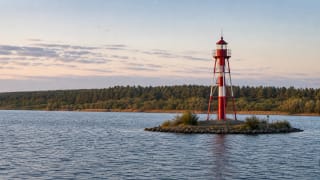
In 1880-1881, under the threat of drifting sand, the village was moved about 1.5 km north to its present site. Around 1895 the dunes began to be afforested, in 1900 a lighthouse was built, in 1901 a one-class school opened, and in 1933 Pervalka gained resort status - a small fishing harbour, a tavern, and a shop appeared.
Fishermen's houses and lagoon architecture
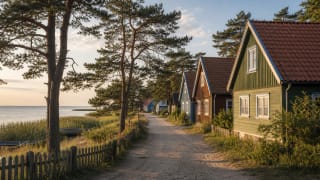
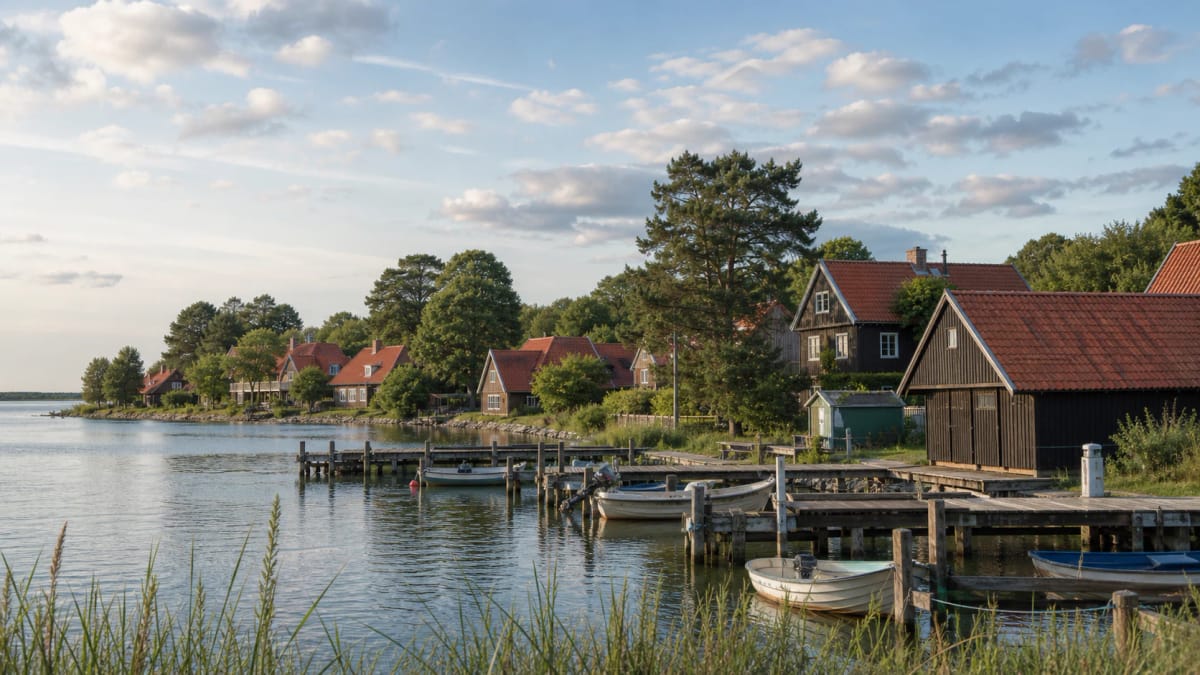
In Pervalka, look for single-storey wooden fishermen's houses from the first half of the twentieth century with gabled tile and reed roofs; some were later reconstructed or restored. By the lagoon there are two small piers and a mole, from which the water and dune horizon opens wide.
Holiday houses built in the second half of the twentieth century partly disrupted the fishing-village view, yet the main street along the lagoon still lets you read the traditional linear plan. It is precisely the small scale and closeness of the water that make Pervalka so quiet.
Rėza and the memory of buried villages
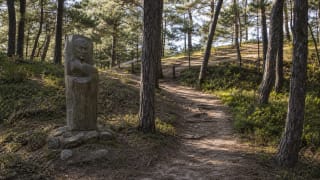
Near Pervalka, on Skirpstas Hill, stands a sculpture of Liudvikas Rėza (1975, sculptor Eduardas Jonušas). It recalls that the spit's villages are connected not only with fishing, but also with Lithuanian letters, song collecting, and the memory of buried Karvaičiai - Rėza's birthplace.
Pervalka itself is a continuation of the same story: this is where fishermen fleeing the sand from Nagliai finally settled. The village is therefore best understood as the living end of a chain of buried villages, rather than as a separate resort.
Visiting Pervalka
Pervalka is an open settlement, so there is no ticket. Plan at least 45-90 minutes, and more if you continue along the shore or toward Žirgai Cape. Local fees and parking rules may apply on the Curonian Spit.
Respect the living environment while visiting: do not treat private yards as scenery, do not park wherever convenient, and protect the lagoon-shore vegetation.