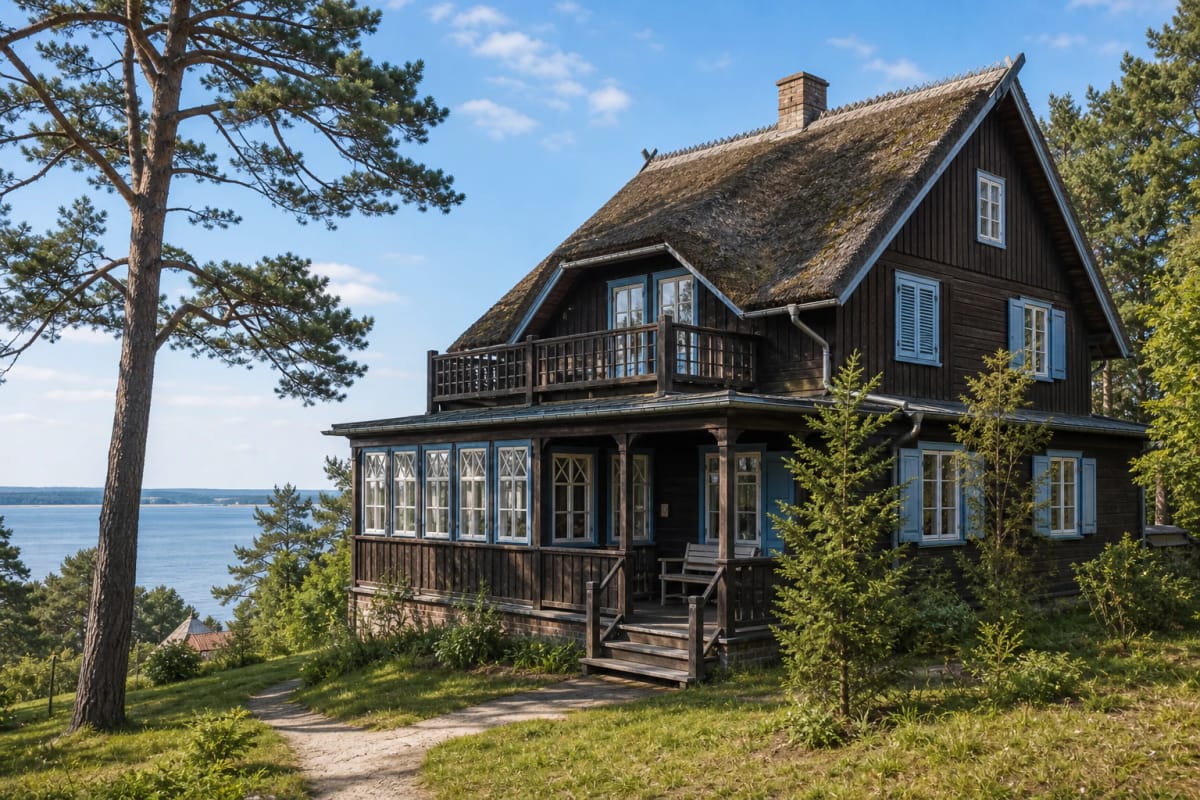
- Place
- Neringa Municipality
- Region
- Neringa
- Type
- writer's summer house and memorial museum in Nida
- Address
- Tomo Mano g. 8, Nida, Neringa
- Coordinates
- 55.31120, 21.00710
Thomas Mann summer house, Thomo Manno namelis
Thomas Mann's house above the Curonian Lagoon
Thomas Mann Memorial Museum is one of Nida's most subtle cultural places and, according to Neringa Museums, one of the most visited museums in western Lithuania. It is not a large literature museum with a massive exhibition; its strength is the summer house itself, the slope above the Curonian Lagoon, the pines, and the Nobel Prize laureate's link with Nida.
The house stands on Tomo Mano Street, on so-called Mother-in-Law Hill above the lagoon. Visitors experience not only biography but also the atmosphere of the place that the Mann family chose for short but very meaningful summers in the early 1930s.
Nida in 1929 and the building of the summer house
In the summer of 1929, Thomas Mann first visited Nida with his wife Katia and, in the writer's own words, they were 'captivated by the indescribable uniqueness and beauty of that nature, the fantastic world of wandering dunes' and soon decided to acquire a permanent residence here. The same year, he received the Nobel Prize in Literature.
In 1930, a summer house was built on Mother-in-Law Hill to a design by Klaipėda architect Herbert Reissmann. This chronology matters: for Mann, Nida was not an accidental resort stop but a deliberate choice, a place for work, rest, and being in the Curonian Spit landscape, where, among other things, he worked on the Joseph and His Brothers novel cycle.
Mann family summers, 1930-1932
According to Neringa Museums, the Mann family spent three summers in the summer house: 1930, 1931, and 1932. It was a short period, but enough for the house to become an important part of Nida cultural memory and a literary place on the international map.
Later European history gives the house additional weight. After Mann emigrated from Nazi Germany in 1933, the summers in Nida remained the family's last calm period by the lagoon; early-1930s Nida here meets growing political tension in Europe.
Nationalization, decline, and restoration
In 1939 the summer house was nationalized and turned into a hunting lodge called Briedžių giria, or Elk Forest, and after the war the building suffered badly. In the 1950s, at the initiative of Antanas Venclova, chairman of the Lithuanian SSR Writers' Union, the house was repaired, and in 1965 it was transferred to Klaipėda City Library.
In 1995-1996 the house was restored again according to surviving drawings by architect H. Reissmann and memories of Thomas Mann's daughter Elisabeth Mann, aiming to recreate the authentic environment. Since 2014 a new exhibition has operated here, using modern technologies not only to recall facts of the laureate's life and work but also to poetically recreate the atmosphere of days spent in the summer house.
Museum and Thomas Mann Cultural Centre
Today two institutions operate in the house: the memorial museum, part of Neringa Museums, and the public institution Thomas Mann Cultural Centre. The museum is not only a domestic reconstruction; it functions as a Nida cultural point where literature, memory, and the Curonian Spit landscape join in one experience.
The museum website hosts chamber-music concerts, literary evenings, and events of the annual Thomas Mann Festival. It is worth checking the programme: the museum is often most interesting during an event.
How to visit Thomas Mann Museum
Allow 45-90 minutes for the museum. Visit without rushing: see the house, read the context, and be sure to leave time for the view over the lagoon from Mother-in-Law Hill, the view that drew the Manns here.
Before travelling, check Neringa Museums opening hours, tickets, and exhibitions. Off-season Nida is quieter and the museum feels more intimate. It is easy to combine with Nida Lighthouse, the Curonian Spit History Museum, Parnidis Dune, and Nida centre.