- Place
- Nida, Neringa Municipality
- Region
- Neringa
- Type
- old cemetery, krikštai tradition, and memorial place
- Address
- Pamario Street 43, Nida
- Coordinates
- 55.30953, 21.00808
Nida Old Cemetery, Nida krikštai, Nidos senosios kapinės
Nida Ethnographic Cemetery on the Curonian Spit
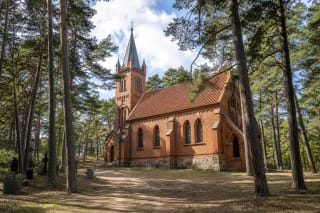
Nida Ethnographic Cemetery is one of Nida's quietest places and one that holds its oldest memory. It lies beside Nida Evangelical Lutheran Church, in the Pamario Street area, in a sandy pine forest by the Curonian Lagoon, within the Curonian Spit, already inscribed on the UNESCO World Heritage List (site No. 994).
In the Register of Cultural Property this is a state-protected site - Nida Old Cemetery (code 10783). The cemetery came into use in the eighteenth century, after Nida moved to its present location around 1732, and most of the surviving graves belong to the nineteenth and early twentieth centuries. It is important to understand that this is not a decorative display but a living memorial space still in use for burials.
Krikštai - the wooden grave markers of Lithuania Minor
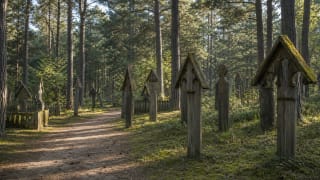
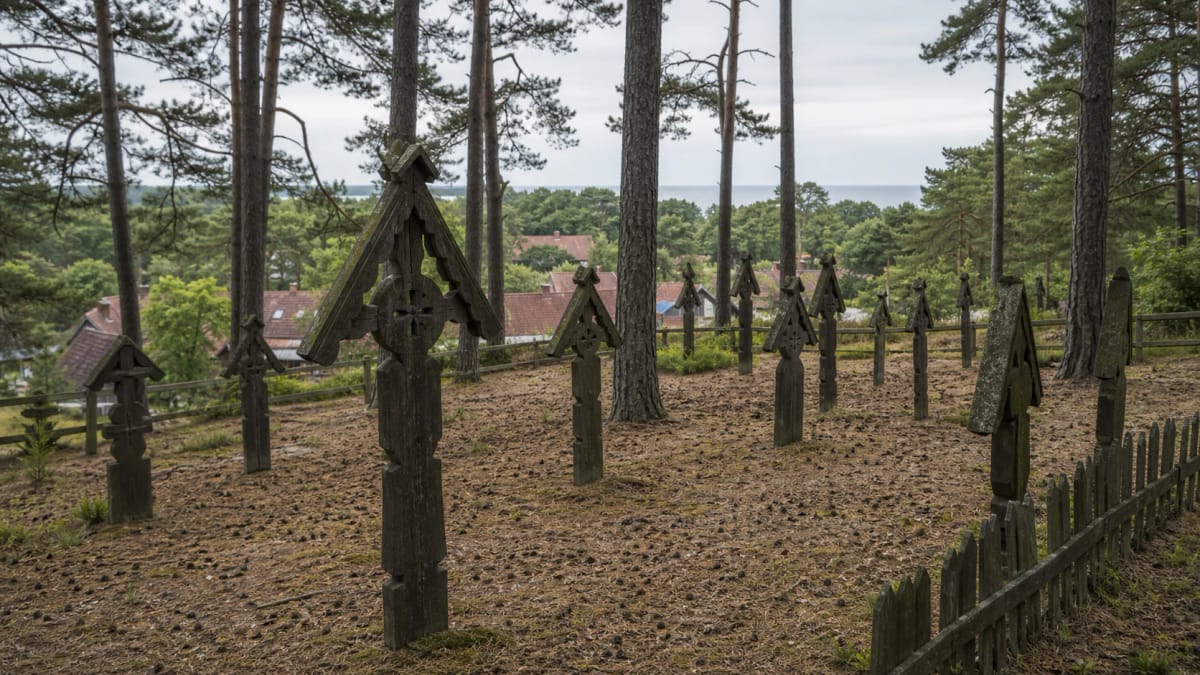
Krikštai (also called krikšteliai or krikštužiai) are Evangelical Lutheran grave monuments - a form of small-scale architecture characteristic of Lithuania Minor. The Universal Lithuanian Encyclopedia describes them as boards 0.5-2 m high and 0.2-0.6 m thick, whose edges are profiled so that the whole marker's silhouette takes on a plant, geometric, or zoomorphic form.
A krikštas was not set at the head of the grave like an ordinary cross. It was fixed to a stem - a long oak board reaching the bottom of the grave - and placed at the foot of the deceased. Krikštai spread in Lithuania Minor from the fifteenth century and are mentioned in sixteenth-century sources; most of them have survived precisely in the fishing cemeteries of the Curonian Spit, especially Nida, and the Nemunas Delta.
Form, timber, and symbolism of the krikštai
Traditionally the timber and decoration of a krikštas were chosen according to the sex of the deceased. Men's graves used oak, birch, or ash, and women's linden, aspen, or spruce. In the seventeenth century men's markers typically bore a horse-head silhouette and women's a bird - most often a cuckoo; from the eighteenth century stylised plants, animals, and heart motifs came to dominate, cut in openwork or painted in combinations of blue, yellow, green, red, black, and grey.
In the Curonian worldview the krikštas silhouette is often read as a mythical tree joining the worlds and as a sign of the soul's journey to the afterlife. The ethnologist Marija Gimbutienė linked the toad, grass-snake, butterfly, and flower motifs of the krikštai with the symbolism of a very ancient, pre-Christian goddess. Such readings are best presented as interpretations of tradition and of researchers, not as an exact decoding of every individual marker.
Cemetery history, burials, and the krikštai restored by Eduardas Jonušas
Alongside the wooden krikštai and crosses, Nida's cemetery preserves massive iron crosses with porcelain plaques on which names, dates, and epitaphs are often written in German, while cement headstones appeared in the early twentieth century. This mixture of monuments reflects everyday life in a fishing settlement, where storms and deaths at sea made the cemetery's memory especially fragile.
Few authentic wooden krikštai have survived to our day, so in 1975 the cemetery was tidied and the krikštai restoration project was led by the Nida artist Eduardas Jonušas (1932-2014). The cemetery is also associated with well-known Nida figures - the guesthouse keeper Hermann Blode, who hosted the famous Nida artists' colony, as well as honorary citizens Algimantas Zaviša, Stasys Mikelis, and Eduardas Jonušas himself, who restored the krikštai.
Visiting Nida's cemetery respectfully
The cemetery can be visited without a ticket, but walk calmly, do not step on graves, and do not touch or move the krikštai or other wooden markers. Even when they look photogenic, they are first of all grave monuments in a living cemetery.
The cemetery is best combined with Nida Evangelical Lutheran Church, the fisherman's ethnographic homestead, and the Curonian Spit History Museum, and the krikštai tradition compared with Juodkrantė's old cemetery. In this way a visit to Nida joins the layers of prayer, the memory of death, and the everyday life of fishing families.