- Place
- Neringa Municipality
- Region
- Neringa
- Type
- old Evangelical Lutheran cemetery and place of Lithuania Minor krikštai tradition
- Address
- Miško g. 2A, Juodkrantė, Neringa
- Coordinates
- 55.54460, 21.12080
Juodkrantė old Evangelical Lutheran cemetery
Juodkrantė old cemetery: a small field of memory
Juodkrantė old cemetery is not a large tourist object, but it matters as a quiet layer of Curonian Spit community memory. The official Neringa Municipality cemetery list identifies it as the Juodkrantė old Evangelical Lutheran cemetery at Miško g. 2A.
The same list states that the cemetery is of limited burial status and covers 0.06 ha. The small scale is important: this is not a broad urban cemetery but a compact local memory space that should be visited calmly and respectfully.
KVR code and official status
Neringa Municipality information states that the cemetery was entered in the Real Estate Register on 3 April 2015, with unique number 4400-3773-4897. It was registered in the Register of Cultural Values on 23 December 1996, code 22440.
These dry registry details are useful for visitors because they confirm that the cemetery is not an accidental green space but a protected cultural memory place. When visiting, do not hurry, do not walk over grave sites, and do not photograph as if the place were decoration.
Krikštai: wooden grave markers of Lithuania Minor
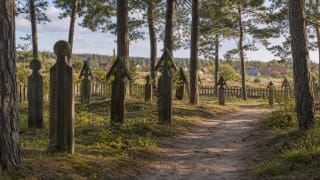
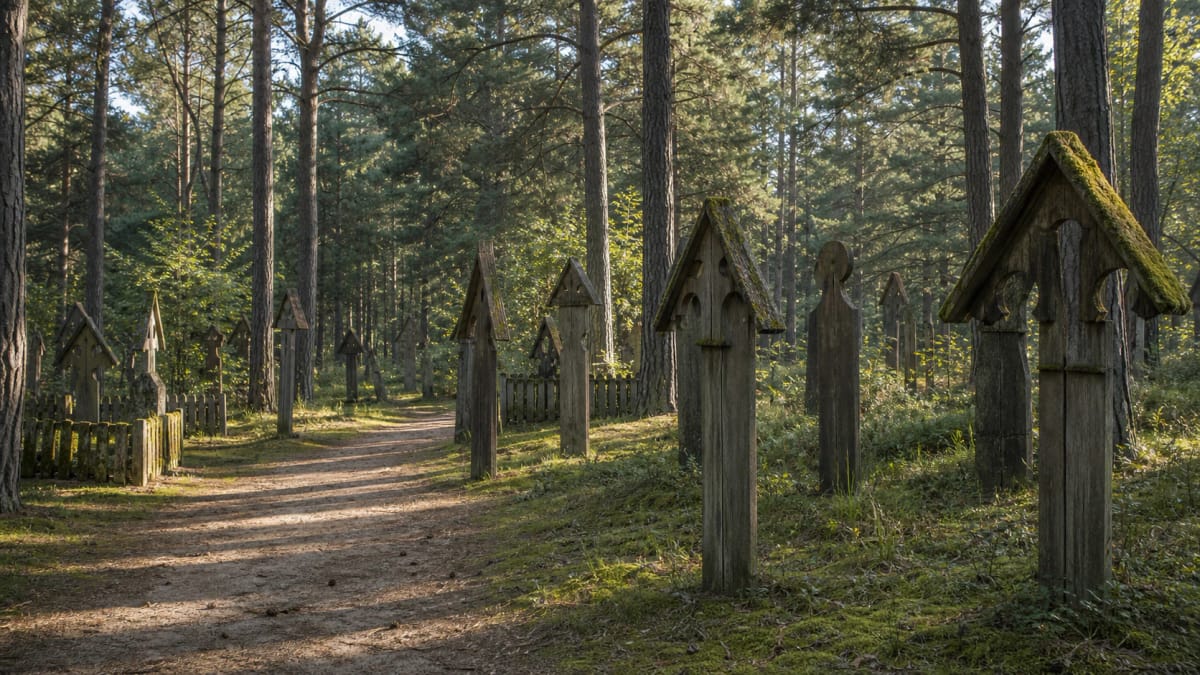
Krikštai, also called krikšta, krikšteliai, or krikštužiai, are a distinctive form of small architecture: Evangelical Lutheran grave monuments. According to VLE, they were boards 0.5-2 m high and 0.2-0.6 m thick, with edges profiled so the whole monument acquired a plant, geometric, or zoomorphic silhouette. A krikštas was attached to a pole, a long oak board reaching the bottom of the grave, and placed at the foot end of the deceased.
Krikštai spread in Lithuania Minor from the fifteenth century and are mentioned in historical sources from the sixteenth century. Their origins are linked with Prussian and German cultural influence and the spread of Protestantism in the seventeenth and eighteenth centuries. Most survived in the fishing cemeteries of the Curonian Spit, especially Nida, and the Nemunas Delta, so Juodkrantė cemetery helps explain why Pamarys cemetery culture differed from the crosses and chapel-posts of other Lithuanian regions.
Krikštai symbolism: wood, motifs, and gender
VLE states that krikštai for men's graves used oak, birch, or ash, while women's used linden, aspen, or spruce; decoration motifs were also chosen according to the deceased's gender. In the seventeenth century, men's krikštai commonly had horse-head silhouettes, while women's had birds, often a cuckoo's head. In the eighteenth century, stylized plants, animals, and hearts became dominant, cut in openwork or painted as symmetrical compositions.
Decoration used combinations of blue, yellow, green, red, black, and grey; blue and black were most often backgrounds on which the deceased's name, surname, and life dates were written in lighter paint. According to Marija Gimbutienė, motifs of toads, grass snakes, butterflies, and flowers in krikštai ornamentation reach back to clan-society times and were linked with symbolism of a Goddess of Rebirth. That makes krikštai interesting not only as craft but as a sign of the Baltic worldview.
What to read on site
In the Juodkrantė cemetery, look not only at individual signs but at the whole setting: the pine forest, paths, small cemetery area, and restrained Evangelical Lutheran character. There is no single spectacular view to photograph quickly.
The krikštai tradition helps explain how Lithuania Minor cemetery culture differed from the crosses and chapel-posts of other Lithuanian regions. Wood, silhouette, motifs, and the position at the foot of the grave speak a separate Pamarys language of memory.
How to visit respectfully
Allow 20-40 minutes and visit the cemetery as a memorial place. Walk on paths, do not touch old signs, do not step on graves, keep quiet, and follow any local rules shown on site.
No official opening hours or tickets were found in verified sources. This is a cemetery space, so the key issue is not a schedule but respectful presence, suitable footwear, and the understanding that you are moving through a living place of memory, not an outdoor display.