- Place
- Kaunas City Municipality
- Region
- Kaunas
- Type
- national drama theatre with five stages
- Address
- Laisvės al. 71, Kaunas
- Coordinates
- 54.89700, 23.91060
Kaunas State Drama Theatre, NKDT
The first professional Lithuanian drama theatre
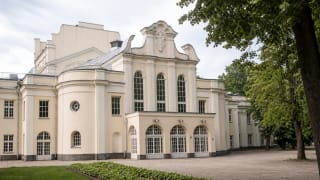
National Kaunas Drama Theatre stands on Laisvės alėja, in the heart of Kaunas. It is the first professional permanent Lithuanian drama theatre, founded on December 19, 1920 by the Lithuanian Art Creators' Society. Its first board included major cultural figures, among them Maironis, Balys Sruoga, and Paulius Galaunė.
The first performance, Hermann Sudermann's Joninės, directed by Juozas Vaičkus, was shown in 1920 in the same city but in another building, the then City Theatre Palace, now Kaunas State Musical Theatre. The drama theatre moved to the current building on Laisvės alėja only in 1959, so in its first decades it performed in other Kaunas halls.
Interwar stage and the beginning of modern directing
During the interwar period, when Kaunas was the temporary capital, the theatre became the country's most important drama stage and a cradle of modern Lithuanian directing. In 1927 Borisas Dauguvietis staged C. Gozzi's Princess Turandot and K. Čapek's R. U. R., regarded as the beginning of contemporary Lithuanian directing.
Andrius Oleka-Žilinskas, who led the theatre in 1929-1933, was the first in Lithuania to apply the Stanislavski system, and in 1932 the famous actor and director Mikhail Chekhov was invited to stage Hamlet. A drama school also operated at the theatre in 1924-1933, training a new generation of actors.
Soviet-period theatre: Jurašas and Vaitkus
During the Soviet period, despite ideological pressure, Kaunas Drama Theatre was known for bold productions. Jonas Jurašas, chief director in 1967-1972, created civically sharp performances; his 1972 Barbora Radvilaitė and other works were censored or banned, and the director later emigrated.
Jonas Vaitkus, who led the theatre in 1977-1988, created expressive, metaphorical theatre, from King Ubu to Caligula. Eimuntas Nekrošius also staged early works here. This generation made the theatre one of the most significant centres of artistic resistance in the late Soviet period.
The Laisvės alėja building and five stages
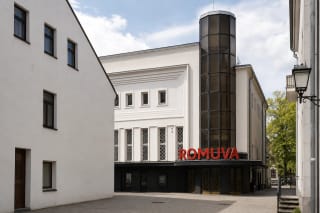
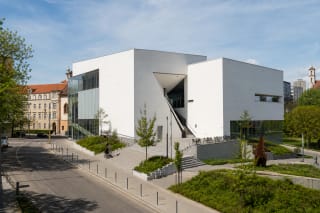
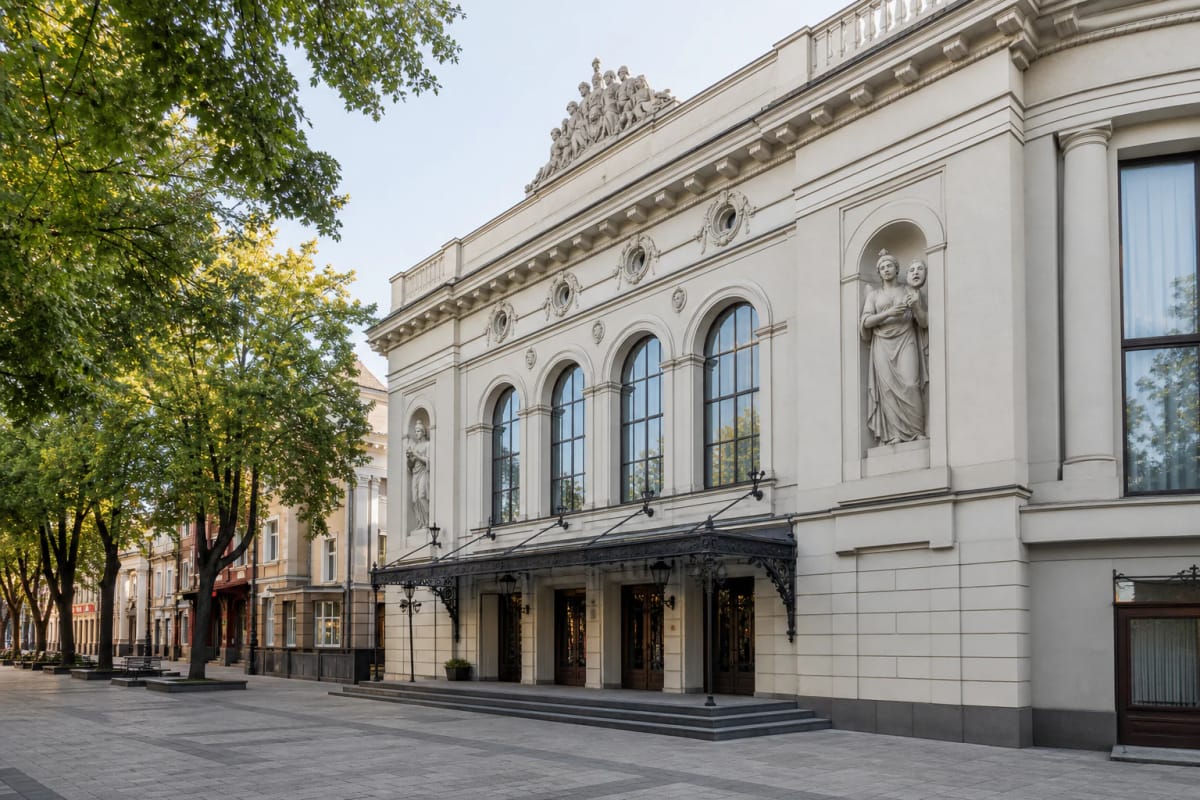
The current theatre building is composite. In 1928 the Metropolitain cinema was built in the courtyard by architects Vladimiras Dubeneckis and Klaudijus Dušauskas-Dūž; in 1929 the street block rose; and in 1953-1956, according to architect Kazimieras Bučas' design, the building was adapted for drama theatre, with works completed in 1959. Four socialist-realist sculptures decorate the facade. In the early twenty-first century, the theatre was substantially reconstructed according to a project by Algimantas Kančas' studio, adding new halls.
Today the theatre has five spaces: the Great Hall, Rūta Hall, Long Hall, Small Stage, and Great Stage Foyer. In 2012 it received national status and the name changed to National Kaunas Drama Theatre. Do not confuse it with the Romas Kalanta memorial Aukos laukas, which is not by this theatre but in Kaunas City Garden near the Musical Theatre.
How to visit the theatre
The easiest way to know the theatre is to attend a performance; the season runs roughly from September to June. The facade with sculptures can be viewed anytime while walking along Laisvės alėja, the city's main pedestrian street.
The repertoire, performance times, and ticket prices change constantly, so check the official theatre page before travelling. Buying tickets in advance is the most convenient option, especially for popular productions.