- Place
- Kaunas City Municipality
- Region
- Kaunas
- Type
- working historic cinema and Kaunas modernism site
- Address
- Laisvės al. 54, Kaunas
- Coordinates
- 54.89775, 23.91569
Kaunas Cinema Centre Romuva, Romuva, Romuva Cinema, Kino namai Romuva
A living cinema, not a frozen exhibit
Romuva is one of the easiest Kaunas modernism places to experience because it still works according to its original cultural function. It is presented as the oldest cinema still operating in Lithuania today, which matters: this is not just a facade to photograph on Laisvės alėja.
Today it operates as Kaunas Cinema Centre Romuva, a space for screenings, events, education, and city culture. The best visit is therefore double: see the architecture in daylight, then return for an evening film or event and experience how the historic building works from inside.
Why the building is set back from Laisvės alėja
The first thing to notice is the urban decision. AUTC stresses that setting the cinema deeper inside the plot created a small public space, enlivening the otherwise perimeter-built fabric of Laisvės alėja.
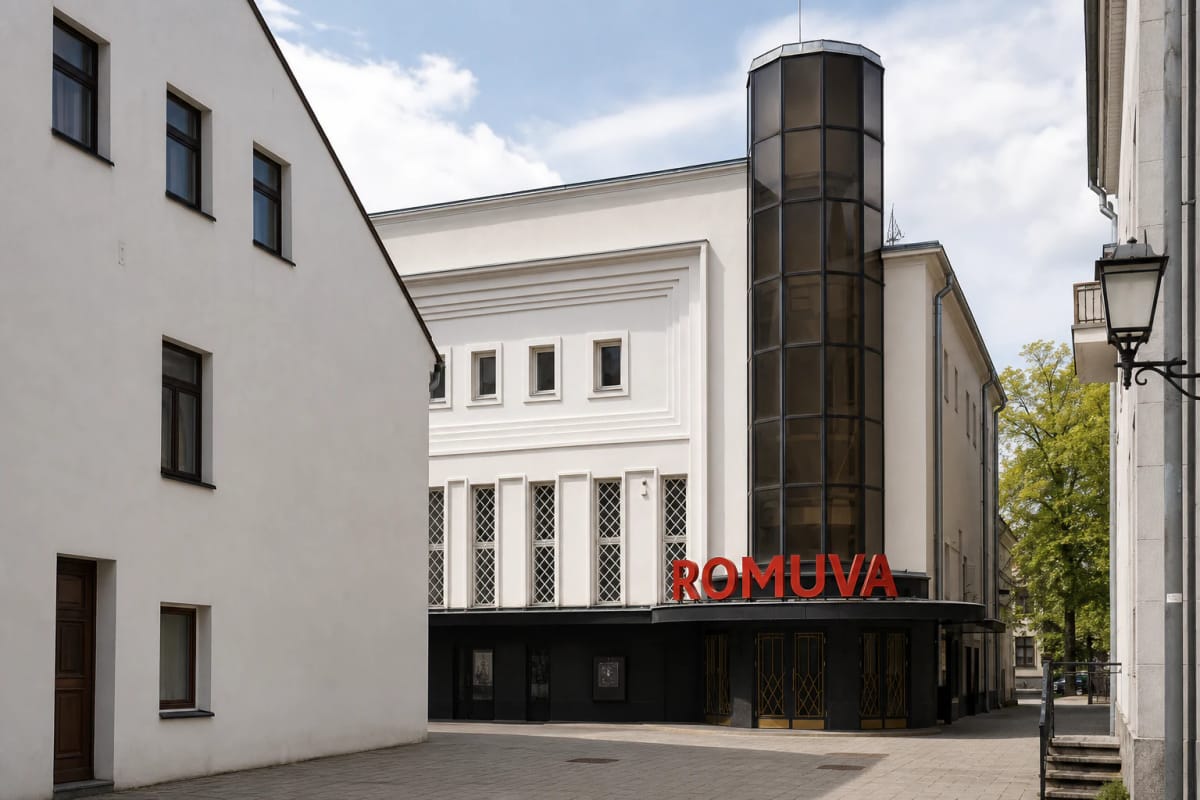
This is not a random gap between buildings. Romuva invites entry through a small forecourt, where the facade opens at close range: a white main volume, a darker entrance zone, the glass tower, and the movement of Laisvės alėja behind you. It feels more like a city-courtyard theatre than a standard street-front showcase.
The plot before the cinema
AUTC gives a very specific prehistory. The plot previously held poor-condition wooden houses, warehouses, and masonry structures; documents from 1924, 1928, and 1929 described them as unsafe, even dangerous because of fire risk.
In 1938 Antanas and Petras Steikūnai acquired the plot. On December 29, 1938 they submitted a request to build a cinema, and on February 3, 1939 a permit was issued for a 687-seat cinema. AUTC states that by April 13, 1940 the building had already been completed.
Architect and structural solution
AUTC names Nikolajus Mačiulskis as the architect, while the reinforced-concrete vault and acoustics of the auditorium are linked with engineer Pranas Markūnas. This makes Romuva more than a handsome facade: it is also an engineered cinema-hall object.
The interwar cinema type required a special logic: good sight lines, sound, safe circulation, and a representative entrance. Romuva's value lies exactly in the combination of these elements: cinema technology, urban representation, and a modern leisure-culture space in one building.
Streamline and late Art Deco
AUTC writes that the plan is dominated by slightly rounded forms reminiscent of the streamline aesthetic of American cinemas of the period. On the exterior, a historicist hint also remains, for example in the cornice logic, so the building is not pure functionalism.
The key visual sign is the glass tower accenting the entrance. Together with the white facade, vertical window strips, and darker entrance zone, it creates Romuva's easily recognizable silhouette. The tower became the building's iconic element, even though before the war it was not lit as planned.
Auditorium and interior details
Passers-by mostly see the facade, but Romuva's value continues inside. KVR valuable-property data and researchers' descriptions mention the oval or rounded logic of the auditorium plan, acoustic materials, geometric ceiling solutions, vestibule flooring, and glass details.
That is why entering the building is worth doing for more than the film alone. Even without specialist knowledge of architecture, a screening lets visitors feel how an interwar cinema building organizes the audience: from entrance and vestibule to hall volume, sound, and seating rhythm.
The threshold of 1940
Romuva was built in 1940, just before Lithuania lost its independence. That circumstance gives the building an extra tension: it closes the stage of interwar Kaunas cultural optimism, but did not have time to become fully embedded in the daily life of an independent state.
For that reason Romuva is best combined with other Kaunas modernism sites. The post office, Officers' Club, museum complex, and Laisvės alėja buildings show state administration, the military, memory, and economy, while Romuva reveals urban leisure, cinema culture, and the rhythm of modern life.
KVR protection
In the Cultural Heritage Register the object is called Cinema Theatre Romuva. Its unique code is 32115, its status is state-protected, its significance level is regional, and the valuable-property type is architectural. KVR also gives the object's territory as 1700 sq. m.
This means protection covers more than a convenient cinema hall. It covers an architectural whole: volume, facade, glass tower, spatial relationship with Laisvės alėja, and surviving interior details. Restoration therefore had to balance the needs of a cinema centre with heritage requirements.
Restoration and contemporary function
The official page for Romuva's heritage-activation project documents a recent renewal stage carried out in the context of the European Union 2014-2020 investment programme. The aim was not to turn the building into an empty monument, but to adapt it for present-day use.
After renewal, Romuva operates as a cinema centre, event venue, educational space, and cultural place. Practical information changes: screenings, hall access, event hire, education, and possible tours depend on the official schedule, so check Romuva's site before going.
How to visit
The exterior takes 10-20 minutes, but it is better not to rush. Stand on Laisvės alėja facing the forecourt entrance, notice how the building pulls back from the main pedestrian axis, then walk closer and examine the glass tower, facade relief, entrance proportions, and side volumes.
If you want to see the interior, plan around a screening or event. It is not a museum with a permanently open exhibition, so spontaneous access to the hall may not be possible. The best approach is to choose a film, event, or educational activity and give Romuva time as a working cinema-culture place.