- Place
- Kaunas City Municipality
- Region
- Kaunas
- Type
- active musical theatre, former State Theatre, and national-stage heritage object
- Address
- Laisvės al. 91, Kaunas
- Coordinates
- 54.89638, 23.90619
Kaunas Musical Theatre, State Theatre, Kaunas City Theatre, Kaunas Operetta Theatre, Kaunas Musical Comedy Theatre, Kaunas State Drama and Music Theatre
Theatre in the City Garden
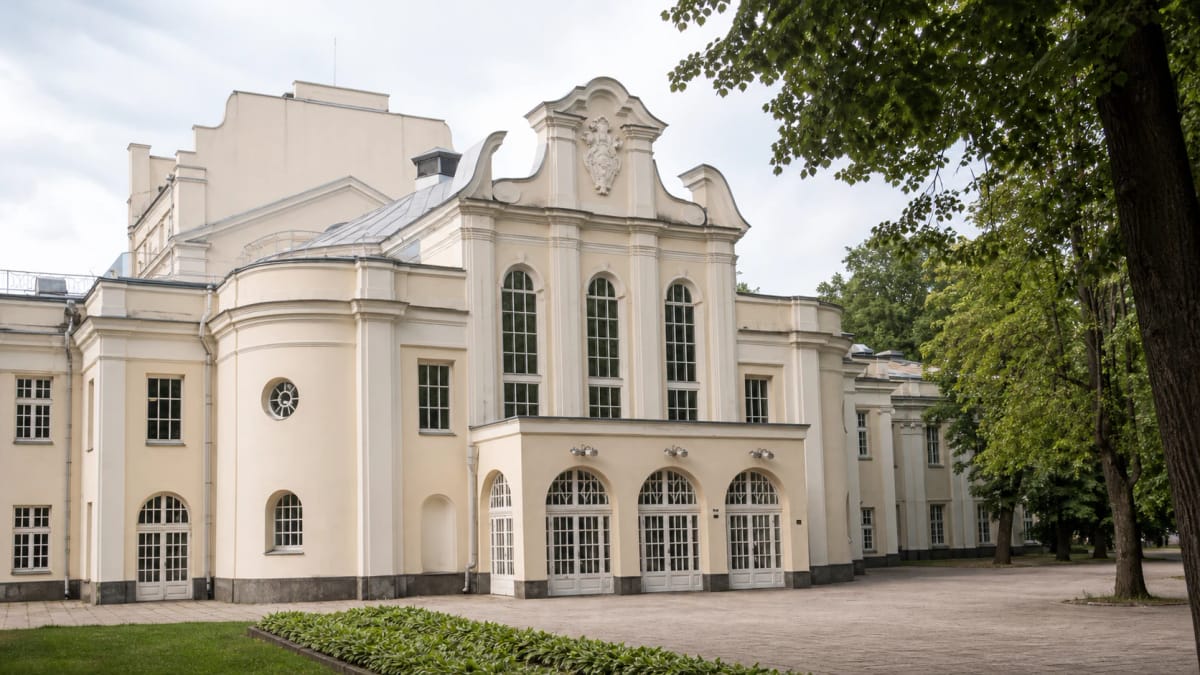
Kaunas State Musical Theatre stands at Laisvės al. 91, on the edge of the City Garden. At first glance it is a calm cream-coloured facade with three tall arched windows, a curved pediment, and trees, but this building is one of the most important knots in Lithuanian stage history.
The Cultural Heritage Register protects the object as Kaunas State Musical Theatre, unique code 10416. Its status is monument, significance level national, and valuable features are connected with architecture, art, and history. It is therefore worth coming here not only for a performance, but also to read the building as the development of state, city, and theatre.
The city theatre of 1892
The official theatre history links the beginning with the 1891 decision by the city administration to build a theatre palace for Kaunas's cultural needs. The building rose quickly: according to a project by governorate architect Ustinas, or Justinas, Golinevicius, it opened on January 9, 1892.
The first theatre had a 500-seat hall, two balcony tiers, foyer, and auxiliary rooms. There was no permanent troupe yet, so touring companies performed here most often. After the 1904 Act of Tolerance, Lithuanian, Polish, Jewish, and German communities could use the stage more actively, and in 1905 the Daina Society held the first Lithuanian evening here with Keturakis's America in the Bathhouse.
Birth of the State Theatre
After the 1918 independence, the theatre became more than a stage. The Theatre as Building project stresses that the first meetings of the city council and the Constituent Seimas took place here. The Cultural Heritage Register also states that on May 15, 1920, the Constituent Seimas of Lithuania began work in this building.
The same year, the core of professional Lithuanian stage art formed here. The official history mentions the 1920 staging of H. Sudermann's Jonines, Verdi's La Traviata in 1920, and L. Delibes's Coppelia in 1925. The register specifies that the first performance of the Lithuanian professional opera troupe, La Traviata, took place on December 31, 1920.
Reconstruction in 1922-1925
The few-hundred-seat hall quickly became too small for a state stage. The 1922-1925 reconstruction was led by Vladimiras Dubeneckis and Mykolas Songaila, with engineer Pranas Markunas assisting. This was not a cosmetic repair, but an attempt to turn a small Tsarist-period theatre into the country's main stage.
The official theatre text states that the exterior gained a Neo-Baroque expression, the auditorium was enlarged to 763 seats, given a horseshoe shape, and fitted with a third balcony tier, central box, and orchestra pit. In the hall, folk tulip, lily, and little-sun motifs were stylized in an Art Deco manner, making the interior one of the most interesting combinations of national representation and modern stage technology in Kaunas.
The Landsbergis-Žemkalnis layer and the 1931 fire
In 1930-1933 the building was reconstructed again, this time under Vytautas Landsbergis-Žemkalnis. New blocks facing Kestucio Street were built for scenery workshops, sewing rooms, and storage, the stage box was raised, foyers were expanded, and stage technology was renewed.
The most important technical solution of this period soon proved its worth. During a major theatre fire in 1931, an iron curtain with an automatic cooling system saved the auditorium and representative part of the building. The Dubeneckis and interwar reconstruction layer seen in the hall today is therefore not a self-evident survival; it was effectively protected by newly installed stage-safety technology.
An interior worth seeing from inside
The Cultural Heritage Register separately lists the U-shaped auditorium, three balcony tiers, central box, stage with orchestra pit, and wooden and plaster relief painted and gilded motifs of tulips, lilies, little suns, and other stylized forms. That means the theatre's real value is not visible from the facade alone.
If possible, the best way to visit is a performance. Then the building works as it was created to work: the viewer sees not only the stage, but also the hall shape, balcony relationships, dome, chandelier, foyer sequence, and the special State Theatre atmosphere that an exterior photo cannot replace.
The 1940 People's Seimas and theatre renamings
The building also had political roles. Theatre as Building states that on July 21, 1940, the so-called People's Seimas proclaimed Lithuania a Socialist Soviet Republic here. This is one of the darkest episodes in the building's history, in direct contrast to the symbolism of the Constituent Seimas beginning here in 1920.
After the Second World War, the troupes and names changed. The official history states that after the opera and ballet troupes moved to Vilnius in 1948, Kaunas State Musical Drama Theatre operated here, and from 1959, after the drama troupe moved out, the Kaunas State Musical Theatre company remained in the City Garden palace.
Romas Kalanta and the memory of the City Garden
The theatre surroundings are inseparable from the memory of Romas Kalanta. VLE states that on May 14, 1972, he self-immolated in the Musical Theatre garden in Kaunas, protesting against the Soviet occupation. After his secret burial, demonstrations on May 18-19, 1972 turned into a mass youth protest.
For that reason, do not stop only at the facade. The City Garden, theatre approaches, and Kalanta memorial place show that this quarter carries not only stage art, but also civic resistance.
The theatre today
Today Kaunas State Musical Theatre is an active stage whose repertoire includes opera, operetta, musicals, dance performances, children's performances, and concerts. The official contact page gives the address Laisvės al. 91 and box-office hours Wednesday-Sunday 11:00-18:00, but repertoire, tickets, and accessibility conditions should always be checked before going.
From the outside the theatre is convenient to view while walking along Laisvės aleja or through the City Garden. If the interior is not open to visitors, 10-20 minutes is enough for the facade, garden, and Kalanta memory context. The full experience comes only with a performance.
Kaunas modernism context
The theatre should not be called a separate UNESCO-listed object, but it is important in the history of Kaunas Naujamiestis and interwar modernization. The UNESCO-recognized Modernist Kaunas: Architecture of Optimism, 1919-1939 tells the story of the temporary capital's public buildings, institutions, and urban modernization.
In this story, Kaunas Musical Theatre works as the transformation of an older nineteenth-century building into a state cultural stage. Its interwar reconstructions, national-stage function, and political events show how the temporary capital not only built new palaces but rewrote existing city buildings.