- Place
- Vilnius City Municipality
- Region
- Vilnius
- Type
- national concert institution and historic City Hall Palace
- Address
- 5 Aušros Vartų Street, Vilnius
- Coordinates
- 54.67627, 25.28783
- Visit duration
- 1.5-2.5 hours for a concert; about 1 hour for a pre-arranged tour
- Best time
- according to the official concert programme; see the facade in daylight and the interior with a concert or tour ticket
LNF, Vilnius Philharmonic, City Hall Palace
From merchants' lodgings to the 1902 City Hall
A complex known as the Ruthenian Merchants' House stood on this site from the early sixteenth century, with shops, warehouses, and courtyards. Fires and rebuilding brought Gothic, Renaissance, and Classical forms over successive centuries. At the beginning of the twentieth century, the Vilnius City Duma decided to convert the ageing Merchants' Palace into a representative theatre and concert hall.
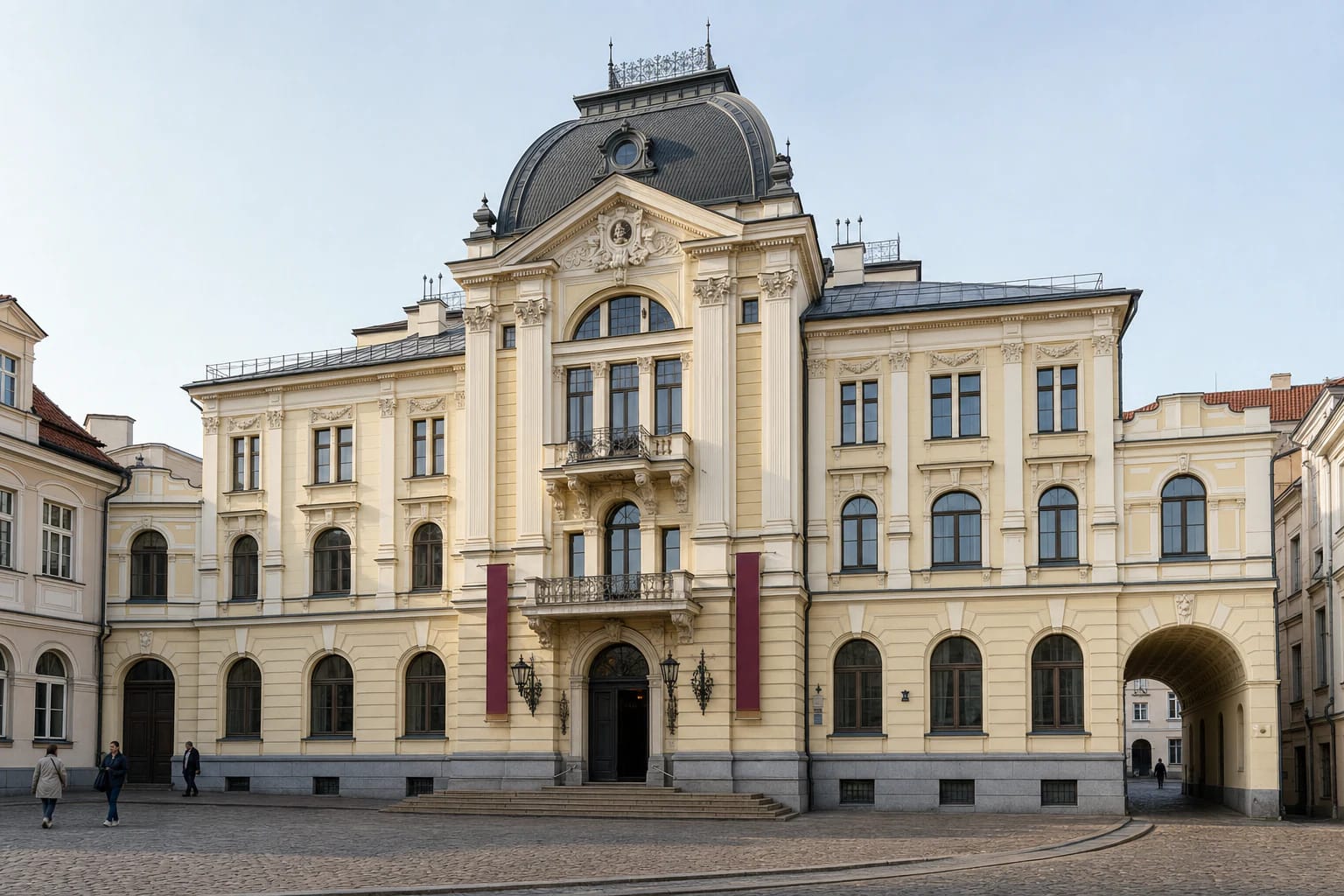
Konstantinas Korojedovas, then the city architect and engineer of Vilnius, prepared the design. The 1900-1902 reconstruction created a City Hall with a concert auditorium, hotel, and commercial premises. A projecting central bay, rich historicist ornament, and a French Baroque-inspired dome define the main facade; the dome concept was linked to the example of the Paris Grand Opera.
The Great Seimas of Vilnius and the first Lithuanian opera
The City Hall quickly became more than a place of entertainment. The Great Seimas of Vilnius met here on 4-5 December 1905 and demanded political autonomy for Lithuania. A plaque set into the pavement before the main auditorium doors and Gediminas Jokūbonis's bronze sculpture of Jonas Basanavičius in the entrance hall now recall this event.
Mikas Petrauskas's "Birutė", regarded as the first Lithuanian national opera, was performed here on 6 November 1906. Leading musicians of the early twentieth century also appeared at the venue, including Sergei Rachmaninoff, Feodor Chaliapin, and Alexander Scriabin. Mikalojus Konstantinas Čiurlionis conducted a Lithuanian choir here in 1907, and Vilnius-born violinist Jascha Heifetz took the City Hall stage in 1909.
The Philharmonic institution since 1940
The Lithuanian State Philharmonic was established in the former City Hall Palace on 1 November 1940 under Soviet occupation. Its early structure included a symphony orchestra, mixed choir, and folk song and dance ensemble. The Nazi occupation administration closed the institution in March 1943, and the Philharmonic was re-established in August 1944.
The institution received national status and its present name in 1998. Today it presents concerts in its Main and Chamber halls and coordinates five permanent ensembles: the Lithuanian National Symphony Orchestra, Lithuanian Chamber Orchestra, Vilnius String Quartet, Čiurlionis Quartet, and the ensemble Musica humana.
Auditoria, organ, and preserved interiors
The Main Auditorium retains the ceremonial character of the old City Hall, although it was adapted repeatedly for concerts during the twentieth century. A concert organ made by Alexander Schuke's workshop in Potsdam was installed at the rear of the stage in 1963. A major reconstruction in 1985 enlarged the vestibule, created a side foyer with cloakroom, and added another staircase.
The central part of the palace, including its vestibule, halls, buffet, main staircases, and corridors, retains the strongest early-twentieth-century character. During reconstruction, an old lane that once separated the merchants' property from the Basilian monastery was uncovered between the basement and ground floor and left visible. The City Hall Palace is a state-protected cultural monument, KVR code 10361.
Concerts, tickets, and audience rules
An ordinary visit is tied to a particular concert. Check the event page for its date, auditorium, programme, duration, age guidance, and price because there is no general-admission ticket. Tickets are sold through the Philharmonic website, its authorised ticketing platform, and the box offices; during the final hour before a concert, the box office sells tickets only for that day's event.
On 25 July 2026, the official box-office page listed Tuesday-Saturday hours of 11:00-19:00, with a break from 14:30 to 15:00, and Sunday opening for the two hours before an event at the Philharmonic. Prices and hours can change, so check the official website. The auditorium closes after the third bell. Pre-school children are not admitted to evening concerts, while specifically marked Family Series events are intended for younger audiences.
Tours, accessibility, and arrival
The Philharmonic offers an approximately one-hour introduction to the building's history and architecture that may be combined with an open orchestra rehearsal. This is not a daily walk-in tour for individuals: the official description refers to groups of 20-30 people registered in advance, so the date and availability must be arranged directly with the Philharmonic.
Concerts and lifts are accessible to visitors with limited mobility, but the institution asks to be notified in advance so staff can arrange entry and assistance. Only paid parking is available around the building and spaces are limited, making public transport or a walk through the Old Town convenient alternatives. The Google Maps card with Place ID ChIJNYfL5D-U3UYRg5IBpNQgyyI marks the building at 5 Aušros Vartų Street; the coordinates are a site point for the palace.