- Place
- Vilnius City Municipality
- Region
- Vilnius
- Type
- early Baroque Carmelite church with Rococo interior
- Address
- Aušros Vartų g. 14, Vilnius
- Coordinates
- 54.67500, 25.28950
St Teresa's Church, Discalced Carmelite Church of St Teresa
St Teresa's Church by the Gates of Dawn
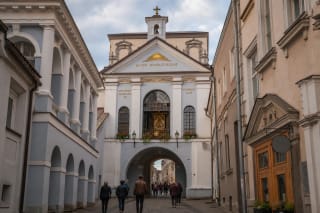
Vilnius St Teresa's Church stands on Aušros Vartų Street, directly beside the Gates of Dawn. It is an active parish church and one of the first and most beautiful Baroque buildings in Lithuania, as VLE describes it. The church was built by the Discalced Carmelites, who settled by the Medininkai, later Gates of Dawn, gate.
Do not confuse the two neighbouring sites. The Gates of Dawn, with the miraculous image of Our Lady of Mercy, are a separate chapel above the city gate, while St Teresa's Church is the shrine beside it, connected to the chapel by a gallery. Historically, the Carmelites cared for the Gates of Dawn chapel, so the places are closely linked but remain two different monuments. Vilnius also has another church of the same name, the Žvejai St Teresa's Church, which is another building.
Pac family foundation and construction history
The Discalced Carmelites settled in Vilnius in 1624 and built a wooden church in 1627. The masonry St Teresa's Church was built in 1633-1654 with funds from Steponas Pacas, a nobleman of the Grand Duchy of Lithuania, royal secretary, and vice-chancellor. It was consecrated in the mid-seventeenth century, with sources giving either 1652 or 1654.
Several names are associated with the architecture. The main facade is attributed to the Italian royal architect Constante Tencalla, while construction was supervised by Ulrich, architect of the Radziwiłł Palace; Giovanni Battista Gisleni is also mentioned in the literature. It is therefore best to present the authorship as the work of several masters rather than assigning it to one person without qualification.
Baroque facade and Rococo interior
St Teresa's Church is a towerless, three-aisled basilica, reflecting Roman Baroque churches of the Il Gesù type. The facade is especially notable because expensive materials were used: Swedish sandstone, black and white marble, and granite. A steep Baroque gable with volutes and obelisks crowns the wavy silhouette.
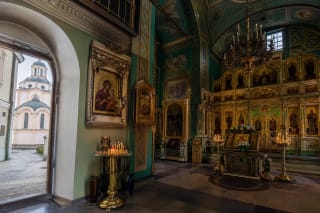
The interior was remodelled in Rococo style in the second half of the eighteenth century. The church has nine Rococo altars, with the high altar considered one of the most valuable in Lithuania, a pulpit, and frescoes on the walls and vaults depicting the life of St Teresa. Around 1763-1764 the painter Motiejus Sluščianskis created these frescoes; in the blind dome he depicted the saint's apotheosis. The church also contains four works by Kanutas Ruseckas. According to VLE, this eighteenth-century mural ensemble is the only surviving artistic heritage example of such scale from the former Lithuanian province of the Discalced Carmelites.
Pociej Chapel and later centuries
In 1783, on the Aušros Vartų Street side, Motiejus Pociej added the Pociej chapel-mausoleum, whose forms combine Rococo and Classicism; the bell tower was built in 1760. In 1844 the Russian authorities closed the Carmelite monastery, but the church continued to function as a parish shrine.
The church has been repaired and restored many times. In 2022 the plinths, column bases, windows and stained glass, central doors, and glass vestibule were renewed, and the cellar was adapted for pilgrim rest. This shows that the place remains a living space of prayer and pilgrimage.
How to visit St Teresa's Church
The church is naturally visited together with the Gates of Dawn and the surrounding old-town route. For the church itself, 20-30 minutes is usually enough. Inside, look slowly at the high altar, frescoes, and the apotheosis in the blind dome.
It is an active parish church, so entry is usually free and visiting is best coordinated with service times. Check the official Gates of Dawn page for current visiting and service schedules, because they can change.