- Place
- Vilnius City Municipality
- Region
- Vilnius
- Type
- historic place of city self-government and representation
- Address
- Didžioji g. 31, Vilnius
- Coordinates
- 54.67830, 25.28760
Vilnius City Town Hall
The self-government centre of the old town
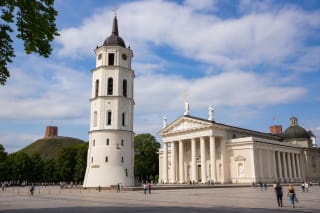
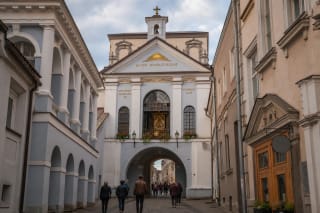
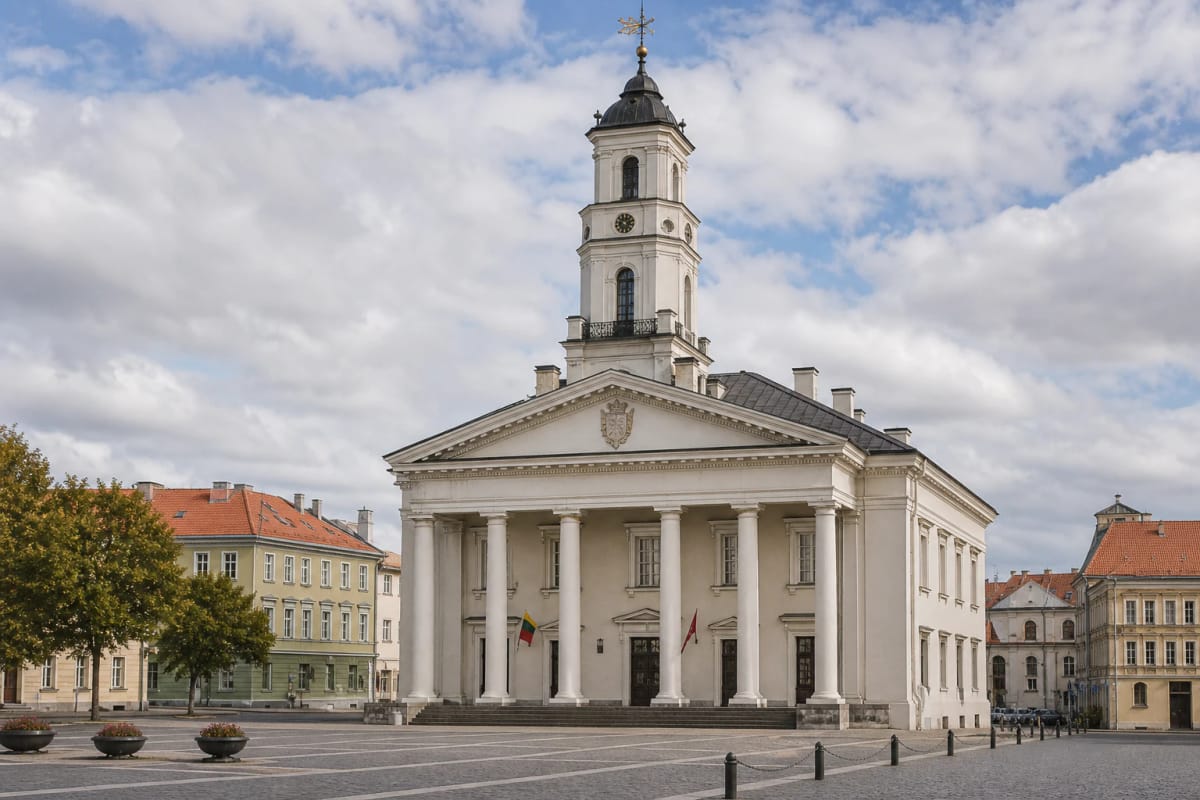
Vilnius Town Hall stands at the highest point of triangular Town Hall Square, where city self-government, trade, courts, markets, and ceremonies gathered for centuries. It is one of the clearest urban anchors in the old town: from here, Didžioji Street leads both toward Cathedral Square and toward the Gates of Dawn.
Today the Town Hall mainly functions as a venue for representative and protocol events, ceremonies, and exhibitions, but its value begins with the site and architecture themselves. It is one of the most important Classical buildings in Lithuania.
From a Gothic town hall with a tower to Classicism
A town hall is thought to have stood here already in the early sixteenth century. In the second half of the sixteenth and first half of the seventeenth century, it was a two-storey Gothic building with a tower, with shops attached to it. In the seventeenth and eighteenth centuries, wars and fires repeatedly damaged the building.
After the fires of 1748 and 1749, reconstruction was entrusted to the prominent late Baroque architect Johann Christoph Glaubitz, and after 1756 architect S. Russelis led the works. When the tower began to lean, Laurynas Gucevičius started to rebuild it in 1781, but the tower collapsed while the foundations were being strengthened. That led to a completely new Classical design.
Gucevičius' Classical building
In 1785-1799, the town hall was rebuilt on old foundations and cellars to a design by Laurynas Gucevičius, gaining its present appearance. It is one of his most important works, created in the same period as his transformation of Vilnius Cathedral.
The building has two storeys, cellars, and a compact almost square plan. On the main facade, the entrance is emphasized by granite steps and a Doric portico with a triangular pediment; the facades are decorated with straight window heads, door and window surrounds, and rectangular rustication imitated in plaster. The exterior is marked by mature Classical restraint, balanced proportions, and monumentality.
City government, court, and urban life
The Town Hall was the heart of Vilnius self-government. It is widely accepted that Vilnius received Magdeburg rights in 1387, and from then on the city needed a place for the vogt, magistrate, court, and urban affairs.
In Gucevičius' building, the ground floor held rooms for measuring instruments, the guard, the clerk's room, entrances to shops, and the prison, while the second floor had the representative vogt's hall, court and merchants' rooms, archives, treasuries, and the great hall. The building was therefore administrative, legal, commercial, and ceremonial at the same time.
From city theatre to art museum
In the nineteenth century, the Vilnius City Theatre operated in the town hall with interruptions: in 1810-1811, 1833-1845, and after a plan change in 1845-1914. In 1936-1940, the building was restored according to surviving Gucevičius drawings, with works led by architects Stefan Narębski and Vytautas Landsbergis-Žemkalnis.
From 1944 to 1995 the building housed the Lithuanian Art Museum. In 1995-1999 it hosted events of the Lithuanian Artists' Palace, and since 1999 it has served city representative and protocol events, state-institution functions, and commercial events.
Town Hall Square and the surroundings
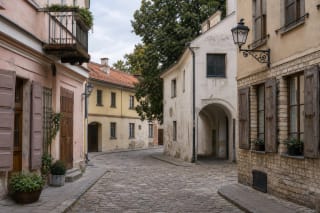
Town Hall Square is one of the main public spaces of the old town, hosting Kaziukas Fair, city celebrations, and concerts. Several routes lead from the Town Hall into different layers of Vilnius: toward the Gates of Dawn, toward Pilies Street and the Cathedral, into the Stiklių quarter, and toward St Casimir's Church.
The Town Hall is a useful orientation point for starting an old-town route. If time is short, look at the facade, the square, and surrounding streets. With more time, combine it with the university ensemble, Cathedral, and Gates of Dawn.
How to visit Vilnius Town Hall
Town Hall Square and the facade can be visited freely, while the interior is accessible according to the programme of events, exhibitions, and guided visits. For the architecture and square, 30-60 minutes is usually enough.
If you want to see the interior or attend an event, check the official Town Hall website before going. Rooms are often occupied by protocol events, so opening hours and access change.