- Place
- Vilnius, Vilnius City Municipality
- Region
- Vilnius
- Type
- late-Baroque church and Basilian monastery ensemble
- Address
- Aušros Vartų g. 7B, Vilnius
- Coordinates
- 54.67520, 25.28830
Basilian Gate, Vilnius Greek Catholic Church of the Holy Trinity
The Basilian monastery and Glaubitz gate
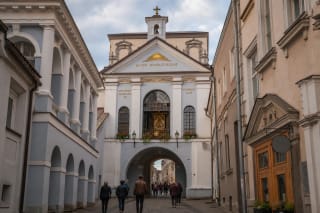
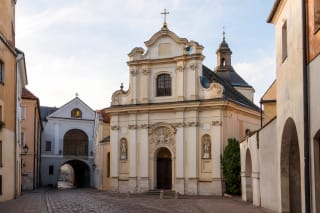
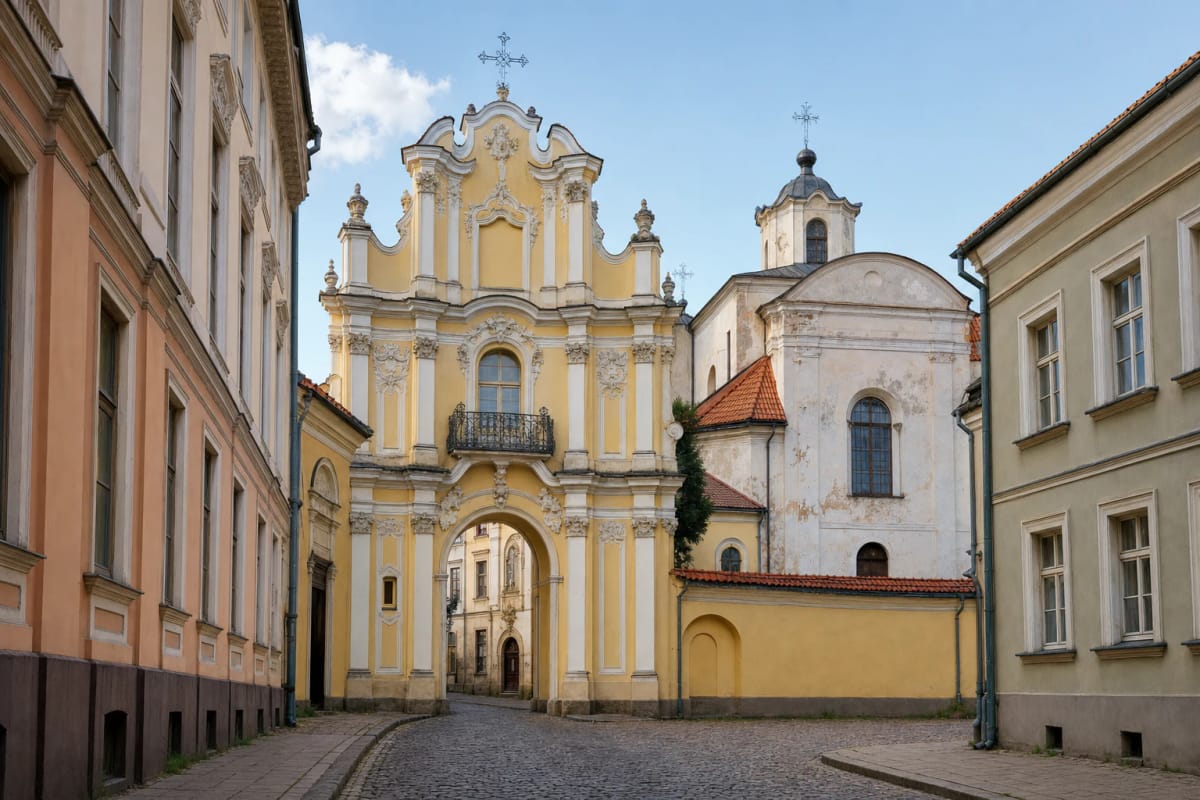
The Vilnius Basilian Monastery and Holy Trinity Church stand on Aušros Vartų Street in the old town. This is a Greek Catholic, or Uniate, ensemble whose most famous part is the impressive late-Baroque monastery gate, known as the Basilian Gate. It is considered one of the most beautiful Baroque gates in Lithuania.
The ensemble should be distinguished from several similarly named places: it is not Trinapolis Holy Trinity Church and not the Gates of Dawn, although the latter are on the same street. Here the Eastern and Western Christian traditions meet.
History of the ensemble
The ensemble began to form in the early sixteenth century under the Grand Hetman of Lithuania Konstanty Ostrogski; the masonry Holy Trinity Orthodox church was built in 1514. After the 1596 Union of Brest, it passed to Greek Catholics, and the Basilian monastery established here became the centre of the order's province.
Across the centuries, the ensemble's fate changed: in 1839 the monastery was closed, the church was transferred to the Orthodox, and a theological seminary operated here. After the buildings passed to Catholics in the twentieth century and the Basilians returned in 1992-1994, the church today serves as a Greek Catholic, Ukrainian Catholic, shrine. Secular institutions also operate in parts of the former monastery wings.
The Basilian, or Glaubitz, Gate
After a fire in 1760, the main monastery gate was designed by the most famous architect of Vilnius Baroque, Johann Christoph Glaubitz; construction began in 1761. Wavy, broken cornices and concave pairs of pilasters make it one of the most expressive monuments of the Vilnius Baroque school.
In the same year, new monastery wings also began to be built to Glaubitz's design. The architect died in 1767, so all works continued long after his death. The gate is often the main reason to step into this old-town courtyard.
Mickiewicz's cell
The monastery is also connected with Lithuanian and Polish literary history. In 1823-1824, members of the Philomath Society of Vilnius University were imprisoned in the former monastery prison, among them the poet Adam Mickiewicz and Ignacy Domeyko.
Since 2009, the so-called Konrad's Cell has operated here with exhibitions. Its name comes from Konrad, a character in Mickiewicz's poem Dziady, Forefathers' Eve. This makes the monastery a place of literary memory as well as architecture.
How to visit the ensemble
The ensemble is easy to see while walking along Aušros Vartų Street, together with the Gates of Dawn and surrounding churches. The gate and church usually take 30-45 minutes; the gate can also be seen directly from the street.
This is an active Greek Catholic church, so it is best to coordinate a visit with service times, and parts of the monastery wings are used for other purposes. Before going, check the official parish page for more exact information about services and visiting.