- Place
- Utena District Municipality
- Region
- Aukštaitija
- Type
- state-protected hydrogeological natural heritage site and active sacred place with a wayside chapel
- Address
- Lygamiškis village, Užpaliai Eldership, Utena District
- Coordinates
- 55.62758, 25.56357
- Visit duration
- 20-40 minutes for the spring, chapel, and grounds; up to 1 hour with nearby Lygamiškis Hillfort
- Best time
- daylight in dry conditions; stone steps can become extremely slippery after rain and in winter
Lygamiškis Spring, Holy Krokulė, Krakula, Užpaliai Spring
A small but protected spring
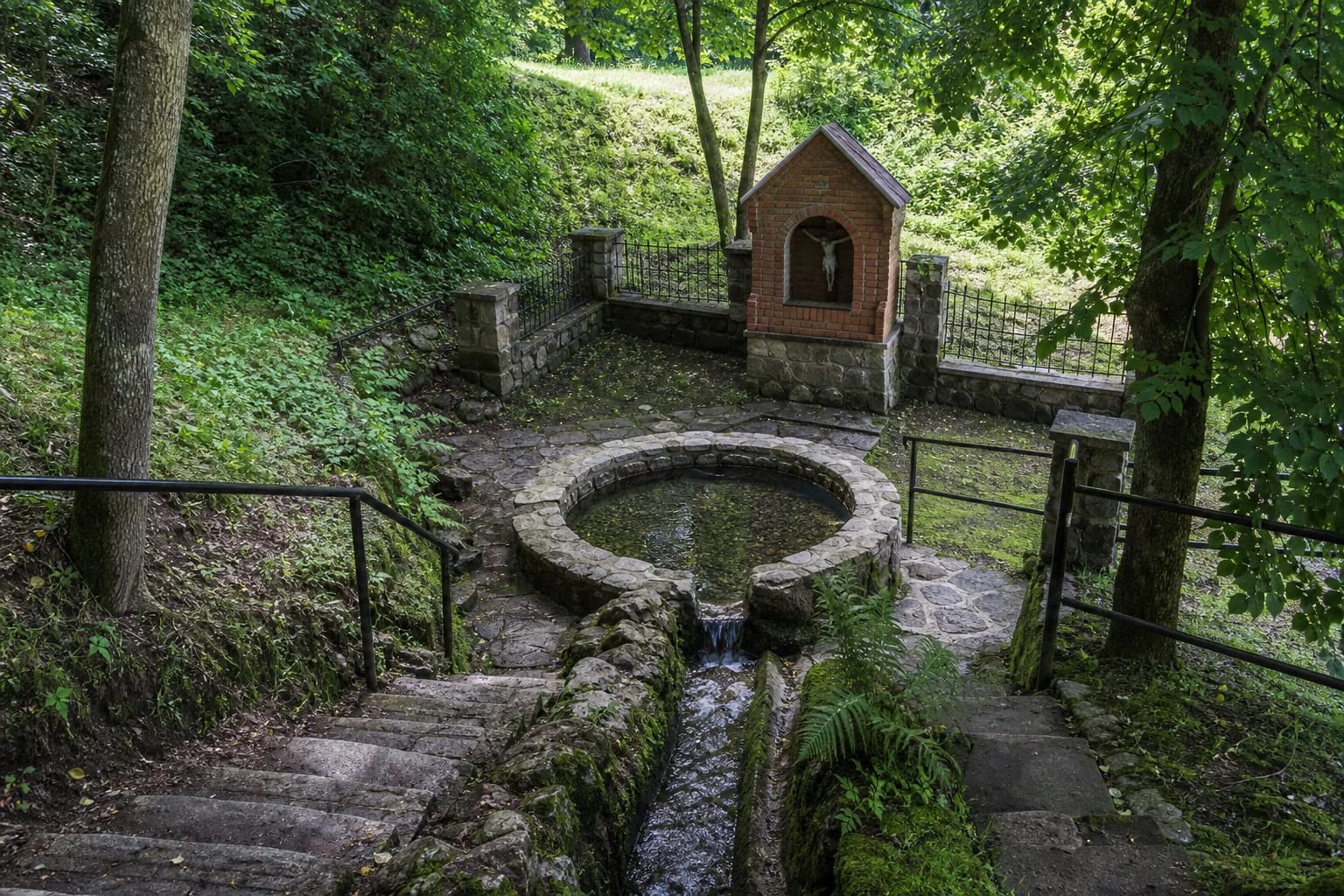
Krokulė rises in a roughly 25-metre-wide hollow formed by groundwater erosion on the right side of the Šventoji valley. Water is collected in a circular stone catchment about 1.2 metres across and 0.6 metres high before flowing through a short channel toward the river.
Stone paving, steps, and handrails improve access, but the hollow remains naturally damp. Shaded stones gather moss and become slippery after rain, during thaw, or in frost. No verified step-free route to the basin was found.
This is not a powerful cascade. The Lithuanian Geological Survey classifies it as low-yield and gives a rainfall-dependent flow of 0.65-0.85 litres per second. Its visual value lies in clear water, a shaded hollow, and the meeting of nature with small-scale sacred architecture.
What geological measurements reveal
On 18 September 2012, surveyors recorded clear, colourless, odourless water at 6.8°C. It was fresh, moderately mineralised, and relatively hard, with nitrate at 7 mg/l. The report notes that nitrate may reflect agriculture in the recharge area.
Tourism pages often repeat a flow of 7 litres per second and a temperature of 7-9°C. The specialist Survey profile's figure, almost ten times lower at 0.65-0.85 litres, is more appropriate for factual copy. The difference may be an old measurement, unit error, or repeated copying mistake.
Krokulė remains monitored: the 2026 groundwater plan lists Lygamiškis Spring as point 36406. Hydrochemical monitoring, however, is not the same as a continuously valid microbiological drinking-water certificate.
From an 1809 place-name to the wayside chapel
The name Krakula appears on an 1809 map of the Užpaliai estate. An 1860 description already noted its clear, odourless, tasteless water and a claimed laxative use. This proves a long healing reputation, not the efficacy of the treatment.
The red-brick chapel is generally dated to 1903 and associated with priests Kazimieras Kozminskis and A. Razmas. In 1930, Antanas Paurys continued improvements, including the masonry-and-metal enclosure; the stone spring catchment is also linked to his work.
The chapel's original Christ statue was stolen in 2003. A new figure by sculptor V. Šimonėlis was installed in 2008. These changes reveal an actively maintained place where a natural monument and community devotion continue together.
Vision legends and folk belief
The best-known legend says shepherd children saw Christ surrounded by rays. They reportedly knelt, received a blessing, and watched the figure disappear. Another version involves a priest sinking in marshland while carrying the Blessed Sacrament; a third speaks of Mary.
A nearby stone is said to bear the footprint of Christ or Mary. The water has been credited with healing illness, protecting from thunder, reducing fear of storms, or bringing luck. These are layers of folklore and religious practice, not effects confirmed by geology or medicine.
Some researchers interpreted the site as an older sacred grove and described a holy oak where the chapel now stands. The idea matters to the study of religious continuity, but it does not prove that a pre-Christian sanctuary definitely operated here.
Drinking the water and behaving respectfully
A chemical analysis from 2012 cannot guarantee current microbiological safety. Heavy rain, surface runoff, animals, and farming can affect a natural spring, so this guide does not recommend drinking it. Children, pregnant visitors, and immunocompromised people should be particularly cautious.
The spring is outdoors and unticketed, but it remains an active prayer site. During Holy Trinity, Pentecost, or Corpus Christi observances, give worshippers space, do not photograph people without consent, and never climb on the chapel, fence, or marked stone.
Park only in an appropriate place and descend slowly. A short stop can be combined with Lygamiškis Hillfort roughly 350 metres to the northeast and the heritage of Užpaliai Manor, but sturdy footwear and extra time are sensible on the natural slope.