- Place
- Klaipėda District Municipality
- Region
- Klaipėda District
- Type
- World War II coastal artillery battery and bunker exhibition
- Address
- Kukuliškiai village, Klaipėda District
- Coordinates
- 55.77841, 21.07409
Memel Nord coastal artillery battery, Kukuliškiai bunkers
Memel Nord: a bunker between pines and sea
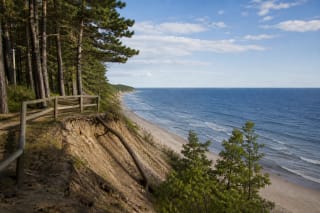
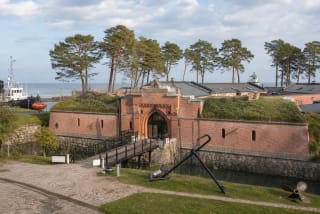
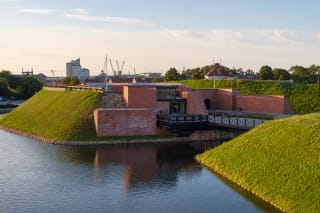
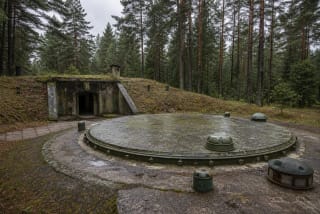
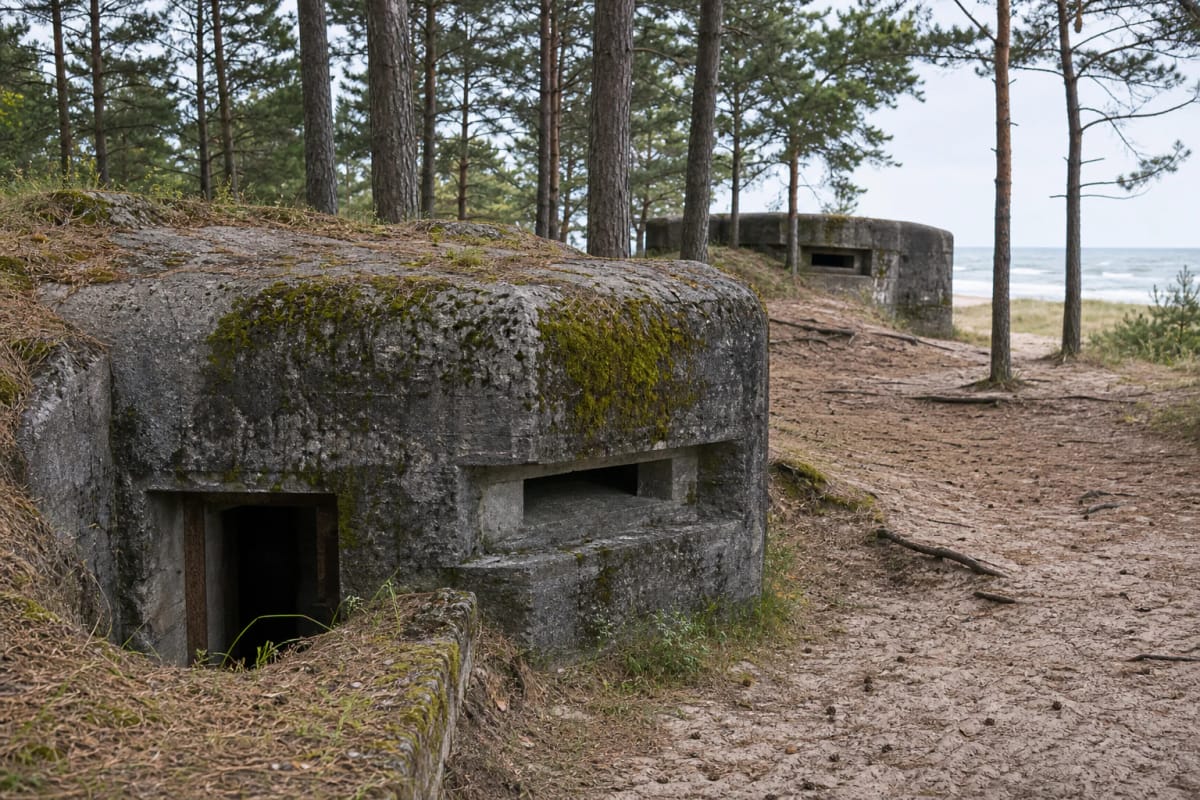
Memel Nord is one of those places where history is not concentrated in a display case. It is visible in the landscape itself: seaside pine forest, sand, concrete bunkers, firing openings, and the Baltic Sea heard nearby. The Kukuliškiai battery makes it possible to see very concretely how twentieth-century military infrastructure was built into the Lithuanian coast.
Klaipėda District Municipality stresses that these are the only fortifications of this type in Lithuania. The place is not only for military-history enthusiasts: it explains why the 1939 annexation of the Klaipėda Region by Germany had rapid military consequences and how the coast was prepared against possible attack from sea and air.
Why the battery appeared in 1939
Memel Nord is linked with 1939, when the Klaipėda Region was annexed by Germany. After this political rupture, a military defence system began to be built on the coast to protect Klaipėda port and the shoreline from a possible attack from the sea.
The location was chosen deliberately: the Kukuliškiai and Giruliai stretch allowed control of the coastal approaches north of Klaipėda, while the bunkers were fitted into the dune and pine-forest relief. Today the visitor sees not only concrete, but also military thinking about horizon, visibility, camouflage, and access to the sea.
Memel Süd and Memel Nord
Two coastal artillery batteries were planned: Memel Süd in Smiltynė near Kopgalis, and Memel Nord beyond Giruliai at Kukuliškiai. Only the northern battery, Memel Nord, was completed.
This matters because Memel Nord is not a random single bunker. It was part of a planned coastal defence system whose southern link remained unfinished, while the northern one has become a visitable military heritage site.
Armament: four 150 mm guns
The battery consisted of two artillery blocks, each with two gun positions, with a fire-control command bunker between them. On top of the protective dune ridge stood four 150 mm guns (15 cm SK L/45 type), intended to fire at sea targets at distances of roughly up to 17 km.
These numbers explain the battery's purpose: this was not a symbolic structure, but a real coastal-defence node able to cover a wide sea sector in front of Klaipėda port. The different bunker chambers, openings, and concrete forms speak of observation, protection, communications, ammunition, and combat readiness.
From coastal defence to anti-aircraft function
The battery was first intended as anti-ship coastal artillery. After Germany secured control of the Baltic coast and some equipment was moved to Norway, Memel Nord was adapted for anti-aircraft defence. This reflects the course of the war: coastal objects had to respond not only to ships, but also to the increasingly important danger from the air.
On site, look at the bunkers not as one generic structure but as a system whose function changed. Even if exhibition details change, the infrastructure itself remains the main source for understanding how the coastal battery worked.
After the war and the creation of the museum
After World War II, places like this often had no clear purpose: some rooms were abandoned, damaged, or covered by sand. Memel Nord's revival began in the twenty-first century, when enthusiasts began cleaning the bunkers and collecting exhibition material around 2002.
According to Klaipėda District Municipality, a museum was set up in the northern block in 2009, and in 2018, after members of the Border Club cleaned parts of the southern bunker, a second exhibition was opened. The site is therefore also an example of heritage preservation: without local initiative, the concrete structures would have remained only fading traces of war.
How to visit Memel Nord
Memel Nord is in Kukuliškiai, Klaipėda District, on the coastal stretch between Giruliai and Karklė. Plan it as a short but substantial stop: see the bunkers, read the exhibition information, then continue toward Olando Kepurė or the seaside trail. Check tours and opening times in advance.
The bunkers are real military structures, so wear comfortable shoes, watch children near stairs, openings, and uneven surfaces, and do not rush in wet or cold weather. Read the bunker as part of the relief: low, hidden, grown into sand and pines, and at first glance smaller than its real military function.