- Place
- Klaipėda District Municipality
- Region
- Lithuania Minor
- Type
- nineteenth-century navigation canal with Lankupiai lock
- Address
- Lankupiai-Klaipėda, Klaipėda District (Lankupiai lock)
- Coordinates
- 55.55300, 21.30100
Klaipėda Canal, Wilhelm Canal
King Wilhelm Canal: a water route around the lagoon
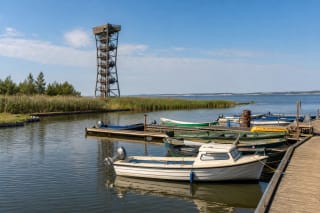
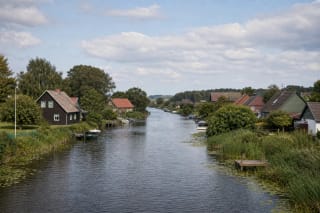
King Wilhelm Canal, also called the Klaipėda Canal, is a historic water route in Klaipėda District that once connected the Minija with the Curonian Lagoon and Klaipėda. It is 24 km long, 22-30 m wide, and 2.3-3.6 m deep. The canal begins at Lankupiai, about 18 km from the mouth of the Minija, and runs northwest to the southern edge of Klaipėda.
Its purpose was practical: to provide a safe route for vessels and timber rafts travelling from the Nemunas to Klaipėda during storms, bypassing the dangerous, shallow Curonian Lagoon. It clearly shows how nineteenth-century engineering solved navigation problems in Lithuania Minor.
Dug in 1863-1873
The canal was dug in 1863-1873 and named after King Wilhelm I of Prussia. It was ceremonially opened on 17 September 1873. Construction was initiated by Klaipėda merchant Gubba, directed by Degner and Mohr, and mostly financed by Klaipėda timber merchants, who contributed more than 1 million silver thalers. In the final years about 690 French prisoners of war from the Franco-Prussian War of 1870-1871 were sent to the works and dug the northern section from Stariškė to the lagoon. The canal was later deepened and widened.
To prevent waves from passing vessels from damaging the banks, boats were allowed to travel no faster than 5 km/h. The journey therefore took 8-9 hours, twice as long as crossing the lagoon directly, so the canal was used only in heavy lagoon waves.
Lankupiai lock: an engineering monument
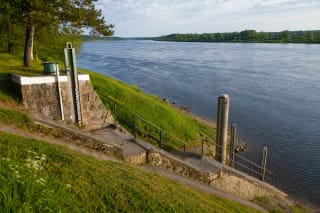
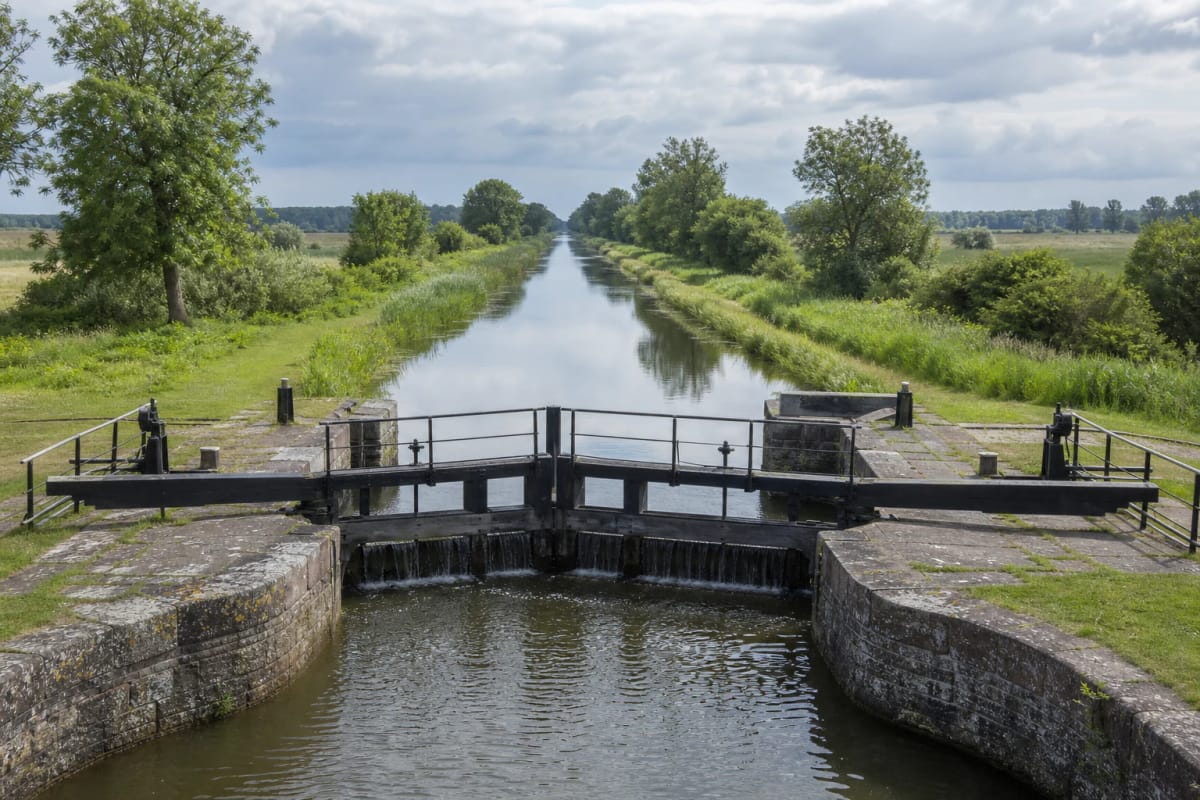
At the beginning of the canal in Lankupiai stands a 157 m long lock with 11 m wide swing gates. Moving a vessel through the lock took about 45 minutes; when water levels were low, both gates were opened and no level change was needed.
Lankupiai lock is considered the only lock in Lithuania declared an engineering monument. It is the main visiting accent of the canal and the best place to understand how the whole system worked.
Bridges, stations, and the protected complex
Bridges over the canal had a movable central section so ships' masts could pass. Several stations were established to monitor water-level fluctuations: at Lankupiai in 1871, Dreverna in 1870, and Smeltė, a part of Klaipėda, in 1875.
The Cultural Heritage Register protects the national-significance King Wilhelm Canal building complex, entered in 2001. It consists of six objects: Lankupiai lock, Jokšai and Kairiai bridges, and the lock master's homestead house, farm building, and cowshed. Of the ten movable bridges once built, only two with metal structures survive; several were destroyed during World War II. The canal is therefore best understood not as a ditch, but as an integrated heritage object.
The canal after World War I
After World War I, King Wilhelm Canal was no longer used for navigation. The former water route began to feed one of Klaipėda's water-supply sites, so the canal was separated from the Curonian Lagoon by an earth embankment to keep seawater out.
Today the canal matters as a landscape and heritage object: its quiet watercourse suits bicycle or water routes, and its history recalls the flourishing of port and navigation life in Lithuania Minor.
How to visit King Wilhelm Canal
The most convenient starting point is Lankupiai lock, the canal's main object. The surroundings can be seen in 1-2 hours, while a longer visit works well by bicycle or boat along the canal.
The best season is spring to autumn. The canal combines well with Dreverna harbour, Mingė village, and other Pamarys and Klaipėda Region sites.