- Place
- Kaunas City Municipality
- Region
- Kaunas
- Type
- Gothic convent church
- Address
- 8 Benediktinių Street, Kaunas
- Coordinates
- 54.89924, 23.89356
- Visit duration
- 30-50 minutes if the church is open
- Best time
- daylight or before a published service, while respecting convent quiet
Kaunas Benedictine Church
A fifteenth-century sanctuary beyond the town core
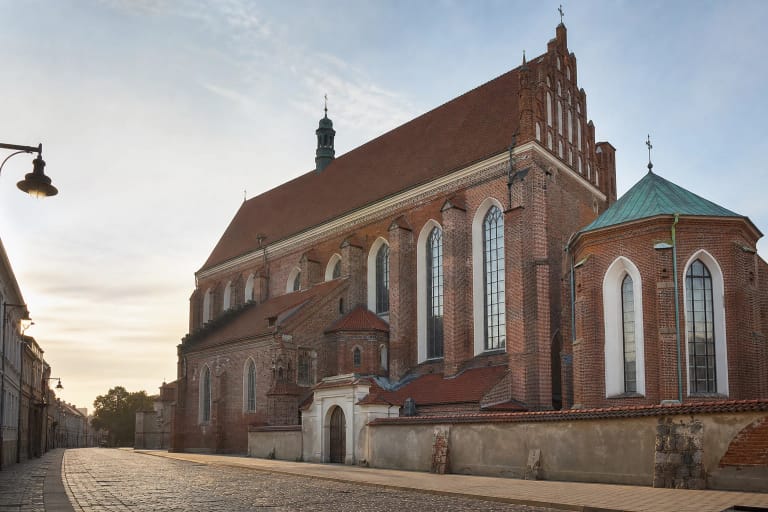
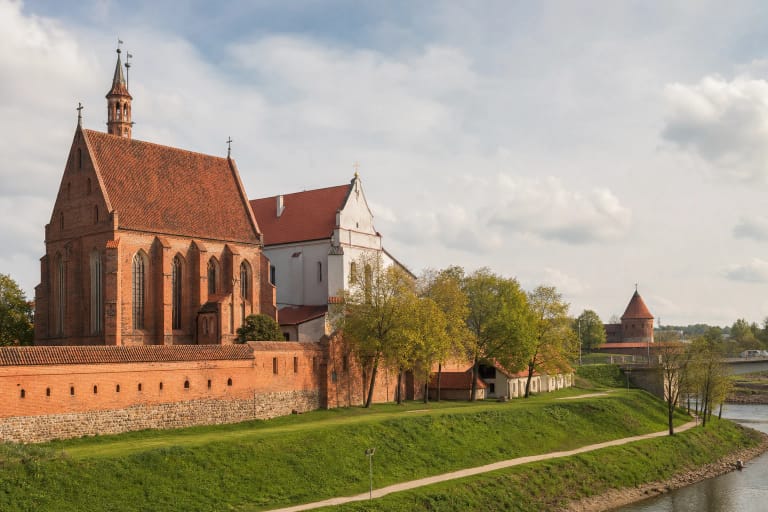
The founder and exact date are unknown, but masonry and architectural forms place the church in the later 15th century. It stood on Antakalnis hill beyond the planned medieval town, and the earliest known written reference dates from 1493.
Pope Alexander VI granted indulgences for several saints' feast days in 1495, and King Alexander gave the church to the parish church of Kaunas in 1503. Because St Nicholas was a patron of merchants, AUTC researchers also connect this sanctuary with the commercial life of the medieval city.
An original Gothic plan and a sequence of vaults
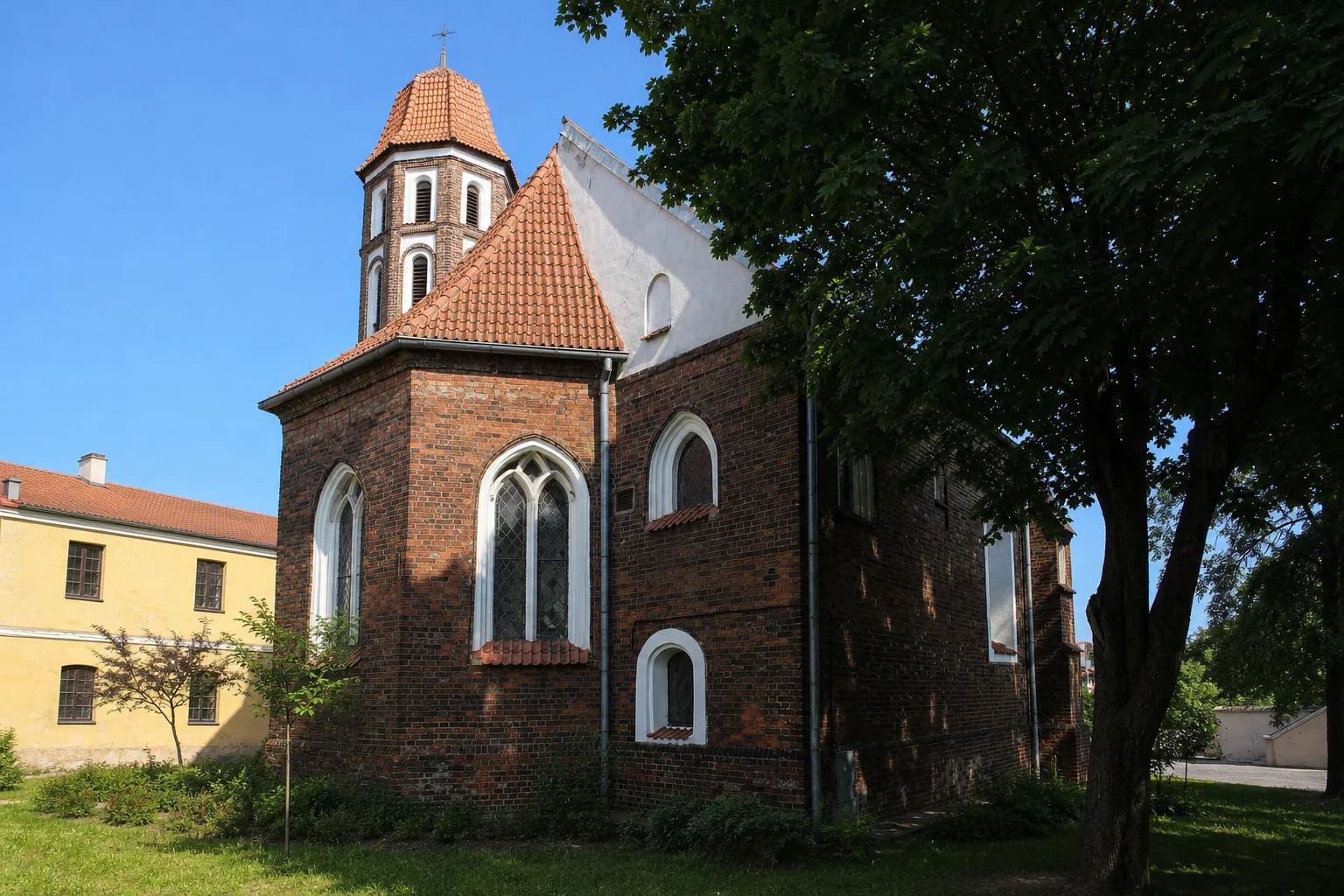
The small single-nave church ends in a three-sided sanctuary whose axis shifts markedly south. The Benedictine account describes this asymmetric Gothic plan as without parallel among other churches in the former Grand Duchy of Lithuania.
Each part has a different vault: a net vault with a six-point star in the sanctuary, an early crystal vault in the sacristy, a stellar vault in the chapel beneath the tower, and a cross vault in the 19th-century organ loft. Outside, the easiest feature to recognise is the octagonal turret with its bell-shaped cap.
The Benedictine convent begins
Through the efforts of Andriejus Skorulskis, a 1621 privilege of King Sigismund III Vasa transferred the church to Benedictine sisters invited from Nesvizh. The founder's daughter Ona Eufemija Skorulskytė became the first abbess, and the church was adapted to convent liturgy.
Baroque altars were installed after the sisters arrived. A churchyard wall followed in the 18th century, while the 19th century added a western organ-loft extension and a two-storey southern gallery linking the church to the new masonry convent.
Liudas Truikys's 1938 interior
The most important 20th-century reconstruction was undertaken in 1938 through the efforts of Blessed Bishop Teofilius Matulionis in preparation for perpetual adoration of the Blessed Sacrament. Parquet flooring, heating, a new high altar, and stained glass in the sanctuary windows date from that campaign.
Stage designer Liudas Truikys created the scheme. His sanctuary composition and the blue light passing through its stained glass form a striking dialogue with the Gothic space; the church also displays a number of recovered paintings dating from the 17th to 19th centuries.
Closure, return, and archaeology
The Soviet authorities closed the church on 2 October 1948 and transferred it to the Republican Library; from 1963 to 1990 it served as a book depository for Kaunas Public Library. Returned to believers in 1990, it was reconsecrated by Cardinal Vincentas Sladkevičius on 22 March 1992 and entrusted to the Kaunas Benedictine convent in 2009.
AUTC's research records a cemetery around the church. Investigators near Benediktinių Street found a cultural layer up to 1.8 metres deep, traces of disturbed grave pits, and displaced human remains, making the buried fabric as sensitive as the visible architecture.
Visiting a living convent church
This is an active convent church, not a conventional museum. On 22 July 2026 the official schedule listed Mass at 18:00 on weekdays, 08:00 on Saturdays, and 10:00 and 18:00 on Sundays; the Sunday evening Mass is omitted in summer. Adoration was generally listed daily from 09:00 to 18:00, with Monday and Sunday exceptions.
Schedules can change, so confirm them officially before travelling. Speak quietly, do not photograph worshippers without permission, and avoid disturbing prayer. If the doors are closed, view the ensemble from Benediktinių Street. There is no standard museum admission fee.