- Place
- Kaunas City Municipality
- Region
- Kaunas
- Type
- historic presidential palace, statehood museum, and historicist architecture monument
- Address
- Vilniaus g. 33, Kaunas
- Coordinates
- 54.89757, 23.89734
Istorinė Prezidentūra Kaune, Presidential Palace in Kaunas, Historic Lithuanian Presidential Palace, Historical Presidential Palace in Kaunas
Head of state palace in Kaunas Old Town
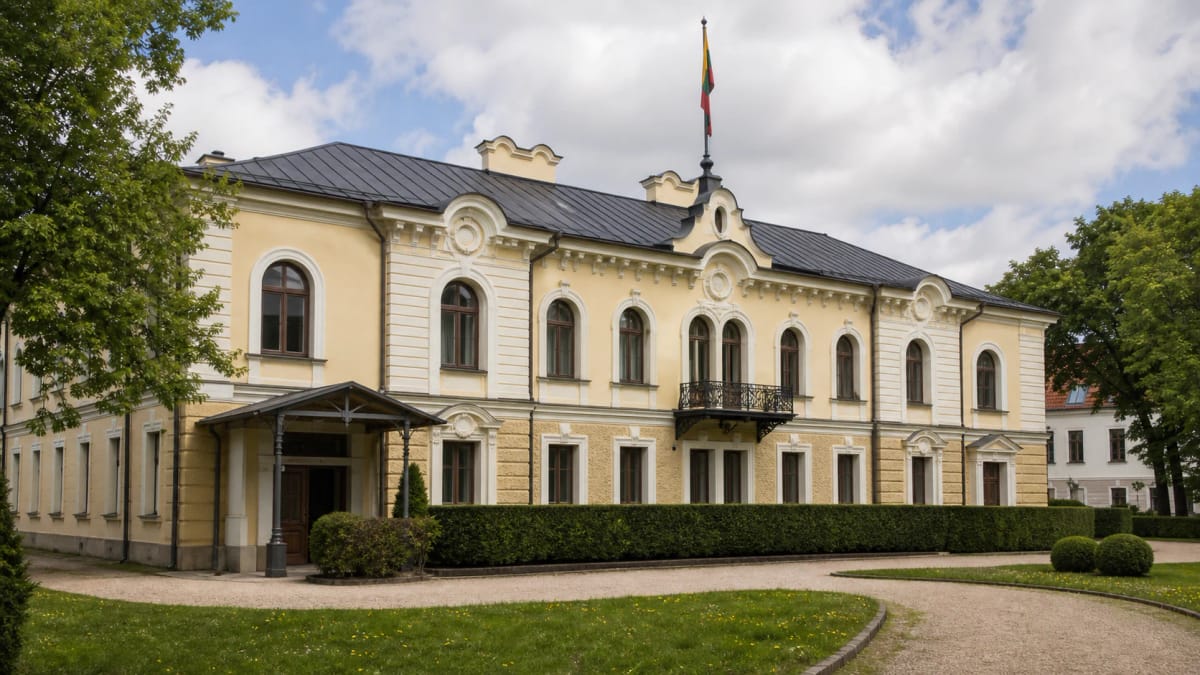
The Historical Presidential Palace in Kaunas stands at Vilniaus g. 33, on the threshold between the Old Town and Naujamiestis. Today it is a museum, but in 1919-1940 the building was the most important working and ceremonial place of the head of state in the temporary capital.
The Cultural Heritage Register entries protect not only the palace but also the wider building complex. The Presidential Palace register code is 16588, and the complex code is 25778. Visit this place not just as a handsome historicist building, but as the physical memory of the Lithuanian presidential institution.
A nineteenth-century house before the presidency
Although the strongest meaning of the site comes from the interwar period, the building itself is older. Research and the museum narrative link the palace history with the 1844-1846 plot of the former Dominican monastery garden and a two-storey house whose project author is given as F. Vinteris.
The house was later expanded, changed owners, and in the second half of the nineteenth century became the governor's residence. Around 1876-1877 it was acquired and reconstructed by imperial administration, so the presidential period overlays an earlier history of governors, city life, and imperial power.
September 1919: Smetona moves in
The official palace page states that when Kaunas became Lithuania's temporary capital, a temporary residence was sought for President Antanas Smetona. The former governor's palace suited the function, but was not immediately free because German civil authority commissioner Ludwig Zimmerle lived there.
In September 1919, the presidential flag with the Vytis on a red field was raised on the roof, and Antanas Smetona, the first president of the independent Lithuanian state, moved into the building. From that moment this historicist palace became the workplace of the head of state.
Three presidents in one palace
The official museum emphasizes that until the Soviet occupation on June 15, 1940, all three Lithuanian presidents of the period resided here: Antanas Smetona, Aleksandras Stulginskis, and Kazys Grinius.
That makes the palace a highly concentrated political-history site. It contains different stages of the Lithuanian Republic: Smetona's first term and authoritarian period, Stulginskis's parliamentary-republic years, Grinius's short presidency in 1926, and the everyday functioning of state institutions between these turning points.
What the presidential palace did
The palace included ceremonial and working rooms and private apartments for the president's family. The official page mentions a separate entrance to the family apartment from the rear of the building, telephone connection, salons for official receptions, the president's study, dining room, gift room-museum, and a nurse's room.
In the Great Salon foreign diplomats presented credentials, and during state holidays the exterior was illuminated and decorated with state symbols. The current museum therefore speaks not only about presidential biographies, but also protocol, representation, diplomacy, and the everyday infrastructure of power.
The garden as a political stage
In front of the palace, on the Vilniaus Street side, the ceremonial garden remains. The official museum states that in the interwar period, large processions gathered here during state holidays to greet the president, who greeted them from the balcony.
Behind the palace, on the side of present-day Šv. Gertrūdos Street, there was once a smaller garden with tennis courts and a greenhouse. It has not survived, but the detail helps explain that the Presidential Palace was not only an administrative office: it was a closed, protected, and at the same time publicly visible space of the head of state.
The June 1940 boundary
The palace remained the presidential residence until the Soviet occupation on June 15, 1940. For that reason the site is especially strongly connected with the political tension of June 14-15, 1940, when the USSR ultimatum and the fate of the Lithuanian state were debated.
A visit to the Presidential Palace lets that date be seen not abstractly, but in the rooms where the daily work of the head of state usually took place. This is one reason the museum is not just a nicely restored house: it preserves the atmosphere of state decision-making.
Soviet period and the museum's emergence
The official museum history states that the idea of a museum here emerged around 1990, when the former presidential residence, which had become a Palace of Pioneers and later Teachers' House during the Soviet period, was handed over to Vytautas the Great War Museum.
After prolonged reconstruction, from 2004 the palace came under the Office of the President of the Republic of Lithuania. On July 3, 2005 President Valdas Adamkus officially transferred it to the National M. K. Čiurlionis Museum of Art, and on July 5, 2005 the Historical Presidential Palace opened to the public.
What to see in the museum
In the museum, look for several layers: the history of the presidential institution, recreated interwar ceremonial rooms, presidential biographies, symbols of statehood, and temporary exhibitions. The official visitor page states that the exhibition is presented in Lithuanian and English, making it suitable for international guests.
The museum also functions as a place of civic education. That is important because the palace is not only about protocol in the past; it opens conversations about democracy, authoritarianism, occupation, state continuity, and civic initiatives.
Practical visiting
At the time of source preparation, the official visitor page listed opening hours as Tuesday, Wednesday, and Friday 10:00-17:00; Thursday 10:00-19:00; Saturday and Sunday 11:00-16:00; closed Monday. It also listed an adult ticket at 5 EUR and an English-language guided tour at 25 EUR. Check current information before going.
The getting-here page states that museum visitors may park free of charge in the Presidential Palace courtyard, entering from Šv. Gertrūdos Street, or use spaces along Šv. Gertrūdos Street. The Vilniaus Street entrance is for pedestrians.