- Place
- Karklė, Klaipėda District Municipality
- Region
- Seaside Regional Park
- Type
- old seaside cemetery and memorial site
- Address
- Karklė village, Kretingalė eldership, Klaipėda District
- Coordinates
- 55.80736, 21.06676
Karklė village first old cemetery complex, Karklė village first old cemetery, Liepų Cemetery, Skenduolių (Drowned People's) Cemetery, Plociai, Noimanai, Dičmonai, and Bertulaičiai Cemetery
A cemetery on a sea-coast dune
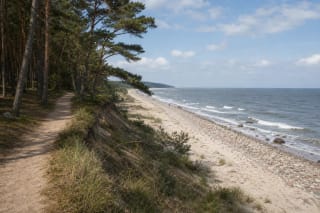
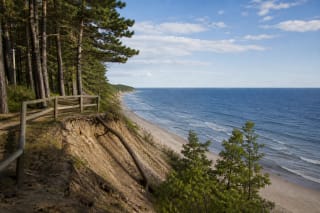
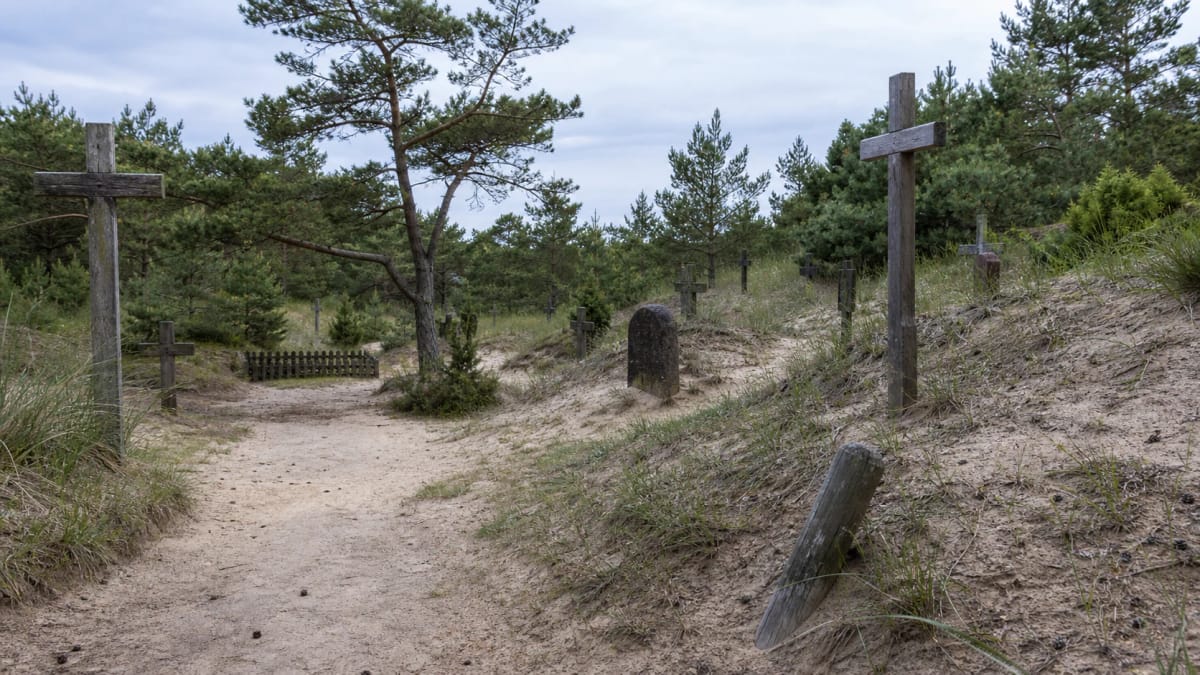
Karklė Ethnographic Cemetery is a small but powerful place of coastal memory in the Seaside Regional Park, north of Klaipėda. The Cultural Heritage Register describes it as the first old cemetery complex of Karklė village (code 35607), set on a natural sand dune right by the Baltic Sea; the complex also includes the first old cemetery itself (code 35608), both protected as objects of regional significance.
The site stands out because the cemetery lies directly on the seashore - it is regarded as the only cemetery in Lithuania on the sea coast. Its early use is linked with the burial of people drowned at sea, which is why it is also called the Skenduolių (Drowned People's) Cemetery; about 200 people are buried here, and the surviving graves date from the nineteenth century.
Liepų Cemetery and Karklininkai memory
The cemetery is dated to the late eighteenth to early twentieth century. It was called Liepų Cemetery and is also associated with the names of the Plociai, Noimanai, Dičmonai, and Bertulaičiai families, so the place matters not only as an official protected site but as the memory of local families and a coastal village. At the beginning of the twentieth century, residents of Karklininkai - today's Karklė - were buried here.
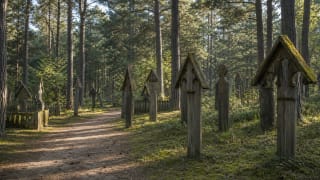
The surviving gravestones are of stone, iron, and wood - plainer than the vivid krikštai of the Curonian Spit, yet belonging to the same Protestant burial world of the Klaipėda region and Lithuania Minor. The cemetery's cultural significance is broadened by the fact that, by the terms of his will, the avant-garde poet and yachtsman Salys Šemerys (1898-1981) is buried here; in 1996 his widow was laid to rest beside him.
What to notice on site
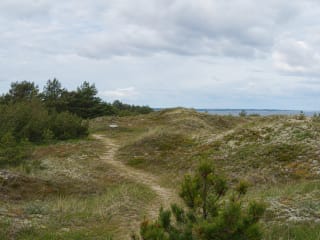
There is no large memorial or museum display here. The important things are the relief, the cemetery's orientation, and its relationship with the sea: graves are laid out east-west, while the shifting dune slope constantly reminds visitors that coastal heritage is fragile and worn away by wind and waves.
It is worth pausing more quietly here than on an ordinary seaside path. Modest crosses, sand, pines, and wind make Karklė legible as a former fishing and coastal-community village, not only as a summer leisure place.
Visiting the cemetery respectfully
The cemetery is a working memorial space with limited burials, so there is no ticket or standard opening time. Visit in daylight, stay on existing paths, and avoid climbing onto the eroding dune slope, which is also a protected natural feature here.
This is not a decorative photography backdrop. Avoid noise, do not step on graves, and do not move stones or grave markers. If you combine the cemetery with Karklė seaside or Olando Kepurė, it works best as the quieter part of the route.