- Place
- Kalvarija, Kalvarija Municipality
- Region
- Suvalkija
- Type
- municipal regional museum in a restored former tavern and a state-protected three-building posting-station ensemble
- Address
- 45B Dariaus ir Girėno Street, Kalvarija
- Coordinates
- 54.41831, 23.22793
- Visit duration
- 1-1.5 hours for the museum and all three exteriors; longer with a guided visit or education session
- Best time
- a Tuesday-Friday morning or a warm-season Saturday, after rechecking the opening hours
Kalvarijos krašto muziejus / Informacijos centras, Kalvarija Posting Station Complex, Kalvarija Horse Post Station, Former Kalvarija Horse Post Station
The museum occupies the former tavern, not all three buildings
The visitor-facing Kalvarija Regional Museum and Information Centre is at 45B Dariaus ir Girėno Street. It is a unit of Kalvarija Municipal Public Library, not an independent institution with three museum buildings. The official museum page's map link resolves to 54.4183068, 23.2279271 within the site, so the map pin is classified as a site point rather than an unverified doorway or vehicle entrance.
The Cultural Property Register calls the whole heritage asset the Kalvarija Posting Station Building Complex, code 15976. Its components are the horse-changing building, code 23563, the post building, code 23564, and the tavern building, code 23565. The museum is specifically inside the restored tavern. The post and horse-changing buildings complete the protected ensemble, but they are not extra museum galleries.
Kalvarija Municipality led the tavern restoration project, and the building's key was symbolically handed to the municipality when it opened in 2019. The municipal library now runs the museum. Official visitor pages advertise no access to the interiors of the other two buildings, while property and planning records indicate separately used premises within the complex. View those buildings from the courtyard and do not enter unmarked spaces.
The Saint Petersburg-Warsaw postal route shaped the ensemble in 1829
Kalvarija Municipality's town history dates the Saint Petersburg-Warsaw road through Kalvarija to 1820-1829 and the posting-station complex beside it to 1829. The Register also dates the ensemble to 1829 and attributes it to architect Vaclovas Ritšelis, or Wacław Ritschel (1794-1872). The route placed Kalvarija within an imperial network carrying post, officials, and other travellers.
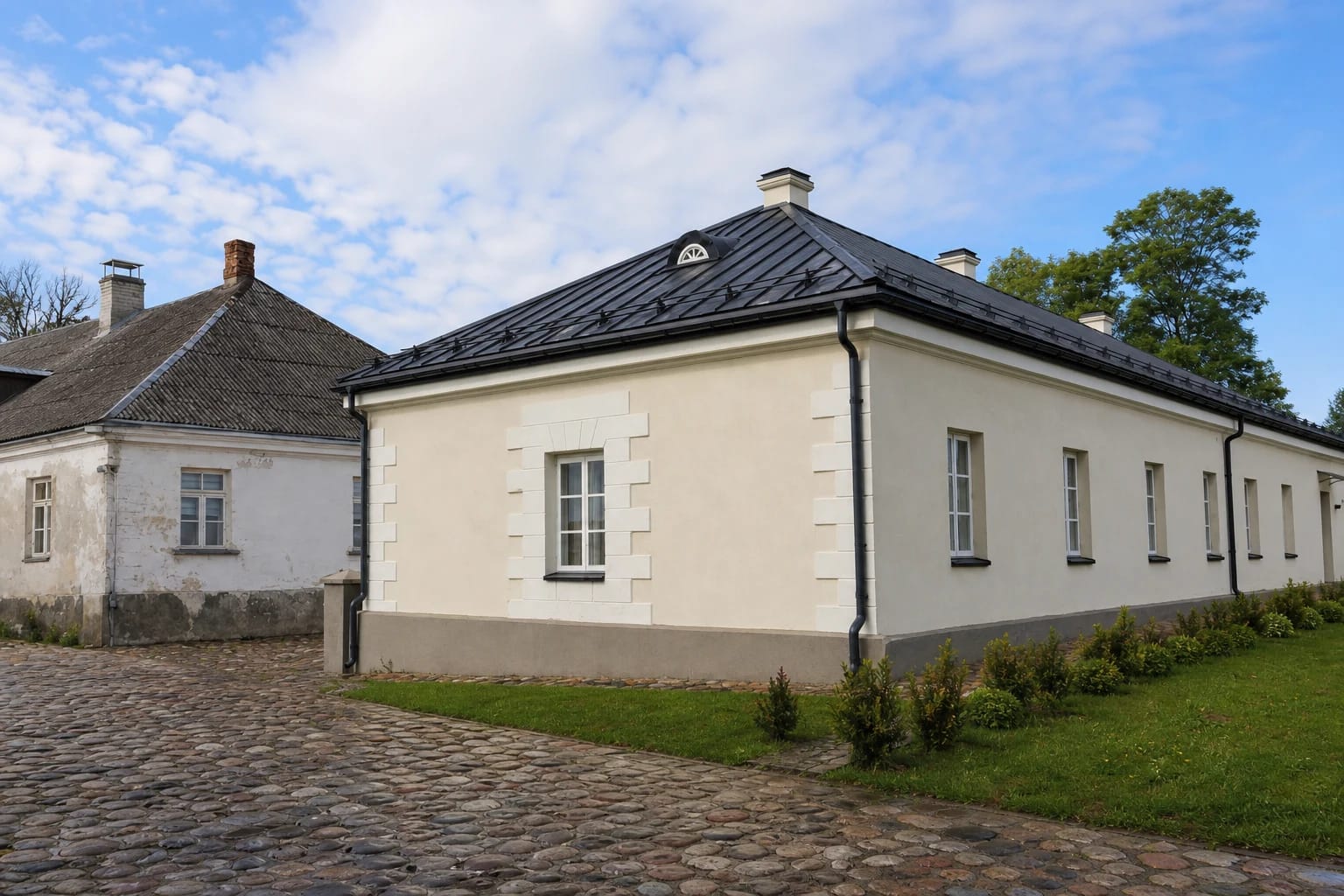
The heritage value lies in more than three facades. The Register protects the symmetrical placement of three single-storey buildings around an inner courtyard, the carriageway alignment, and its type of paving. Paired gates once closed both ends of the ensemble and have not survived, but the cobbled drive still makes the original circulation legible.
The architecture is restrained: rectangular one-storey volumes, hipped roofs, plastered facades, moulded cornices, and limited rustication. The restored tavern stands out through its clean pale plaster and dark metal roof; later alterations remain more visible on its companions. LIMIS describes Kalvarija as one of only two surviving Classicist horse-post complexes in Lithuania, making the courtyard composition as important as the museum facade.
The dates 1829, 1963, and 2019 refer to different layers of history
The station buildings date from 1829. The present visitor venue opened on 25 January 2019, after the former tavern had been restored for Kalvarija Regional Museum and Information Centre. The library's own 2024 activity report likewise says that this present unit has operated since 2019.
LIMIS and Kalvarija Municipality's 2025-2035 strategic plan, however, give 1963 as the museum's founding year. The municipal town chronicle records a museum opened in Kalvarija Secondary School that year, while the strategy separately lists a Kalvarija ethnographic museum still based at the school. The official publications do not fully reconcile that institutional continuity. The careful formulation is therefore that Kalvarija's museum tradition is traced to 1963, while the current library unit in the restored tavern dates from 2019.
The address discrepancy is documentary rather than architectural. Annexes to the 2015 Register act recorded the horse-changing, post, and tavern buildings at numbers 45, 47, and 49 respectively. Newer municipal planning papers use 45, 45A, and 45B on the same site, and the museum's public address is 45B. There is no fourth historic building hidden in the numbering: navigate to 45B and expect to encounter 49 only in older heritage records.
Local history, a three-language audio guide, and the wider courtyard are the priorities
The museum collects, preserves, and presents material on Kalvarija and its surroundings, records contemporary local life, and runs education projects. The municipal restoration project envisaged displays of geological and archaeological finds, objects from different historical periods, plans, maps, photographs, and ethnographic tools. It also set aside part of the narrative for the Jewish, Polish, German, and Tatar communities of Kalvarija. Temporary exhibitions and events change, so check the current programme before travelling.
The library's 2025 activity report counted 3,250 registered objects in the museum collection at year end. It also confirms a popular tablet-based audio guide in Lithuanian, Polish, and English, followed by a knowledge quiz. That makes an independent visit practical, although a particular device and language should still be confirmed on arrival or by phone.
A coherent visit starts inside the museum, continues around the restored tavern and cobbled courtyard, and then compares the other two buildings from outside. Allow 1-1.5 hours. From here, walk on to the Kalvarija Synagogue Complex and the Church of the Name of the Blessed Virgin Mary to connect the postal route with the town's broader, multicultural history.
Verified 2026 hours, tickets, and details that still require confirmation
On 19 July 2026, the permanent official page listed Tuesday-Friday hours of 10 am-5 pm, with a lunch break from noon to 1 pm. Saturday hours were 9 am-1 pm. The permanent page still placed the Saturday season between 1 April and 30 September, but a newer library notice dated 20 April 2026 extended it through 31 October. No Monday or Sunday hours were listed. Because the two official pages differ by one month, check again before travelling.
The official fees page on the same date listed adult admission at €1 and a €0.50 ticket for pensioners, disabled visitors, school pupils, and students. A one-hour museum tour cost €5 for a group of up to 15 and €10 for 16 or more. Education and special programmes were €1 per participant plus the cost of materials. Municipal fees can change, so confirm group arrangements and the final charge in advance.
The official visitor page does not provide a complete statement on step-free access throughout the building, an adapted toilet, animals, or personal photography. For particular access needs and audio-guide availability, call the published museum number, +370 685 85090. Viewing the courtyard does not replace a museum ticket, and museum opening hours do not imply permission to enter the other two historic buildings.