- Place
- Kaunas City Municipality
- Region
- Kaunas
- Type
- site of the former Central Jewish Bank and passage, now the zoological museum
- Address
- Laisvės al. 106, Kaunas
- Coordinates
- 54.89830, 23.90395
Central Jewish Bank, Former Jewish Bank, House in Kaunas at Laisvės al. 106, Former Jewish Bank, now Zoological Museum, Kaunas Tadas Ivanauskas Zoological Museum building site
A place where you have to see the lost passage
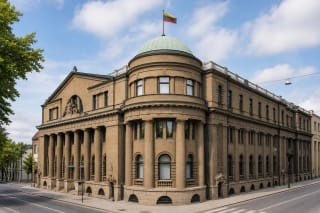
The Jewish Bank in Kaunas is a different kind of landmark from most surviving Kaunas modernist buildings. At Laisvės al. 106 today stands the Kaunas Tadas Ivanauskas Zoological Museum, while the historic Central Jewish Bank passage is essentially lost and replaced by the museum reconstruction.
For that reason the site needs to be visited with two layers in mind. Today's public access is to the zoological museum, while the interwar bank value lies in sources, plans, archival photographs, and the former-building site protected in KVR. It is not a restored decoration, but a point of urban memory.
The Central Jewish Bank
AUTC states that permission to build the Central Jewish Bank was issued in 1924. The bank was one of the larger financial institutions of the time, with a developed network of offices across the country. This matters because the building was not a local shop, but the centre of a wider Jewish economic self-organization.
Before it, a single-storey wooden house stood on the site, which the Kaunas city Construction Commission considered outdated and dangerous in terms of fire safety. The new building was one of the most ambitious commercial projects of early interwar Kaunas.
Architects and dates
AUTC dates the object to 1924-1925 and names two authors: Grigorijus Mazelis and Mikas Grodzenskis. The KVR Naujamiestis entry repeats the same date and authorship for the former Jewish Bank site: built in 1924-1925 to a design by architects Mazelis and Grodzenskis.
AUTC also mentions a hypothesis by interwar architecture researcher Jolita Kančienė that changes from the design may be connected with Feliksas Vizbaras, then a city technician who carried out technical construction supervision. The main designers remain Mazelis and Grodzenskis, while Vizbaras belongs to the context of possible changes.
Why it was a passage
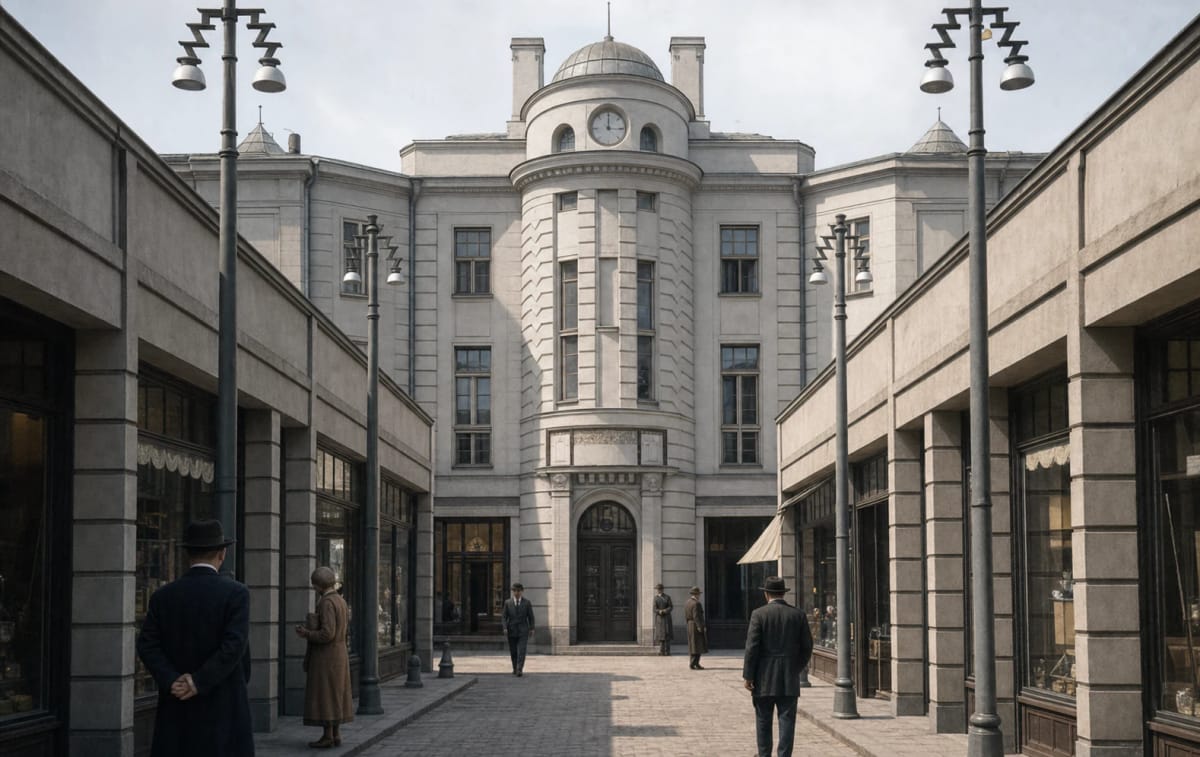
The long narrow plot meant the object was understood as a passage. AUTC writes that the main building stood deep in the plot, while an urban space was created on Laisvės aleja, connecting the main street with a pedestrian public courtyard.
This was a rare solution in Kaunas. AUTC emphasizes that unlike many major European cities, the temporary capital had almost no shopping passages. The Jewish Bank offered not only a facade to Laisvės aleja, but an inner urban space with movement, display windows, and commercial programme.
More than a bank
AUTC describes the complex as a multifunctional urban public centre. Its main purpose was the bank, but rows of shops stretched on both sides of the narrow passage, a cafe operated there, and an open-air summer cinema was installed on the second floor.
This mix of functions is very interwar: financial institution, commerce, cafe, and cinema entertainment in one place. It shows Laisvės aleja not only as a promenade, but as an intense layer of everyday urban life, business, and leisure.
Architectural language
AUTC describes the style as historicism with Art Deco elements. At first glance the building relied on simplified neoclassical forms common to commercial institutions, but more playful 1930s decoration appeared in the details.
The most important elements to reconstruct in the visitor's imagination are the zigzag-shaped outdoor lamps, stepped dome of the central staircase, decorative details, rhythmic shop facades of the passage, and the narrow movement corridor into the inner courtyard. The urban solution was even more important than the main facade itself.
Criticism and today's evaluation
AUTC recalls that in the interwar period the building was not praised unanimously. Vladimiras Dubeneckis mentioned it among buildings accused of borrowed architectural ideas. This criticism helps show that the field of interwar Kaunas architecture was a space of debate, not only later heritage recognition.
From today's perspective, AUTC's evaluation is clear: it was a distinctive interwar public-use object, and the demolition of the Jewish Bank and destruction of the passage were a significant loss to Kaunas architectural heritage.
The zoological museum layer
The history page of the Kaunas Tadas Ivanauskas Zoological Museum states that in 1948 the Kaunas Zoological Museum was moved to the former bank premises at Laisvės al. 106, where it still operates. AUTC also writes that in the Soviet period the object was turned into the Zoological Museum.
The museum history page gives 1975-1982 for the building reconstruction and installation of the new exhibition. AUTC specifies that the passage was destroyed, a new museum building by architect Alfonsas Keturka was built in its place, and the doors opened in 1981. These years differ by whether the source is speaking about the opening or the whole reconstruction period.
KVR status: site, not a separate building
The Jewish Bank in Kaunas does not have a separate KVR building code in the way many other objects on this route do. KVR records it within the entry for the Kaunas city historical part called Naujamiestis. That area's code is 22149, status state protected, significance level national.
In the list of valuable features, KVR directly records the site of the Jewish Bank building at Laisvės al. No. 106 in block No. 9 (165). It also states: built in 1924-1925, designers Grigorijus Mazelis and Mikas Grodzenskis, turned into the Zoological Museum in 1948, and reconstructed in 1981. This is the most precise heritage wording for the place.
How to visit today
If you want to understand the Jewish Bank as a heritage site, stop at Laisvės al. 106 and imagine the narrow passage that connected the avenue's movement with an inner courtyard. The current museum building no longer recreates that passage experience, so it is worth keeping AUTC archival photographs and plans in mind.
If you visit the current Kaunas Tadas Ivanauskas Zoological Museum, the official opening-hours page lists the exhibition as open Tuesday-Sunday 10:00-18:00, with entry until 17:15, and closed on Mondays and some holidays. Check the museum website before travelling because opening hours are operational information.
UNESCO modernism context
The Jewish Bank site is on Laisvės aleja, in the Kaunas Naujamiestis modernist heritage environment connected with the UNESCO World Heritage property Modernist Kaunas: Architecture of Optimism, 1919-1939. The bank itself, however, is not separately inscribed as an individual UNESCO object.
The site's importance in the UNESCO context is urban and social. It reminds visitors that modernizing Kaunas was not only a city of Lithuanian state institutions, but also a multiethnic city of commerce, community finance, entertainment, and the everyday economy of Laisvės aleja.