- Place
- Šiauliai City Municipality
- Region
- Samogitia
- Type
- monumental galvanized-sheet animal sculpture and public-space landmark
- Address
- Lake Talkša waterfront, Šiauliai
- Coordinates
- 55.93111, 23.32905
- Visit duration
- 20-35 minutes for the sculpture and Lake Talkša view; 1.5-3 hours when combined with Sundial Square or Salduvė Hillfort
- Best time
- a bright, dry day for the sheet-metal texture and lake backdrop; in the evening, check whether the sculpture's lighting is operating that day
Geležinė lapė, Šiauliai Iron Fox, Metal Fox by Lake Talkša
The Iron Fox stands on Lake Talkša's south-western shore, not at Salduvė Hillfort
The Iron Fox occupies a public waterfront space on the south-western shore of Lake Talkša in Šiauliai. The city's official tourism-object map labels it Metalinė lapė, prie Talkšos ežero, meaning Metal Fox by Lake Talkša, and places it at 55.931113, 23.329052. This pin identifies the sculpture itself, not a guaranteed parking place or the start of a complete circuit around the lake.
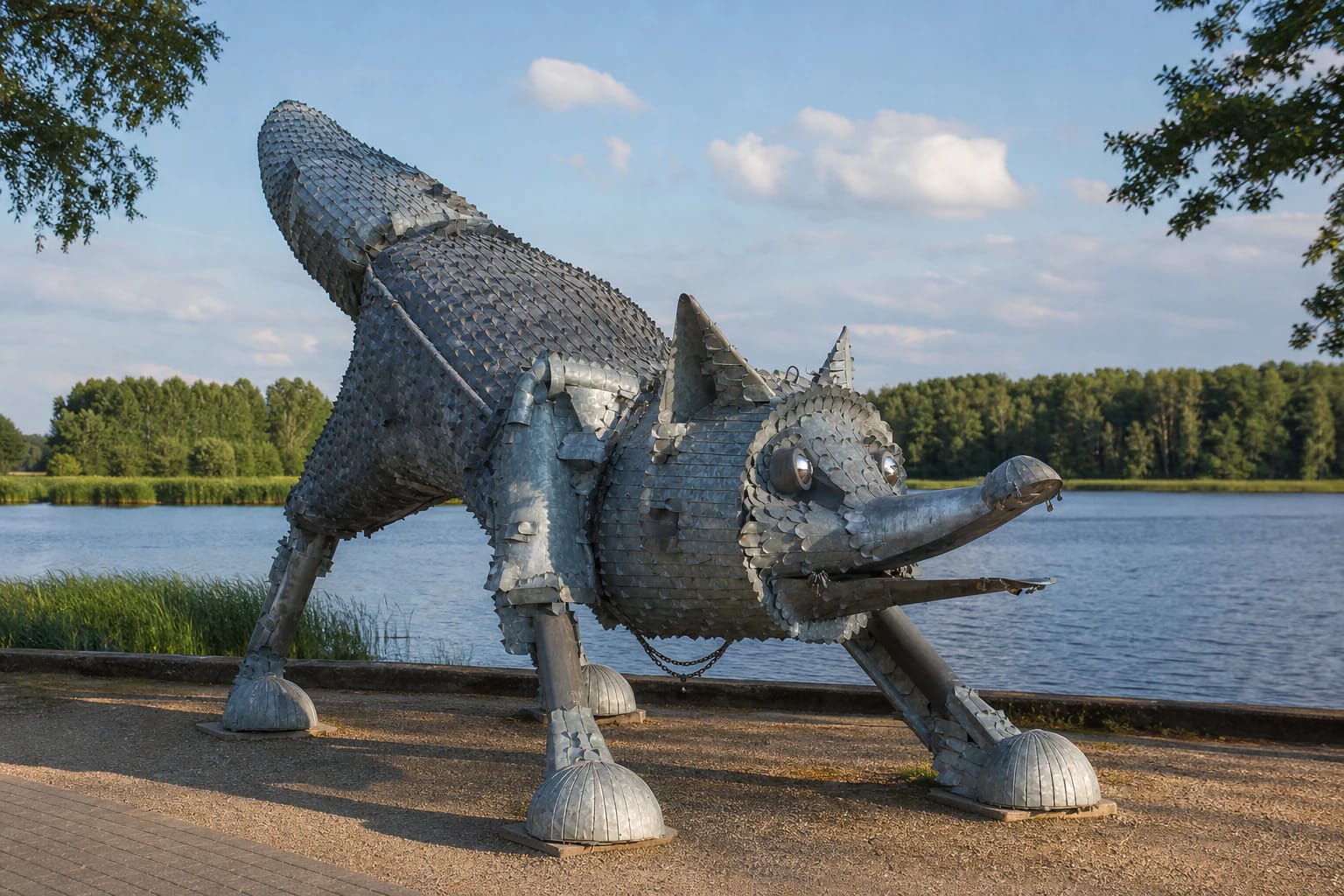
The work is unmistakable: its head hangs low, a long mouth gapes open, large round eyes project from the face, four legs spread far apart, and a huge tail rises sharply above the body. Galvanized-sheet plates create a hand-built, scale-like surface, so close viewing reveals a very different object from the silhouette seen across the lake.
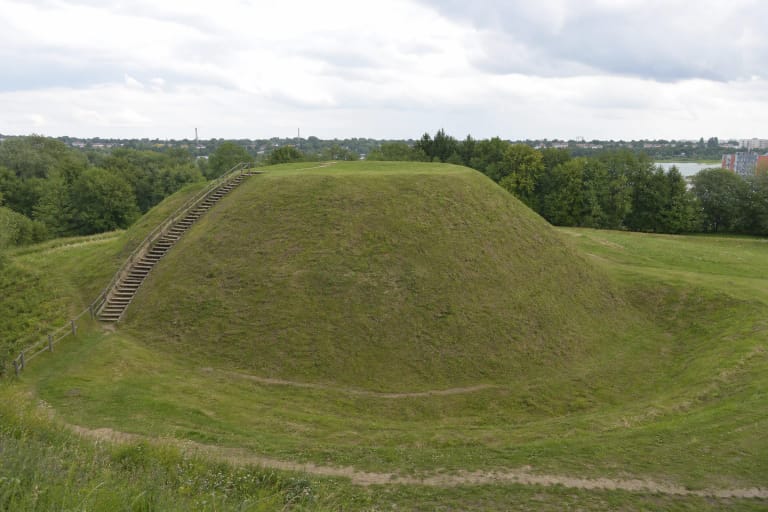
The Iron Fox is one work of public art. The Talkša ecological paths, wider waterfront recreation infrastructure, and Salduvė Hillfort roughly 2 kilometres to the east can belong to the same walk, but their histories and visitor conditions are not attributes of the sculpture itself.
Its recorded dimensions are about 15 metres long, 6.6 metres high, and 4.15 metres wide
Šiauliai municipal and Lithuanian record sources give a length of about 15 metres, a height of 6.6 metres, a width of 4.15 metres, and a mass of nearly 7 tonnes. VLE identifies it as Lithuania's largest animal sculpture recorded in the Lithuanian Book of Records. This is a national record; no reliable confirmation was found that the work holds a Guinness World Records title.
Some early reports from 2009, along with later press accounts, call the sculpture 25 metres long. They do not explain how that figure was measured, whereas the present Lithuanian record entry and municipal information use approximately 15 metres. This guide therefore treats 15 metres as the main recorded dimension and preserves 25 metres as a documented but unexplained discrepancy in the early publicity.
Iron is part of the work's name and symbolism, but VLE describes its material more precisely as galvanized sheet metal. Hundreds of overlapping pieces form the scale-like surface, while an internal metal structure and widely braced legs support the heavy body and steeply raised tail.
A factory team translated Vilius Puronas's design into a stable monumental structure
The Iron Fox was conceived by Šiauliai industrial designer, artist, and local historian Vilius Puronas. VLE places the 2009 work among his sculptural constructions in folded galvanized sheet metal. That wording matters: Puronas described himself first as a designer rather than as a sculptor working in a conventional monumental tradition.
The sculpture was fabricated at the Šiauliai company Elga, which also helped finance and transport the project. Contemporary reports name engineer Viktoras Jančenkovas, who prepared structural drawings, and metalworker Vaclovas Butkus, who welded the fox together. The widely spread legs were not merely expressive: they helped solve the stability problem posed by a large metal volume with connection points high above the ground.
In a later account of the process, Puronas said fabrication began in February 2009 and the main work was complete by mid-October. The oversized structure was transported to the waterfront at night, when it would interfere less with traffic. This collaboration between industrial fabrication and urban design explains why the fox looks like an animal assembled in the visual language of Šiauliai's metalworking industry.
Created for Lithuania's name millennium, the fox playfully answers Vilnius's Iron Wolf
The work was conceived for the millennium of the first written mention of Lithuania's name, commemorated in 2009. Puronas explained the idea through a playful dialogue with the Vilnius legend of the Iron Wolf: if the capital has a wolf, Šiauliai can have an iron fox. In the designer's account, the fox represented wisdom, resourcefulness, independence, and a refusal to be trained.
Inside the sculpture is a steel heart measuring 1.20 metres high and 0.90 metres wide. It contains a capsule with a copper plate carrying words for future generations and facts about the period in which the work was created. Visitors cannot see the heart from outside, so it operates not as decoration but as a deliberately hidden layer of time within the work.
This story is not an old Šiauliai legend. It is contemporary civic symbolism created by the artist in 2009, borrowing the Iron Wolf motif and deliberately reshaping it. The distinction matters because the Iron Fox does not tell a medieval foundation myth: it marks Lithuania's millennium and a twenty-first-century image of Šiauliai.
Sources differ by one day over the December 2009 installation
A contemporary report says the sculpture was transported to Lake Talkša late on 22 December 2009 and that commuters already saw it on the waterfront on the morning of 23 December. Tourism descriptions likewise usually give 23 December as the day the fox reached the shore. No dependable date for a separate formal unveiling ceremony was found.
The Lithuanian record entry instead gives 24 December 2009. That date may refer to the public announcement or another stage of recording rather than the overnight placement itself, so the two entries should not be merged mechanically. The most precise wording is that the fox physically appeared on the shore overnight into 23 December, while the record source lists 24 December.
In 2020, Vilius Puronas transferred the sculpture to Šiauliai City Municipality under a donation agreement, placing responsibility for its care with the city, and the municipality reported installing lighting for the Iron Fox in 2021. On 23 June 2026, four separate monumental chamotte works were unveiled on the waterfront beside it: Awakening Bull, Protecting Bear, Eye of Providence, and Princely Hat. They have changed the sculpture's immediate setting, but they are not parts of the 2009 Iron Fox.
Allow time to see the full silhouette, the sheet-metal texture, and the lake backdrop
The sculpture stands outdoors, and the municipality publishes neither museum-style opening hours nor an admission fee for it. Its exterior can normally be viewed free from the public waterfront, but check current city notices before travelling because events, waterfront works, weather, or temporary barriers can alter access. Lighting installed in 2021 does not amount to a guaranteed nightly schedule, so treat an illuminated evening view as a possibility rather than a promise.
Begin far enough away to fit all four legs, the long muzzle, and the highest point of the tail into one view. Then approach only as far as the path and current signs permit to inspect the overlapping plates, seams, eyes, and chain below the neck. Do not climb on the structure, place objects inside its openings, or attach locks: this is an artwork, not play equipment or a love-lock fence.
The main waterfront has pedestrian and cycle paths, but no formal audit of the full step-free route was found, and compacted gravel or uneven surfaces occur immediately around the sculpture. Allow 20-35 minutes for the fox alone. A longer route can link it with Sundial Square a few hundred metres away, the cathedral, Chaim Frenkel Villa, or a separate walk to Salduvė Hillfort.