- Place
- Šiauliai City Municipality
- Region
- Samogitia
- Type
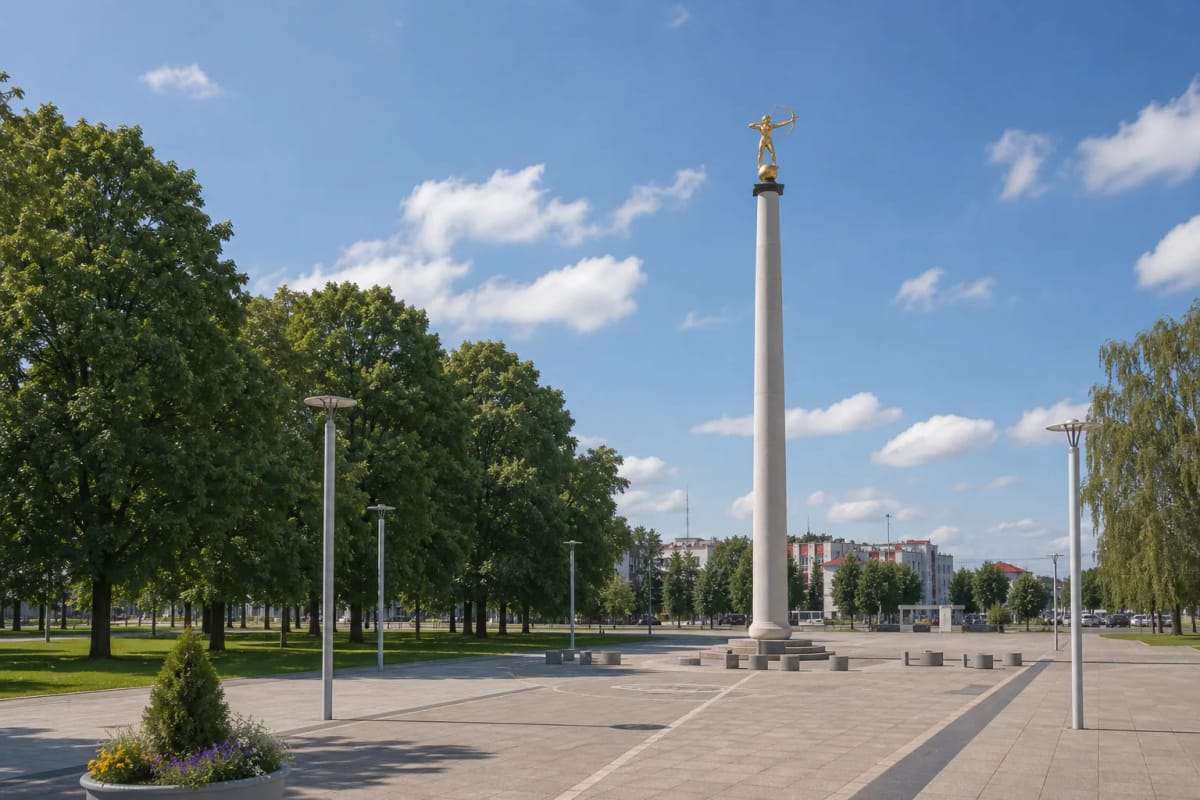
- city square with a sundial and the gilded Archer sculpture
- Address
- Ežero g. / Vilniaus g. area, Šiauliai
- Coordinates
- 55.93070, 23.32520
Archer sculpture, Sundial
Sundial Square: The Symbol of Šiauliai
Sundial Square is the main sign of Šiauliai and a popular meeting place in the centre, at the end of the pedestrian boulevard. The square was created in 1986, when the 750th anniversary of the name of Šiauliai was marked. Its composition centres on an approximately 18 m high column crowned by the gilded Archer sculpture.
The square joins three city symbols: the sun, the archer, and the flow of time. The column functions as the pointer of a large sundial, so the object is not only a monument but also a working time-measuring device, a rare example at this scale in Lithuania.
The Archer and Stanislovas Kuzma
The gilded Archer figure was created by Stanislovas Kuzma (1947-2012), one of the most important Lithuanian sculptors of the twentieth century. Visuotinė Lietuvių enciklopedija lists the Archer in Sundial Square among his major works. The sculpture shows an archer drawing a bow, linking the city's name with images of the sun and aim.
The sculpture and square are recognized as a valuable heritage place: the Archer is entered in the Cultural Heritage Register. Over time the figure has been restored and regilded so that it continues to shine above the city centre.
Sun City and the Battle of Saulė
The square's symbolism rests on Šiauliai's own history. Visuotinė Lietuvių enciklopedija states that the name Šiauliai, also Saulė, was first mentioned in 1236 in the account of the Battle of Saulė, where the Livonian Brothers of the Sword were defeated. The phonetic link between Šiauliai and Saulė, meaning sun, has long nourished the image of the city as Sun City.
This symbolism is exactly what the new square expressed in 1986: the sun as a sign of the battle and the city name, the archer as an etymological image, and the sundial as a reminder of passing time. A single monument thus brings together history, language, and civic identity.
How to Visit
Sundial Square is an open public space in the city centre, so it can be visited freely and without charge at any time. The best time is a sunny day, because only then can you see how the column's shadow falls across the square and makes the sundial work.
The square combines easily with a walk along the Vilniaus Street pedestrian boulevard, Šiauliai Cathedral, and the city museums. For a short stop and photograph, 15-30 minutes is usually enough.