- Place
- Vilnius City Municipality
- Region
- Vilnius
- Type
- Presidential Palace of the Republic of Lithuania and ceremonial square
- Address
- S. Daukanto a. 3, Vilnius
- Coordinates
- 54.68360, 25.28610
President's Palace in Vilnius, Office of the President of the Republic of Lithuania
State palace on S. Daukantas Square
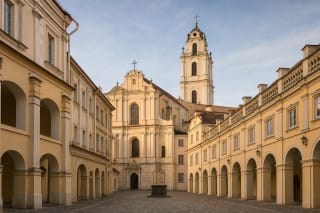
The Presidential Palace in Vilnius stands on S. Daukantas Square, one of the quieter but politically most important spaces in the old town. Here the city's scale changes abruptly: narrow university courtyards open into a ceremonial square with a state institution. The palace wings close the square on three sides and create a formal space in front of the facade.
Today the building is associated first with the institution of the President of the Republic of Lithuania, but its history is almost six centuries older than the modern state. Layers of former bishops' palace, governor-general's residence, and independent Lithuania's Ministry of Foreign Affairs make it possible to read Vilnius as a city of power, church administration, imperial structures, and restored statehood.
From the 1387 bishops' palace to an imperial residence
The documented history of the palace begins with Jogaila's privilege of February 17, 1387, establishing the Diocese of Vilnius and granting land near the city to the bishop. The first palace was built by the first Bishop of Vilnius, Andrew (Andrzej, bishop 1388-1398). In the mid-sixteenth century Bishop Paulius Alšėniškis greatly expanded it, and the neighbouring estate was considered one of the city's most impressive after the Palace of the Grand Dukes.
For the last bishop who resided here permanently, Ignotas Jokūbas Masalskis, the palace was to be remodelled by architect Laurynas Stuoka-Gucevičius. Under the Russian Empire it became the governor-general's residence and received famous guests: Tsar Paul I in 1796, the future King Louis XVIII of France in 1804, and in the summer of 1812, during Napoleon's campaign against Russia, both Emperor Alexander I and Emperor Napoleon Bonaparte.
Vasily Stasov's Classical palace
The palace received its present late Classical, Empire-style form during the 1824-1832 reconstruction designed by the St Petersburg architect Vasily Stasov. That work created the restrained, monumental facade with a portico, side wings, and the ceremonial square now known as S. Daukantas Square.
The architectural decision still defines the palace today: strict proportions, smooth plastered facades, and calm solemnity suit its role in state representation. The building is protected in the Cultural Heritage Register as the Vilnius Bishops' Palace, also known as the President's Palace.
From foreign ministry to presidential institution
After Lithuanian statehood was restored, the Lithuanian Ministry of Foreign Affairs and ELTA moved into the palace in 1920. During the Soviet period it housed the Officers' Club, and after independence was restored it became the Presidential Palace of the Republic of Lithuania; it was renewed in 1997.
For visitors, this means the building cannot be understood only through its present function. It contains several periods: the memory of the bishopric and Grand Duchy administration, Stasov's Classical architecture, marks of imperial rule, and the contemporary presidential institution.
Square, flag ceremony, and guided tours
On S. Daukantas Square, look not only at the facade but also at the whole composition of portico, side wings, and paving. On ceremonial occasions the square hosts the raising of the state flag and other protocol events, making clear even from outside that this is a working state institution rather than a museum object.
The Presidential Palace periodically organizes free public tours of the palace and garden, but they follow official rules and require registration. Do not expect spontaneous interior access: first check the official Presidential Palace website and follow security and visitor rules. For the exterior and square alone, 20-45 minutes is usually enough.
Adding it to an old-town route
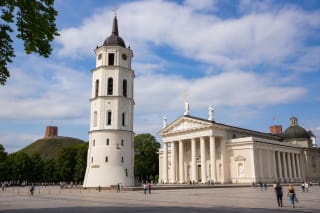
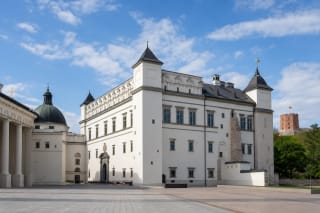
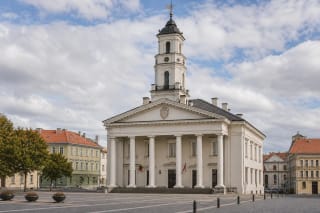
The palace is very easy to combine with the Vilnius University Ensemble, Cathedral Square, the Palace of the Grand Dukes, and the Town Hall. A short route can show different forms of authority: university, church, ruler, municipal, and modern state power.
The best approaches are from Universiteto Street or from Cathedral Square. Over a short distance you can feel how Vilnius changes its spaces: courtyards, square, palace, and ceremonial streets.