- Place
- Kaunas District Municipality
- Region
- Kaunas District
- Type
- state-protected botanical natural heritage object
- Address
- Dubrava Forest, Samylai elderate, Kaunas District
- Coordinates
- 54.81724, 24.12099
- Visit duration
- 20-40 minutes, longer with a walk in Dubrava Forest
- Best time
- early autumn, when oak foliage contrasts with the evergreen pine and their different bark is easy to compare
Dubravos dvyniai, Dubrava oak and pine
Two different trees meeting at one base
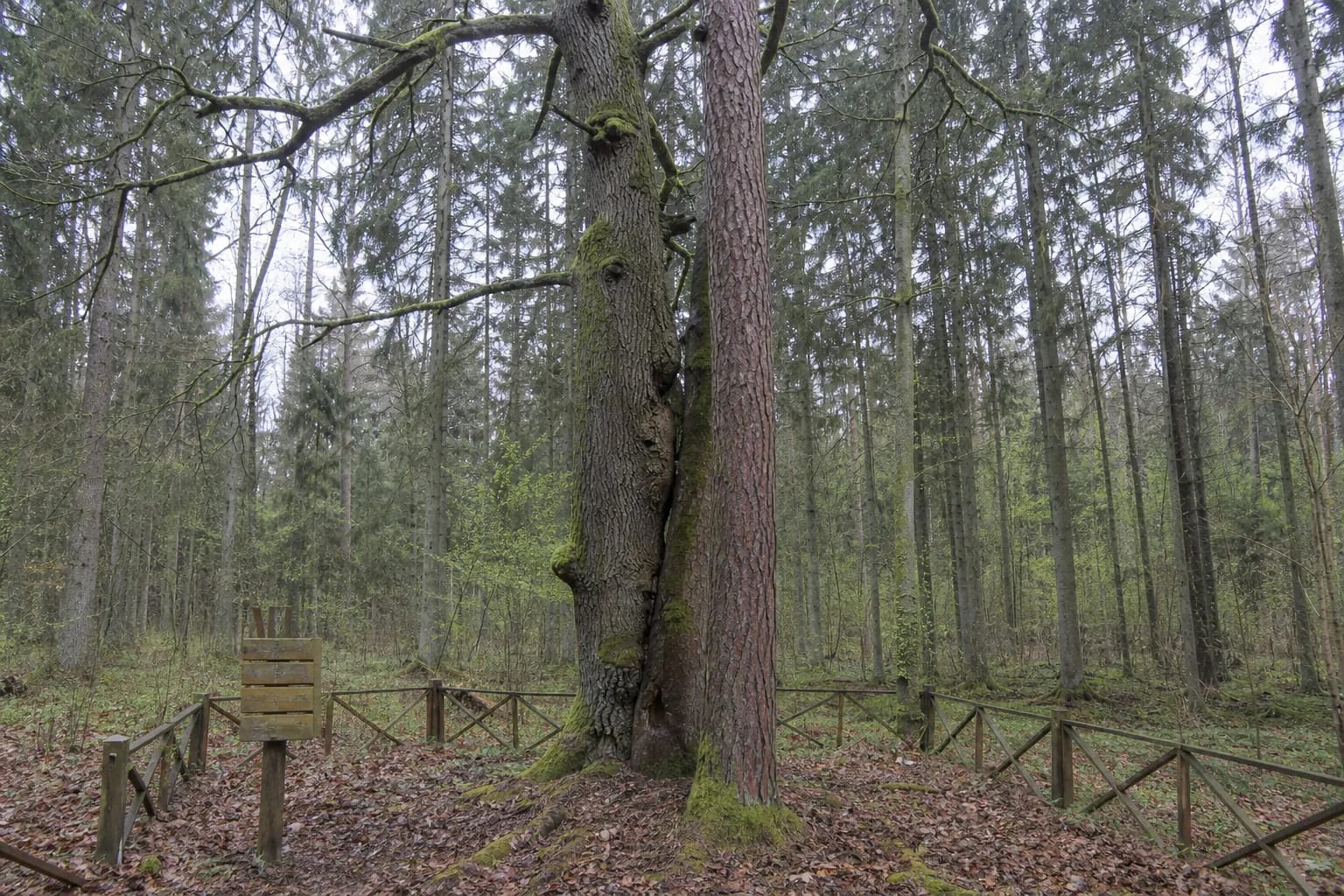
The Dubrava Twins are two native species, a common oak and a Scots pine. Their trunks grew so close that the lower sections pressed together and long appeared to form one broad base, before separating into individual crowns higher up. This is neither a two-stemmed tree of one species nor a deliberately grafted pair.
Public protected-area descriptions give roughly 33 metres for the pine, 27 metres for the oak and 3.6 metres for the circumference of their base. At the site, compare more than height: oak bark is deeply furrowed, while the pine is plated and more reddish.
Protected since 1971
The Dubrava Twins were placed under protection in 1971 and current state lists identify them as trees grown together and a botanical natural heritage object. Legal records locate them in Dubrava Forest in Samylai eldership, historically within compartment 78, plot 16 of Šilėnai Forest District.
The often-repeated age of roughly 100-150 years is an estimate, not a documented planting date. Nor is it known precisely how the seedlings came to share the spot. Stories about a jay hiding an acorn, a squirrel dropping a seed or two trees falling in love are imaginative interpretations rather than documented origins.
Are the trunks still joined?
These are living and changing trees. A forester's assessment published in 2017 reported that a formerly knotted joined section had separated and that internal rot affected the base of the pine. Today's appearance may therefore differ from older photographs in which the trunks seem completely fused.
Official lists still protect the pair under the historic name Dubrava Twins. Rather than looking only for a perfect seam, notice the unusually close growth of two species, marks left by contact between their bark and their distinct crowns. Do not test the condition by pulling, climbing or knocking on the trunks.
Finding the trees and visiting responsibly
The twins stand in Dubrava Forest rather than a staffed visitor site. The exact OpenStreetMap marker leads to the small railed tree site, but the final approach depends on the chosen forest road and seasonal surface. Search specifically for Dubravos medžiai dvyniai in navigation so that you do not end up at another Lithuanian pair of twin trees.
There are no tickets or opening hours. Stay outside the protective rail, avoid trampling roots, do not tie ribbons or leave symbolic objects, and assess hanging branches after storms. A short stop combines well with Girionys Park or the Dubrava Strict Nature Reserve trail, but the latter is a separate protected site with its own rules.