- Place
- Molėtai District Municipality
- Region
- Aukštaitija
- Type
- Asveja peninsula castle site with remains of the Radziwiłł palace and church
- Address
- Dubingiai, Molėtai District
- Coordinates
- 55.05958, 25.44404
Castle Hill, Dubingiai castle place, Radziwiłł palace remains in Dubingiai
Castle Hill above Asveja
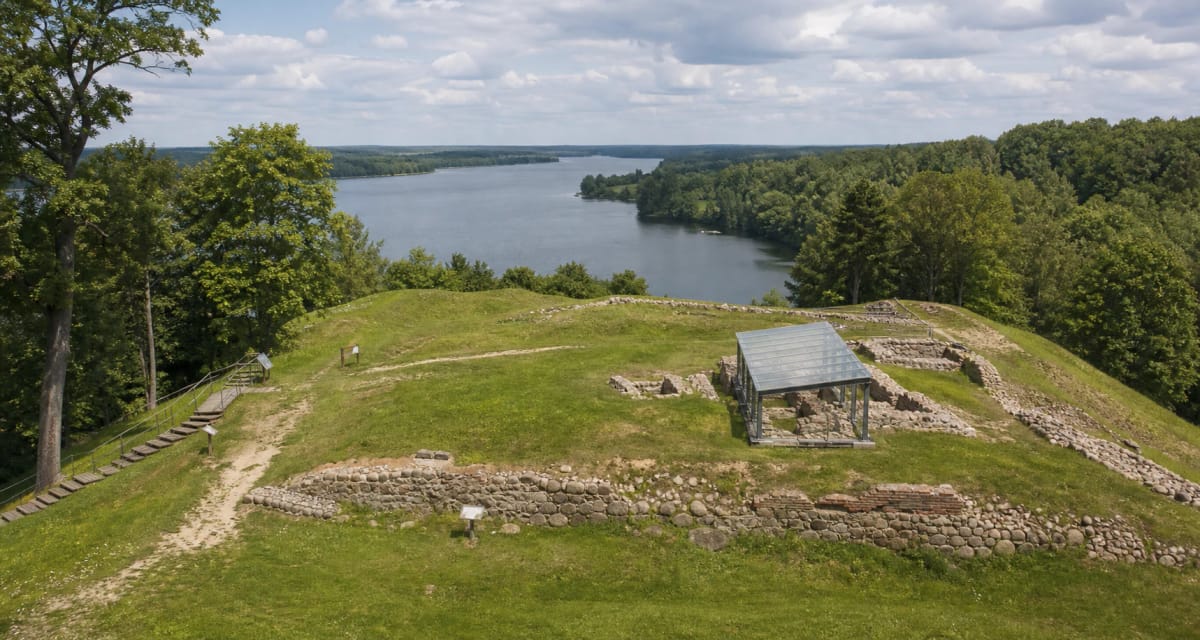
At Dubingiai Castle Site, first look at the relief. VLE describes it as a 500 m long and 100-220 m wide hill on a Lake Asveja peninsula, formerly an island, called Castle Hill. KVR adds steep former-island slopes rising 25-40 m from the water.
Dubingiai is therefore not only an archaeological foundation display. It is a former-island landscape that explains why a castle could stand here: water protected the approaches, the long narrow lake shaped movement, and the hill controlled crossings between shores.
From wooden castle to Vytautas's residence
Dubingiai land is mentioned in written sources in 1334. KVR stresses that the Livonian branch of the Teutonic Order devastated the area in 1373 and 1375, making the existence of a wooden castle on the Asveja island very likely.
VLE states that in the first half of the fourteenth century a wooden castle probably stood here, guarding the road to Vilnius from Livonian Order attacks. In 1412-1413 Grand Duke Vytautas built a new castle, and before 1430 also a wooden Catholic church.
Radziwiłłs, Barbara Radziwiłł, and the Dubingiai centre
In the sixteenth century Dubingiai passed to the Radziwiłłs and became one of their most important residences. VLE writes that Barbara Radziwiłł lived in the castle in 1547-1548, while KVR specifies that from 19 November 1547 she spent almost five months here.
Dubingiai is inseparable from Mikołaj Radziwiłł the Red, Janusz Radziwiłł, and the broader Biržai-Dubingiai branch. The site is connected with Vytautas the Great, Barbara Radziwiłł, and other major figures of the period.
Church, Reformation, and Radziwiłł mausoleum
Around 1565 the Catholic church on the castle site was transferred to the Evangelical Reformed community. In the early seventeenth century Janusz Radziwiłł built a masonry Reformed church in place of the wooden one; VLE states it burned in 1735.
The church became the Radziwiłł family burial place. KVR mentions remains probably linked to Mikołaj Radziwiłł the Black and Elżbieta Szydłowiecka, Mikołaj Radziwiłł the Red, Janusz Radziwiłł, and other family members. In 2009 remains found during excavations were reburied in the former church cellar.
Archaeology under the turf
For a long time the site looked like a green hill, but research recovered a clear structure. VLE mentions investigations by Vytautas the Great Culture Museum in 1939, surveys in 1969, 1979, and 1987, and Vilnius University archaeological work in 2003-2011.
Finds included masonry building, castle, and church remains, burial crypts, traces of coffins and human remains, black polished marble slab fragments, a ring, a John Casimir copper shilling from 1661, floor tiles, roof tiles, nails, and other objects. KVR describes the cultural layer as reaching 1.5-3.2 m near masonry foundations.
What visitors see today
Since 2012 the site has displayed fragments of the Radziwiłł palace, prepared for viewing and covered by a protective shelter. Asveja Regional Park also identifies the former Evangelical Reformed church site with the Radziwiłł burial pantheon.
This is not a reconstructed castle. The valuable experience is reading layers: where the palace stood, where the church was, where the old entrance may have run, where ramparts and ditches are, and where old bridge piles still survive under Asveja's water.
Nature trail and Asveja panorama
A natural-surface trail crosses the site. Asveja Regional Park gives its length as about 1.5 km, with 6 observation stops at archaeological and natural objects, wooden stairs, information panels, and benches.
Lake Asveja is essential context. VLE states that Asveja is Lithuania's longest lake: 21.9 km, or 29.7 km with bays; area 1015 ha, maximum depth 50.2 m. From Castle Hill you see a landscape that explains Dubingiai's defensive and political importance.
Planning a visit
For a first visit, start in Dubingiai with the Asveja Regional Park visitor-centre surroundings and Dubingiai Bridge, then walk the castle-site trail. If you want exhibition interiors or a guide, check Asveja Regional Park information before travelling because hours and tickets can vary by season.
The trail is natural ground, so after rain or in winter use suitable shoes. With children, make the site a search: find the palace-remains shelter, church place, crypt signs, lake viewpoints, and old rampart forms.