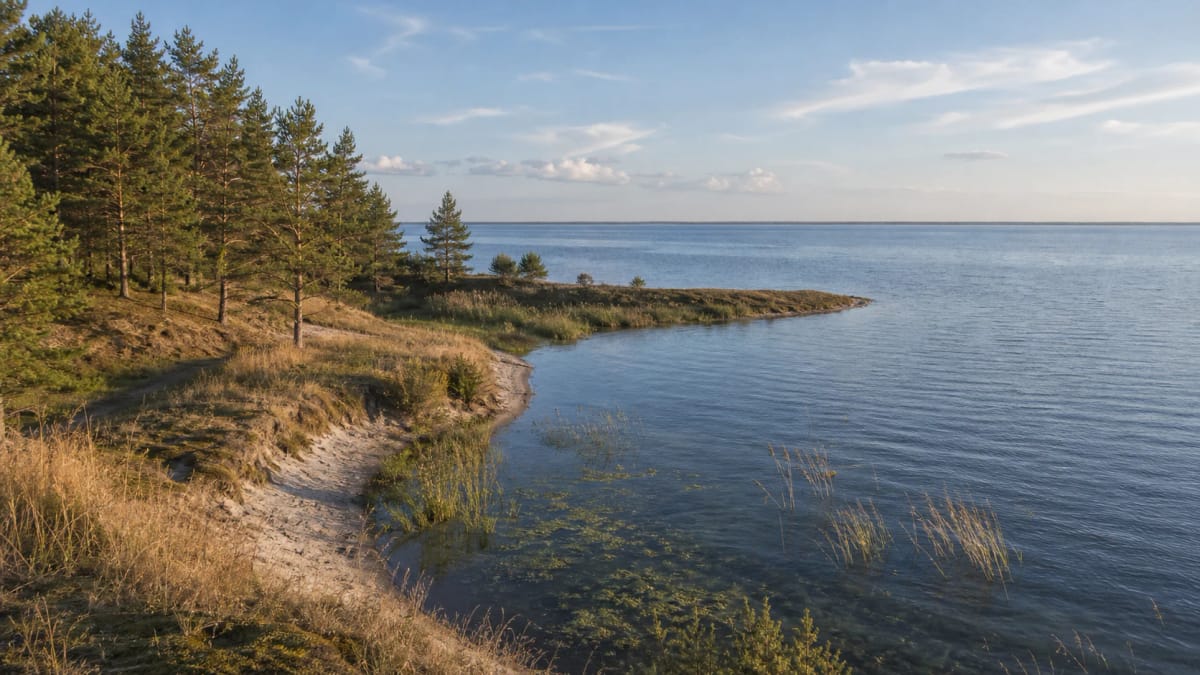
- Place
- Juodkrantė area, Neringa Municipality
- Region
- Curonian Spit
- Type
- viewpoint, cape, and landscape-reserve feature
- Coordinates
- 55.51366, 21.11051
Avino Hill, Avikalnis, Avių kalnas, Avinkalnis promontory, Avikalnio ragas
The Avino Hill viewpoint in the Juodkrantė area
Avikalnis Cape, also called Avino Hill and, in official park sources, the Avinkalnis promontory, is a viewpoint in the Juodkrantė area. It is not a high tower: an observation platform is set on the summit of a sand hill, letting visitors see the Curonian Spit relief up close.
From the platform the Avikalnis palvė complex opens up, along with one of the finest panoramas on the spit - a valley, the Grey (Dead) Dunes in Naglių Nature Reserve, and fragments of Juodkrantė old-growth forest. It is a good place to stop and grasp how parabolic dunes, forest, and palvė form one continuous peninsular landscape.
Garnių Hill Landscape Reserve
Avikalnis belongs to Garnių Hill Landscape Reserve, which covers 250.09 ha. The reserve is wedged between the Juodkrantė recreational zone and Naglių Nature Reserve, and its purpose is to preserve the scientifically valuable Juodkrantė surroundings - old-growth-forested parabolic dunes, the expressive Avinkalnis promontory, and level and moist lagoon-side palvė.
The reserve protects habitats of European Community importance and Lithuanian Red Book species: the hobby falcon, stock dove, otter, and stoat are found here. The Avikalnis viewpoint is a good place to understand why it is not a single tree or path that is protected, but a whole complex of relief and habitats.
Lithuania's largest heron and cormorant colony
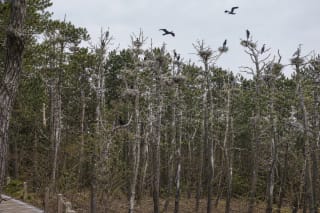
Garnių Hill Reserve is home to Lithuania's largest colony of grey herons and great cormorants - according to the Universal Lithuanian Encyclopedia, more than 500 heron pairs and about 2,000 cormorant pairs breed near Juodkrantė. It is from this colony that the hill takes its name, Garnių (Herons') Hill.
The colony can be watched from a dedicated observation platform near Avikalnis. It is one of the most striking natural scenes on the Curonian Spit, but it should be watched respectfully, without disturbing the birds and while keeping to the path.
Versions of the name
The name Avių kalnas or Avikalnis (Sheep Hill) is explained in several ways. One version says that, seen from the lagoon side, the hill's outline once resembled a sheep's head. Another links it with sound change: from the German name Schapen (Berg) on an 1796 map it gradually became Schafen (Berg), and Schaf means sheep in German.
A third explanation is simply that sheep were grazed on the sand hill. The variety of names is interesting in itself, because Lithuanian, Curonian, and German names often overlap on the Curonian Spit, reflecting the region's complex history.
How to reach it and visiting
Avikalnis is easiest to reach by car: coming from the Klaipėda side, at the 23rd kilometre of the Klaipėda-Nida road, on the right. Official park sources list the site as partly friendly to visitors with mobility disabilities, but accompaniment is recommended, and it is worth checking the real trail condition before going.
There is no separate ticket, but the site lies within Curonian Spit National Park. Stay on the paths, avoid disturbing the birds, and protect the sensitive dune and old-growth-forest environment.