- Place
- Juodkrantė, Neringa Municipality
- Region
- Curonian Spit
- Type
- outdoor sculpture exhibition and forest trail
- Coordinates
- 55.53557, 21.11723
Raganų kalnas, Hill of Witches wooden sculpture exhibition
Hill of Witches in Juodkrantė: what kind of place it is
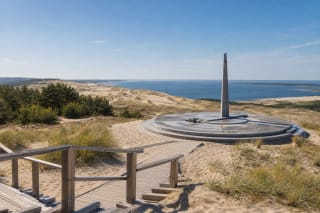
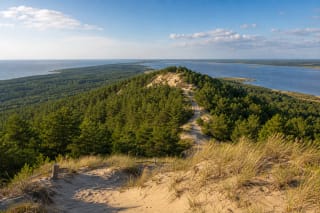
The Hill of Witches, which VLE also calls Jono Hill, is a dune in Juodkrantė, in the eastern part of the old parabolic dune massif. It is not a closed museum but an outdoor sculpture exhibition where, walking the path, you meet one oak figure after another from Lithuanian fairy tales, folktales, and legends.
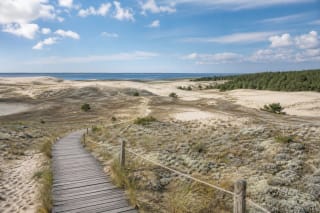
VLE gives the hill's height as 42 m, its shape as an elongated horseshoe, and its slopes as covered with pines and shrubs, a surviving part of the Curonian Spit old forest. The Hill of Witches is in Curonian Spit National Park, inscribed on the UNESCO World Heritage List in 2000 as a cultural landscape. Today it is one of Juodkrantė's most recognizable places, suitable both for a family walk and for a folklore theme.
How the Hill of Witches sculptures began
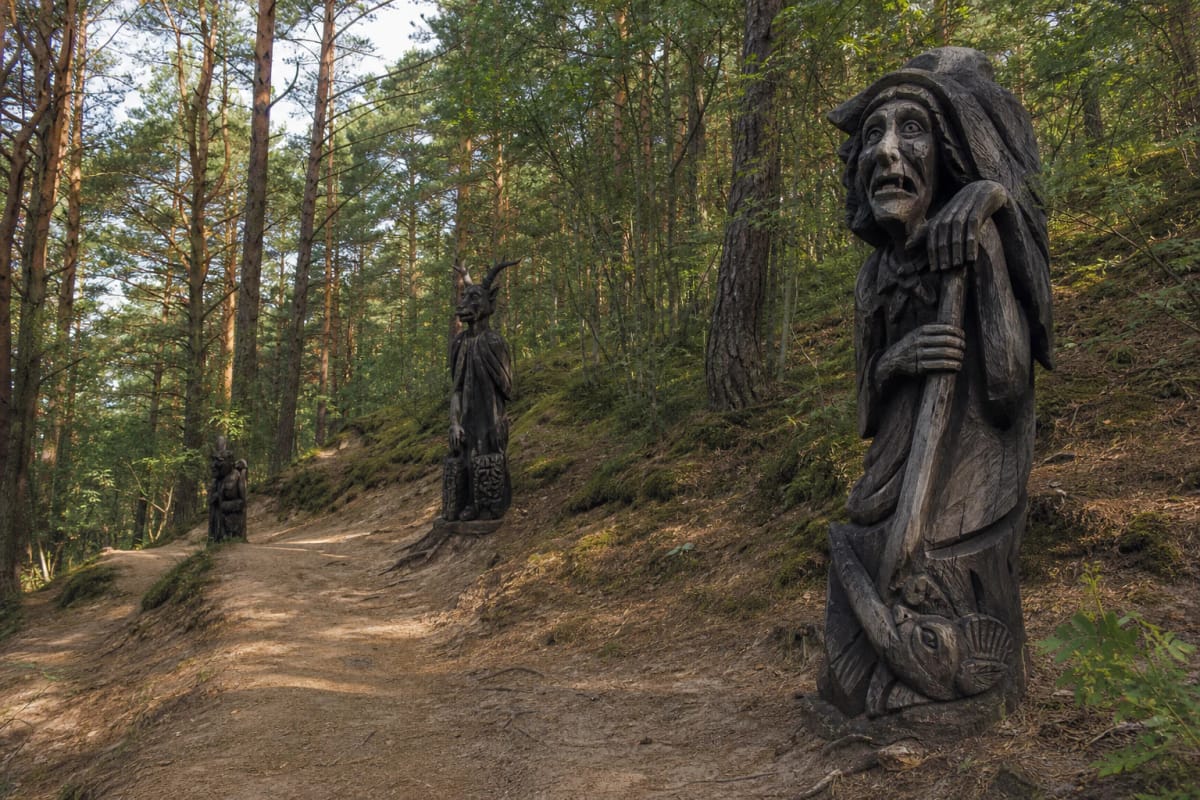
VLE says the idea for the exhibition grew from legend: according to it, devils and witches liked this hill and held feasts here. Juodkrantė forester Jonas Stanius wanted to revive the legend in carved form, and in 1979 the first Lithuanian folk-artist creative camp was held, producing 25 wooden sculptures. The project authors were sculptor Steponas Šarapovas and architect Algimantas Nasvytis.
Since 1979, craftsmen have come almost every year to restore old figures and carve new ones, so according to VLE more than 100 wooden sculptures have now been created, some with blacksmith-made ornaments. Oak is important here not only as material: it allows the sculptures to age together with the forest, so the Hill of Witches looks slightly different every year.
Hill of Witches, Joninės, and Juodkrantė memory
The hill also remembers an old Juodkrantė festival tradition. VLE states that in the nineteenth and early twentieth centuries, residents of Lithuania Minor celebrated Rasos, or Joninės, here, and until the First World War musicians and singers from Tilsit, Rusnė, and Klaipėda gathered on the hill.
For that reason the Hill of Witches is not only a collection of sculptures. It connects Curonian Lagoon travel, the celebration of the shortest night of the year, the fern-blossom motif, and the folkloric world of wooden figures.
How to visit the Hill of Witches
The Hill of Witches is easiest to visit on foot from Juodkrantė centre. The path winds through forest, so even in summer there is more shade than on open dunes. Still, after rain, roots and sandy slopes can be slippery, so comfortable footwear helps.
Most visits take 45-90 minutes. If you come with children, do not rush: some sculptures have details that are easy to miss, and at the foot of the hill visitors often find play elements intended for children.
What to notice along the trail
It helps to know that the trail has two parts. VLE states that on the light side, along a winding route of about 1.5 km around Eglių Valley, carvings depict fairy-tale characters, among them the giantess Neringa, the twelve brothers flying as ravens and their sister Elenutė, and the fisherman Kastytis; on the dark side are dragons, witches, and devils. Also look for musicians, gates, thrones, and scenes of folk humour; some figures are made so that the viewer becomes part of the scene.
The best time to photograph the Hill of Witches is not harsh midday sun but soft side light in the forest. Then the wood grain, carved faces, and relationship between sculptures and dark pine forest are clearer.