- Place
- Neringa Municipality
- Region
- Neringa
- Type
- cultural centre, exhibition space, and Juodkrantė history exhibition
- Address
- L. Rėzos g. 8B, 93101 Neringa
- Coordinates
- 55.54220, 21.12080
L. Rėza Cultural Centre, Juodkrantė Exhibition House
Liudvikas Rėza Cultural Centre: Juodkrantė's cultural node
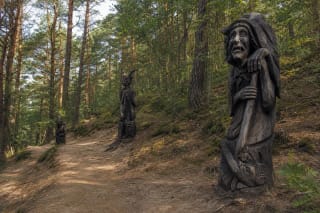
Liudvikas Rėza Cultural Centre is one of Juodkrantė's most important indoor cultural spaces. It works not only as an event or exhibition venue but also as a local-history interpretation point, where visitors can pause between the lagoon shore, the Hill of Witches, and the old layers of the settlement.
The centre's official presentation emphasizes Martynas Liudvikas Rėza and Juodkrantė history. It is therefore a good place for those who want to understand Juodkrantė not only as summer recreation but through Lithuania Minor writing, school life, exhibitions, and community culture.
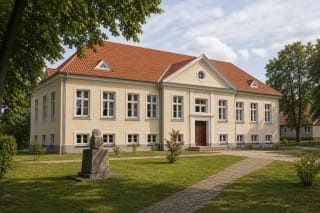
The red-brick school of 1902-1903
The official centre page states that the building is a red-brick school built in 1902-1903. This biography gives the centre a firm local-historical base: a cultural space operates in a building already connected with education and community life.
The red-brick school architecture in Juodkrantė differs from wooden villas, fishermen's homesteads, and the Hill of Witches sculptures. It reminds visitors that Curonian Spit settlements had not only resort history but also everyday institutional history.
From exhibition house to cultural centre
The centre's official history states that in 2003, for the first time after about 100 years, the old school's function changed: the Juodkrantė Exhibition House moved in. In 2007 the institution was reorganized as the Liudvikas Rėza Cultural Centre, and in 2008 its curatorium was established.
This development shows that the present centre is not only a hall for events. It continues exhibition activity, gathers local cultural initiatives, and operates as a municipal budgetary institution connected with Juodkrantė's cultural life.
Who was Martynas Liudvikas Rėza
Martynas Liudvikas Rėza, German Martin Ludwig Rhesa (1776-1840), was born in Karvaičiai on the Curonian Spit, a village buried by dune sand at the end of the eighteenth century. He was an Evangelical Lutheran pastor, professor at the University of Königsberg, doctor of philosophy (1807), worker of Lithuanian letters, and folklorist. From 1810 he led the reorganized Lithuanian Language Seminar and trained many figures in Lithuanian writing.
Rėza's work is foundational for Lithuanian culture: in 1818 he first published Kristijonas Donelaitis' poem The Seasons, and in 1825 he published the first collection of Lithuanian folk songs, Dainos, or Dainos, oder littauische Volkslieder, which he sent to J. W. Goethe in Weimar. He cared for Lithuanian Bible editions, encouraged collecting Lithuanian folklore, and protested against Germanization of Lithuanians. The L. M. Rėza Culture and Art Prize was established in 2008, and a monument by sculptor A. Sakalauskas was erected to him in Juodkrantė in 1994.
Historical exhibition about Rėza and Juodkrantė
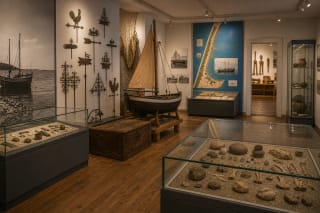
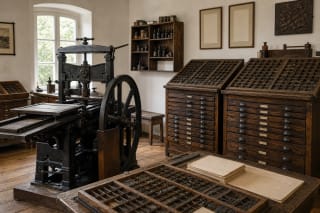
The centre's information mentions a permanent historical exhibition about Martynas Liudvikas Rėza and Juodkrantė. Exhibition information is provided in Lithuanian, English, and German, making it accessible for foreign visitors.
The exhibition matters because Rėza's name on the Curonian Spit is not only a street or centre name. It opens themes of Lithuania Minor writing, song collection, Protestant culture, and local memory that are worth carrying through a Juodkrantė route.
How to visit
Allow about an hour if you want to see the exhibition and a show. If you come for an event, concert, or presentation, plan according to the event length and check the centre calendar in advance.
At the time of research, official information stated that the exhibition halls and historical exhibition were open Tuesday-Saturday 10:00-18:00 and closed Sunday and Monday. The services page then listed an adult ticket to the historical exhibition at 1 euro and a concession ticket at 0.50 euro. Check the official page before travelling, because events, seasonality, and prices may change.