- Place
- Dreverna, Klaipėda District Municipality
- Region
- Pamarys
- Type
- ship-shaped community garden, educational space, and living display of historically interpreted plants
- Address
- Mokyklos g. 1, Dreverna, Klaipėda District
- Coordinates
- 55.51998, 21.24520
- Visit duration
- 30-60 minutes independently; longer for a pre-booked educational session or event
- Best time
- June to September for the fullest beds; the exact display depends on the growing season and maintenance
Dreverna Ancient Plant Garden, Lamata Ancient Plant Garden, Antique Plant Garden Dreverna, Ship-Shaped Plant Garden in Dreverna
What the Ancient Plant Garden in Dreverna actually is
The garden stands in central Dreverna on the grounds of the former school, beside the Education House of the Lamata Artisans' Guild at Mokyklos g. 1. It is a compact outdoor display, activity yard, and resting place, not a botanical garden with a scientific collections catalogue and not an ancient plot surviving in situ.
Coordinates 55.519980, 21.245204 mark the garden itself in the western part of the Mokyklos g. 1 property. The official attraction record does not identify one separate visitor gate, so the pin represents the site rather than a confirmed entrance, parking bay, or step-free arrival point.
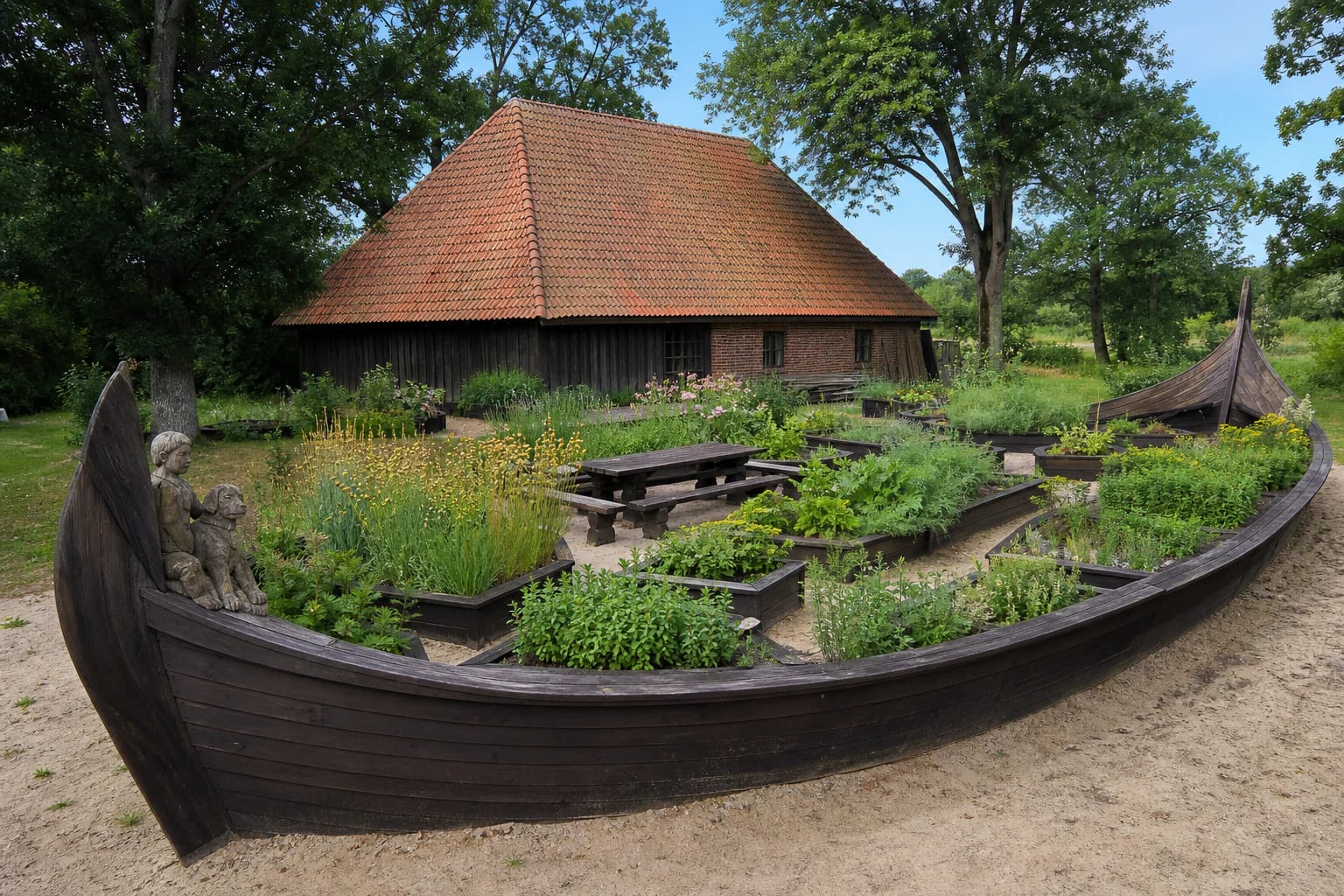
The first impression comes as much from the structure as from the plants. A dark timber enclosure traces a ship, with raised beds arranged inside and around a central meeting area, a long table and benches, mature deciduous trees overhead, and the red-tiled Education House behind it.
How a ship of 50 beds took shape in 2022
The idea came from historical-food interpreter Edita Nurmi, president of the Lamata Artisans' Guild. During her sessions, she found that people struggled to picture the plants named in the story. European wild ginger became the emblematic starting point because Nurmi presents it in her interpretations of ninth- to twelfth-century food as a local alternative to pepper.
The project became a 2022 winner of the Mes - bendruomenė community initiative and received EUR 10,000. Boatbuilder Darius Petkevičius was asked to develop the ship form and oversee construction. Community work produced 50 raised beds of different sizes, a fence suggesting a hull, high timber ends, and carved figures.
Construction of the beds began in August 2022, and the public opening celebration took place on 15 October that year. This is why photographs of the first autumn look much sparser than later growing seasons. From the outset, pupils, older residents, organisations, and local businesses were invited to tend individual beds, making community work part of the garden's identity rather than an incidental extra.
What 'ancient plants' means here
The specimens in the garden are living plants of the present, grown from modern seed or young plants. Promotional descriptions sometimes say that the seeds date from the Neolithic to the twelfth century, but the dates belong to evidence about past use and to the interpretive narrative, not to the physical age of seeds being sown today. The garden reconstructs possible historical plant selections; it is not an archaeological bed preserved where it was found.
Nurmi and her team gathered material around the Baltic, travelling through Sweden, Finland, Denmark, Norway, Latvia, and Estonia and visiting museums, botanical gardens, seed banks, and Viking-period displays. Ninth- to twelfth-century food reconstruction forms the core of the project, but individual plant stories can extend beyond those centuries. A publicised 2022 label for skirret, for example, discussed its use in the sixteenth to eighteenth centuries.
Archaeological evidence and the final dish are not the same thing either. At the opening, Nurmi presented an experimental sweet millet porridge informed by millet, pollen, and milk-protein traces from Kukuliškiai hillfort, yet explicitly acknowledged that the precise ancient recipe is unknown. The most responsible way to read the garden is therefore as a source-based experiment with its uncertainty visible, not as a promise that the past has been recreated exactly.
What grows here and how to read the beds
Official descriptions report about one hundred plant species in season, not a permanent year-round inventory. Recorded in autumn 2022 were several turnips, kale, broad beans, parsnips, silverweed, water mint, wild chervil, burnet-saxifrage, and woad used in dyeing. The selection, abundance, and condition of a living community garden can be different on every subsequent visit.
Plant labels add names and historical stories. The district attraction record says that fuller descriptions were prepared in Lithuanian, English, German, Ukrainian, Finnish, Swedish, Norwegian, and Russian, using QR codes and including information in Braille. This supports independent exploration, although no recent public audit was found confirming that every label and digital description is currently present and functioning.
Do not treat an account of historical use as modern medical or dietary advice. Do not pick, dig up, or taste plants on your own. Official stories place touching, smelling, and tasting within an educational session, so only do so after a facilitator has identified the exact plant and explicitly invited participants to try it.
Living history and community rather than a static display
The central table and benches were designed for lessons, artists' workshops, meetings, and celebrations. The initiative's 2026 profile on Lietuvos galia says that at least one educational activity generally takes place each week, with attendance ranging from small groups to major events. This is the initiative's description of its level of activity, not a guaranteed public weekly timetable.
In 2024, the Priekulė Art and Culture Centre's Autumn Equinox program listed garden tours and Lamata activities at Mokyklos g. 1. That program shows how the site is used in practice, but one dated event does not establish a daily guide service, permanent tasting, or the same activities in another season. Group visits need to be arranged in advance.
Opening, cost, season, and practical access
On 20 July 2026, the official Klaipėda District attraction record described the outdoor garden as open throughout the year but did not publish separate staffed hours. This indicates access to an outdoor space, not a promise that the Education House will be open, an educator will be present, or around one hundred species will be visible at any time. In winter and early spring the timber ship remains the main feature; the richest living display is more likely from late spring into early autumn.
No general admission tariff was found for simply looking around the outdoor display. Educational programs, historical-food presentations, and events are separate activities arranged in advance, so their availability and price cannot be inferred from access to the garden. Before making a special journey, confirm current terms with the Lamata Artisans' Guild; the district record listed pries1000metu@gmail.com and +370 686 41 552 on 20 July 2026.
No detailed public description was found for route surfaces, parking, toilets, or accessibility throughout the grounds. Actual photographs show raised timber beds and mostly earth or sand between them, including some narrower passages. Braille information and raised beds are valuable features but do not by themselves establish full step-free access. Discuss wheelchair, mobility, or sensory needs in advance, and park only where local signs clearly allow it.