- Place
- Neringa Municipality
- Region
- Neringa
- Type
- Juodkrantė lagoon bay, amber-history place, and dendrological-trail sound object
- Address
- Juodkrantė, Neringa
- Coordinates
- 55.55239, 21.12746
Amber Bay in Juodkrantė, Juodkrantė Sound Catcher
Amber Bay and the Sound Catcher: Juodkrantė between history and listening
Amber Bay and the Sound Catcher make a good pair on a Juodkrantė route because one place speaks about nineteenth-century amber industry, while the other invites you to slow down and listen to the sounds of the Curonian Spit. Neither object is large, but together they deepen an ordinary Juodkrantė walk.
Amber Bay is a place of memory on the lagoon shore, while the Sound Catcher is a sound object on the dendrological trail. One recalls what people searched for beneath water and sand; the other asks what you can hear if you stop among the pines.
Amber Bay and the Stantien & Becker amber mine
Amber Bay, in the northern part of Juodkrantė, has a rich industrial history. From 1855, as the German authorities deepened the lagoon fairway between Memel and Königsberg, dredgers near Juodkrantė brought up 'blue earth' containing pieces of amber. In 1858, Memel businessman Wilhelm Stantien and Moritz Becker founded the Stantien & Becker company, which became the largest industrial object then operating in the Klaipėda Region: a real amber empire.
According to Curonian Spit National Park, from 1862 over almost 30 years about 2,250 tonnes of amber were extracted from the lagoon bottom; the record year, 1868, produced more than 94 tonnes, with an average of about 75 tonnes per year. Up to 21 steam dredgers were used, and the harbour now known as Amber Bay was formed for them. As extraction flourished, Juodkrantė's population jumped from 170 to 851 by 1885, and the village overtook Nida as the largest settlement on the Curonian Spit.
The Juodkrantė amber hoard: 434 Stone Age objects
While extracting raw amber, workers also found handmade objects. According to VLE, in 1860-1881 a 434-object Juodkrantė hoard of Middle Neolithic and Bronze Age amber artefacts, dated to the third millennium BC, was collected in a shallow stretch about 2.5 km long, 2-4 m deep, and 0.65 km north of Juodkrantė. It included pendants, boat-shaped buttons, tubular beads, amulets, and especially valuable amber figures of humans and animals.
The hoard is also called the R. Klebs collection; it belonged to Stantien und Becker, and the finds were assessed by geologist G. M. Berendt and archaeologist O. Tischler. In 1944 part of the hoard was taken to the Geological and Palaeontological Museum of Göttingen University, where it remains; another part stayed in Königsberg and is thought to have perished at the end of the war. The objects may have been washed in from settlements on the Sambia Peninsula, or the place may have been a long-term Stone Age offering site. Analogues of the hoard, recreated by Lithuanian artists, can be seen at the Mizgiriai Amber Gallery-Museum in Nida.
What to see at Amber Bay today
Today Amber Bay is not a large open-air exhibition; its value is mainly contextual. Standing by the lagoon, you can imagine nineteenth-century steam dredgers working here, up to a thousand labourers on the site, and the workers' colony called California forming opposite the bay. It is estimated that about 112 tonnes of amber may still lie in the lagoon near Juodkrantė.
That is why the bay is best visited with the story already in mind. Without context it may seem only a beautiful lagoon shore; with context it becomes Juodkrantė's main amber-memory place and one of the most important industrial-heritage points on the Curonian Spit.
The Sound Catcher on the Juodkrantė dendrological trail
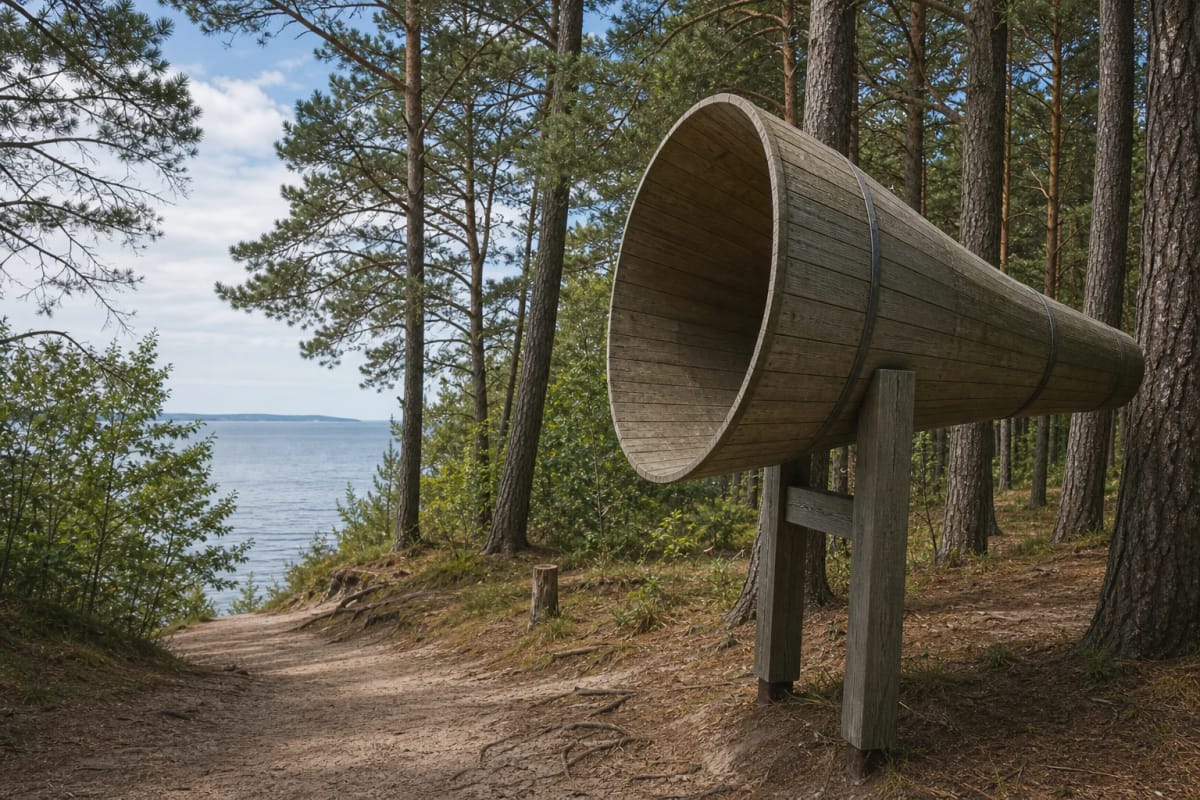
Near the lagoon, on the Juodkrantė dendrological trail, stands the Sound Catcher, a large wooden acoustic object about 3 m in size. It is simple but effective: the wooden horn directs attention toward sound rather than view, adding another layer to the natural forest route.
Stop here without rushing. Listen to wind in the pines, steps in sand, lagoon water, birds, and more distant Juodkrantė sounds. The Sound Catcher only works when the visitor agrees to be quiet, so it is most meaningful outside peak times.
How to combine both objects
Amber Bay and the Sound Catcher are best visited as one quiet segment of a Juodkrantė route. Start at the lagoon shore, then move to the dendrological trail, and continue toward the Hill of Witches or Juodkrantė centre.
If travelling with children, this pair works well: one theme is amber and old extraction, the other is listening to sounds. It turns the route into a game of observation and listening, not only walking.
What else to combine in Juodkrantė
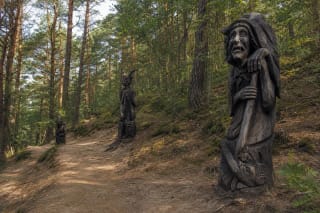
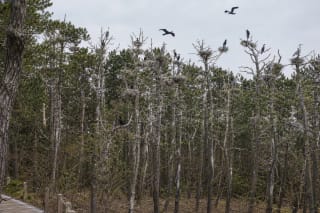
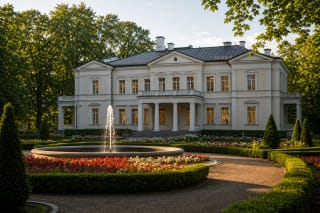
Nearby, visit the Hill of Witches, the Juodkrantė cormorant and grey heron colony, the lagoon shore, and the villa zones of Juodkrantė. Amber Bay and the Sound Catcher work best as smaller but meaningful stops in that route.
For a quieter experience, choose early morning or an off-season day. Then the Sound Catcher makes more sense, with less surrounding noise and clearer lagoon and pine-forest sounds.