- Place
- Kretinga District Municipality
- Region
- Samogitia
- Type
- historic homestead, biographical museum, and authentic five-room granary
- Address
- 9 Motiejaus Valančiaus St, Nasrėnai, Kretinga district
- Coordinates
- 55.99090, 21.51806
Motiejus Valančius Birthplace Museum, M. Valančius Birthplace Museum, Valančius Birthplace in Nasrėnai, Nasrėnai Museum
What is authentic at the homestead, and what has been reconstructed
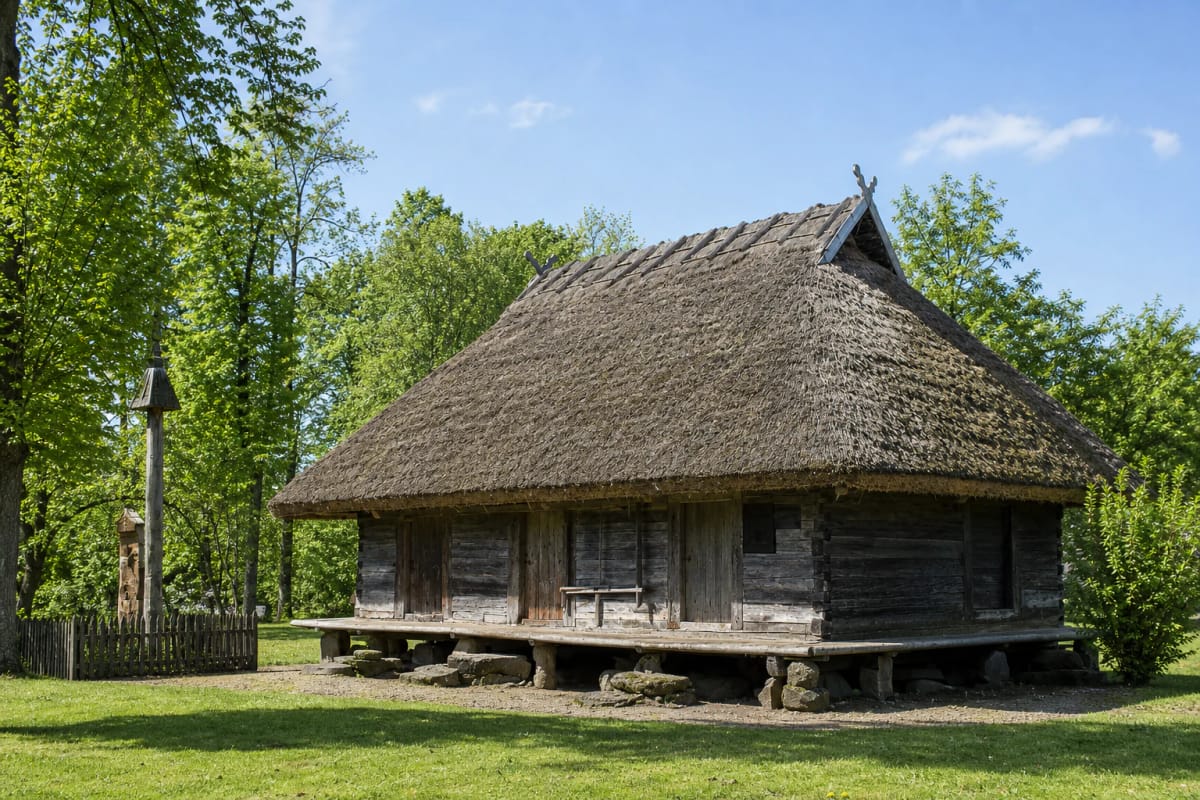
The museum occupies the Nasrėnai homestead where Motiejus Valančius was born and spent his childhood in 1801, but not every building visible today is his untouched family home. The principal authentic structure is a dark-log granary from the late eighteenth or early nineteenth century, raised on stones beneath a deep thatched roof. Two stone wells also survive from the old farmstead, while other outbuildings were later restored or reconstructed according to its plan.
The Register of Cultural Values records the entire birthplace complex as 10518, the granary as 23221, and the two wells as 23222 and 23223. These identifiers distinguish protected historic fabric from the ensemble adapted for a functioning museum. Local historian Ignas Jablonskis, Kretinga Museum director Juozas Mickevičius, and academician Adolfas Jucys helped establish the museum in 1969; Jablonskis reconstructed the old homestead plan and the positions of surviving and lost buildings.
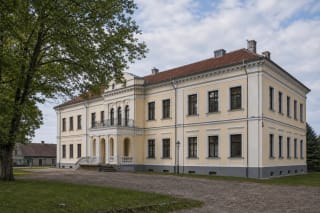
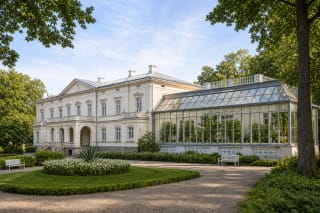
The granary contains five separate chambers: the mistress's or best room, the maid's room, the farmhand's room, the implement store, and the grain store. Its ethnographic display does not reduce rural life to one picturesque interior. Instead, it shows how a relatively prosperous family of free Samogitian peasants separated sleeping rooms from household equipment and grain storage. The main museum building displays Valančius's personal belongings, documents, his books, and works written about him.
From a child in Nasrėnai to Bishop of Samogitia
Motiejus Kazimieras Valančius was born at Nasrėnai on 28 February 1801 in the Gregorian calendar used today, or 16 February in the Julian calendar then used by the Russian Empire. The two dates found in sources are therefore not a contradiction. His parents, Mykolas Valančius and Ona Stonkutė-Valančienė, were free and comparatively prosperous peasants whose circumstances allowed their son to pursue an education.
Valančius attended the Dominican school at Žemaičių Kalvarija in 1816-1821, studied at the seminaries in Varniai and Vilnius, and was ordained in 1828. After working as a teacher and professor, he directed Varniai Seminary from 1845 to 1850 and was consecrated Bishop of Samogitia in 1850. The museum makes this progression feel less inevitable: it was an exceptional route from a peasant household to one of the most influential positions in nineteenth-century Lithuania.
As bishop, Valančius reformed clerical education, visited parishes, and encouraged a network of parish schools for children and adults. He initially treated the idea of the 1863 uprising cautiously but supported its participants once it began. In 1864 the imperial authorities forced him to move from Varniai to Kaunas, where he remained under surveillance, fines, and restrictions until his death in 1875.
Temperance, schools, and clandestine Lithuanian print
The temperance movement Valančius launched in 1858 was more than an appeal to avoid spirits. Parish brotherhoods brought people together, reduced the tavern's pressure on household finances, and gave peasants experience of mass civic organisation. The imperial administration prohibited the movement in 1864 because it recognised a social as well as a moral force.
After the 1864 ban on Lithuanian publications in the Latin alphabet, Valančius organised religious and didactic books printed in Prussia, carried across the border, and distributed clandestinely in Lithuania. He supported book smugglers and priests harmed by repression, while his own texts taught readers and resisted Russification. This was a risky network documented in historical sources, not merely a heroic legend created later.
In 2026, declared the Year of Motiejus Kazimieras Valančius and marking his 225th birth anniversary, the museum opened its Secret School exhibition and education activity. It approaches the bishop's work through the experiences of book smugglers, banned Lithuanian books, and children taught in secret. This is a genuinely new layer, giving returning visitors more than the museum's established biographical display.
Palangos Juzė, the oak grove, and living homestead traditions
Valančius was a prose writer as well as a bishop and organiser. He published the historical study The Samogitian Diocese in 1848, A Little Book for Children in 1868, and Palangos Juzė in 1869. In the latter, the travelling tailor Juozapas Viskontas describes the people, customs, songs, and games encountered on his journeys, so the wooden Palangos Juzė welcoming visitors at the homestead is more than decorative folklore.
Nine wooden sculptures made by folk artists now interpret Valančius's writing and public activity around the grounds. A grove of 200 oaks was planted opposite the museum in 1995 for his bicentenary. At its entrance stands a monument unveiled in 2001, designed by sculptor Kęstutis Balčiūnas and architect Edmundas Giedrimas after an initiative by Chicago Lithuanian Stasys Vaičius.
The homestead also remains a venue for living Samogitian culture. It has hosted an annual barn-theatre festival since 1999, while education programmes use the Samogitian language, bake shepherds' bread on sticks over a fire, prepare regional foods, or make soap. Content, group size, season, and price vary, so book a programme in advance instead of expecting one on an unannounced visit.
Opening hours, tickets, access, and a 4.6 rating
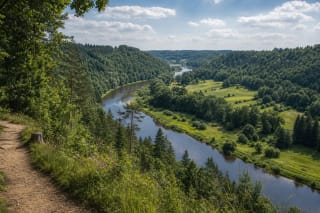
The museum stands at 9 Motiejaus Valančiaus Street in Nasrėnai, within Salantai Regional Park. It became a branch of Kretinga Museum in 2025, so old directory contacts and the former 8:00-17:00 schedule may no longer be valid. When checked in July 2026, the official branch page listed Wednesday-Sunday hours of 10:00-18:00. Confirm before travelling on the official site or with branch manager Rasa Balsevičienė at +370 684 90191.
At the same check, the official price list charged EUR 2 for an adult and EUR 1 for pupils, students, and pensioners, with free admission for specified groups. Kretinga Museum's general free-admission dates were 15 April, 18 May, and 27 September. Prices, concessions, and holiday schedules can change, so verify the official list; education programmes require separate booking at +370 671 19792.
The official branch description does not publish a complete step-free route, accessible-toilet specification, or access plan for every homestead building. The authentic granary is raised above ground and retains historic thresholds, so discuss mobility, visual, or other access needs in advance and ask which displays are reachable on the day. In July 2026, the museum's Google Maps listing was rated 4.6 out of 5 from 125 reviews.