- Place
- Kretinga District Municipality
- Region
- Samogitia
- Type
- 1883 cruciform timber church with a separate three-tier bell tower and movable Easter-soldier sculptures
- Address
- 12 Motiejaus Valančiaus St, Kalnalis, Kretinga district
- Coordinates
- 56.01555, 21.54055
Kalnalis Church, Church of St Lawrence, Kalnalis, Kalnalis St Lawrence's Church
Valančius was baptised here, but not in the present building
The history of worship on this hill predates the surviving church. A wooden chapel belonging to Salantai parish stood here from the seventeenth or early eighteenth century. After it decayed, Prince Andriejus Oginskis initiated a timber Church of St Lawrence in 1777. That earlier building was where Motiejus Kazimieras Valančius, born in nearby Nasrėnai, was baptised.
The original baptism register gives 17 February 1801 in the Julian calendar then in use, equivalent to 1 March in today's Gregorian calendar. The baptism followed one day after his old-style birth date of 16 February. Different dates in publications therefore reflect calendars rather than two separate baptisms.
Lightning struck the 1777 church on 28 July 1882 and destroyed it by fire. Priest Simonas Jucevičius and parishioners completed the present sanctuary in 1883, followed by the separate bell tower in 1884. A construction memorial board preserved inside records this sequence. Kalnalis remained a filial church of Salantai until an independent parish was established in 1926.
A cruciform plan, five forged crosses, and a separate bell tower
The church is 23.4 metres long and 15.6 metres wide across its side chapels. Its single-nave hall is close to a Greek-cross plan, with projecting transept arms and a three-sided apse. Pale-green vertical boards cover the hewn-log walls. Above the roofs rise a small central turret and five ornamental iron crosses forged in 1883. The current grey roof covering sits over a historically important shingle-roof form recorded by the heritage register.
The spatial design belongs to vernacular timber architecture, while the carved and gilded late-nineteenth-century altars introduce Neo-Baroque qualities. The Register of Cultural Values assigns 1453 to the whole ensemble, 23599 to the church, and 23600 to the bell tower. It became state-protected in 2005, and its architectural, historical, artistic, and sacred significance was assessed at regional level in 2022.
The square bell tower stands separately at the western edge of the churchyard, narrowing through three tiers and incorporated into the same loose-fieldstone wall. A small balcony above its door once allowed a priest to preach to crowds gathered outside on major feast days. The tower was restored in 2011, while the forged cross at its summit retains the date 1887.
What to identify inside, and what not to call a survival from 1777
Three polychrome and gilded wooden altars from the late nineteenth century organise the interior. The main altar, 4.65 metres wide, is dedicated to St Lawrence; side altars honour the apostles Philip and James the Less and the Immaculate Conception. The St Lawrence painting and sculpture, two processional altars, and the Easter soldiers each have their own movable-heritage records.
The church preserves an oil portrait and a lithograph of Motiejus Valančius. A quotation on the beam above the presbytery reads, in translation, 'Sober hearts are pleasing to God. From the writings of Bishop Valančius.' These pieces deliberately commemorate the baptism-site connection, but they do not mean that the present altar or whole interior was seen by the infant Valančius in 1801.
The Holy Spirit composition on the ceiling and emblematic stencil decoration on the walls were painted in 1967, so today's colourful room combines nineteenth- and twentieth-century layers. A seven-stop organ made in Šiauliai after 1926 by the Czech-born builder Otto Kratokvil stands in the gallery. The 2022 assessment judged its case satisfactory but its mechanism poor, so visitors should not assume that it is regularly playable.
Easter soldiers: not year-round decoration, but ritual theatre
Kalnalis's žalnieriai are two polychrome wooden Roman-soldier figures registered as Easter Soldiers under code 47348. Scholarly fieldwork on Samogitian puppet-theatre heritage describes them as approximately 70 centimetres high, making the often-repeated claim that they are life-size inaccurate. They are placed beside a symbolic Holy Sepulchre while the congregation awaits the Resurrection.
Moving mechanisms survive in and around the figures. Cords once turned their heads or lifted a spear and sword, while young men concealed beneath the platform animated the guards with an unexpected movement. This ritual play connects the Easter Vigil with one of the oldest surviving forms of vernacular puppet theatre in Samogitia.
The soldiers are kept in the church and traditionally brought out for the Easter period, but they are not a permanent museum showcase. Whether they are displayed, whether their mechanisms are operated, and the precise installation date depend on the parish community and liturgy. If they are your main reason for visiting, contact the parish rather than expecting to see them on a random summer day.
Mass times, visiting, the bell, and a 4.5 rating
This is an active parish church, not a museum with daily opening hours. When checked in July 2026, the official diocesan page listed Mass on Sundays at 10:00, Wednesdays and Fridays at 18:00, and Saturdays by arrangement; the St Lawrence feast of 10 August is transferred to Sunday. There is no admission ticket, but plan an interior visit around worship or call parish priest Mindaugas Nausėda at +370 687 81988 in advance.
The churchyard and adjoining cemetery form an open space of remembrance, so do not block gates, disturb services, or photograph people without permission. The official parish page does not publish a step-free route, accessible-toilet details, or a dedicated visitor-parking plan; discuss access needs before travelling. Public climbing in the historic bell tower is not advertised. Its present bell is not eighteenth-century: it was cast in Liepāja in 1931 and bears the names Pranas and Barbora Petkai.
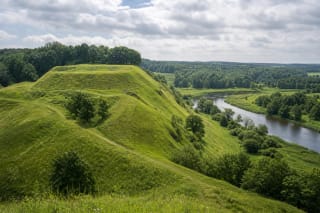
Do not confuse the church bell tower with the nearby metal Kalnalis observation tower. A public path of roughly two kilometres begins at the observation tower and follows the Salantas valley towards Imbarė Hillfort, extending a brief church stop into a longer landscape walk. In July 2026, the church's Google Maps listing was rated 4.5 out of 5 from 61 reviews.