- Place
- Klaipėda City Municipality
- Region
- Klaipėda
- Type
- urban square with a fountain and monument to a Lithuania Minor philosopher
- Address
- Bokštų g. 6, between Bokštų and Puodžių streets, Klaipėda
- Coordinates
- 55.71197, 21.12783
Vydūnas Garden, Vydūnas Pocket Park, The Spring
The Spring: monument, fountain, and abandoned shoes
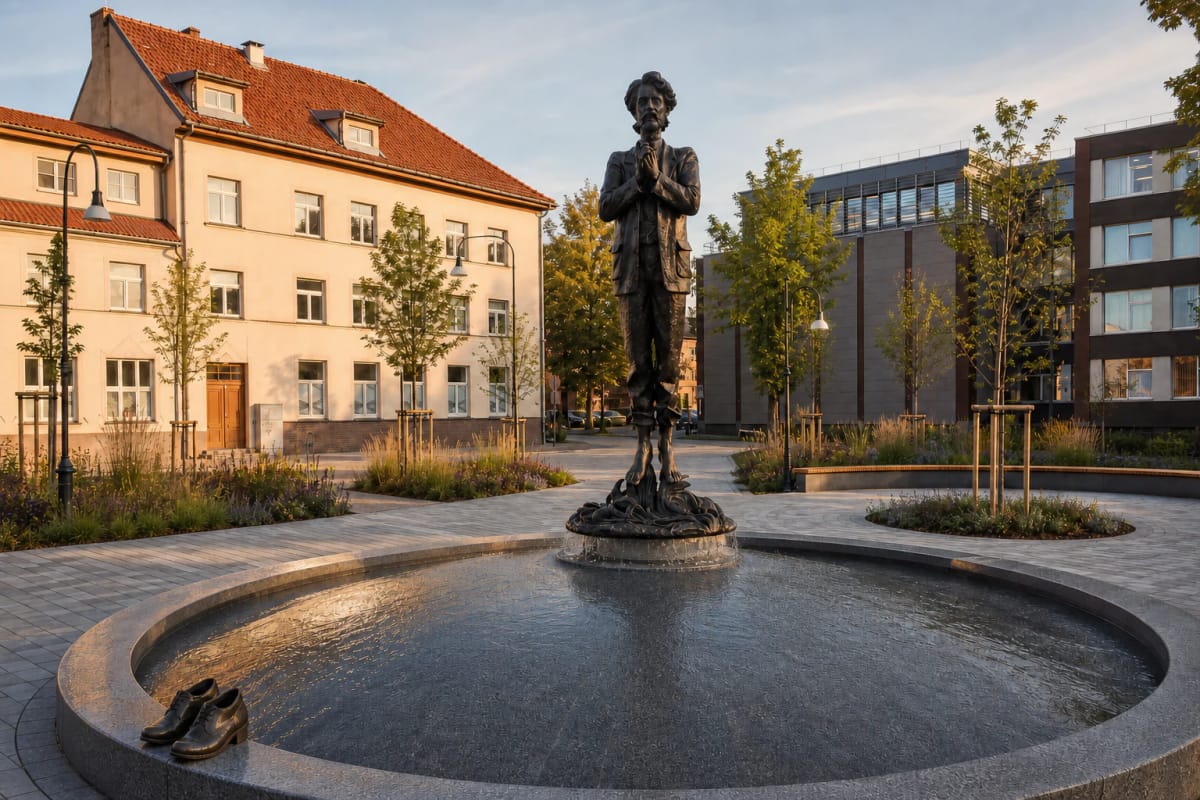
The centre of Vydūnas Square is not a conventional bust on a tall rectangular pedestal but a unified composition called The Spring. The roughly 3 m bronze Vydūnas is barefoot, rising lightly from an organic island in the middle of a circular pool, with his hands joined near his chest.
A separately cast pair of bronze shoes rests at the fountain's edge. In the artists' interpretation, Vydūnas pushes away from earthly concerns and rises in spirit, while water emerging below him signifies life, inner growth, and continually renewed thought. This is an artistic reading, not a literal event from his biography.
An oval surface of flame-finished granite surrounds the composition and carries thoughts and symbols drawn from Vydūnas's writings. Walk around the fountain rather than photographing it only from a distance to find the shoes and read the texts integrated into the paving.
Who created the monument to Vydūnas
The monument project team included architect Petras Džervus and Ukrainian sculptors Olesis Sidarukas and Boris Krylov. Klaipėda sculptor Arūnas Sakalauskas represented them locally and worked on the realisation; VLE names all three artists as the sculptors of the 2019 Vydūnas Monument.
The technical landscape project was developed by Megaplantas, landscape architect Lidija Sadauskienė, and project lead Romualdas Regesas. This joined two tasks: creating a monument and shaping an everyday urban garden around it with paths, benches, bicycle stands, and evening lighting.
Private patrons financed the bronze figure and fountain composition, while Klaipėda City Municipality allocated €484,000 to renewing the square. The separate funding explains why records often describe the monument and surrounding reconstruction as connected but distinct projects.
Seven years from idea to unveiling
The Klaipėda Region branch of the Council for Lithuania Minor Affairs and like-minded residents began gathering support for a monumental Vydūnas memorial in late 2012. Before then, the square between Bokštų and Puodžių streets had served for about half a century as a green recreational space without a principal memorial focus.
An open competition selected The Spring design, a technical project for the square was prepared in 2017, and reconstruction began in 2018. The 150th anniversary of Vydūnas's birth added momentum, although the full project extended beyond the anniversary year.
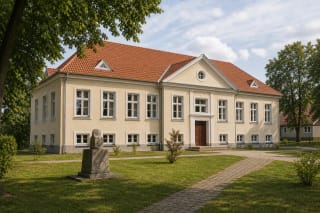
The renewed square and bronze monument were ceremonially unveiled on September 1, 2019, opposite the educational building. The date coincided with Lithuania's Day of Science and Knowledge, linking the philosopher, teacher, and cultural educator with a living educational setting.
Apple trees, magnolias, and an open urban garden
Reconstruction substantially changed the previously tree-dense square. After older and poor-condition trees were removed, the open design gained one oak, 23 apple trees, three Japanese magnolias, perimeter planting, and herbaceous beds.
The decision prompted public debate about lost shade, so today's space is more accurately described as a young urban garden than an old park. Apple blossom becomes the main seasonal accent in May, followed by the fountain and perennial planting in summer, while lamps define the bronze-and-water composition in the evening.
Granite paths are level, and the square includes seating areas and bicycle stands. It is a compact place that works best as a calm stop on a wider city walk rather than a park for several hours.
Why Vydūnas matters to Klaipėda
Vydūnas, born Wilhelm Storost in Jonaičiai in today's Šilutė region in 1868, became one of Lithuania Minor's leading philosophers, writers, and cultural activists. He taught in Kintai and Tilsit, founded the Tilsit Lithuanian Singers' Society in 1895, and wrote drama, philosophy, and works interpreting history.
His connection with Klaipėda goes beyond the shared setting of Lithuania Minor. Vydūnas taught cultural history at Klaipėda Music School in 1926-1927, gave lectures in the city, and took part in its cultural life. The square therefore honours someone directly connected with the port city's education.
Persecuted by the Nazi authorities, Vydūnas fled to Germany in 1945 and died in Detmold in 1953; his remains were reburied in the Bitėnai-Rambynas cemetery in 1991. The Klaipėda monument is one point on a meaningful Vydūnas route that continues through Kintai and Bitėnai.
How to visit Vydūnas Square
Vydūnas Square is an open public space between Bokštų and Puodžių streets, freely accessible around the clock with no ticket. Allow 20-40 minutes for its principal details; the exact location is 55.7119651, 21.1278345.
The fountain is normally a warm-season feature, but operation depends on municipal maintenance, weather, and technical condition. Water may be absent in winter or during repairs, so visitors travelling specifically to see The Spring flowing should check current city information.
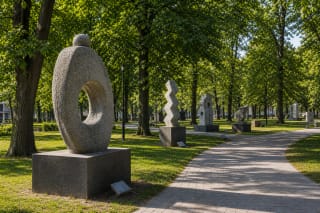
The square is close to Klaipėda Old Town and the Danė, making it easy to combine with Sculpture Park, Lietuvininkai Square, or a longer public-art route. Granite inscriptions are easier to read by day, while evening brings out the silhouette and lighting.