- Type
- God
- Domain
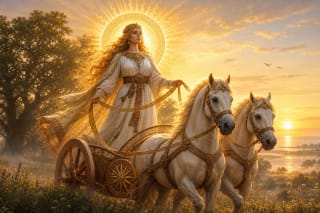
- Heavenly twins, solar horses, sons of God, protectors of the Sun's daughters
- Source status
- disputed
Dievo sūneliai, Dievo sūnūs, heavenly twins, Dieva dēli
Who are the Ašvieniai?
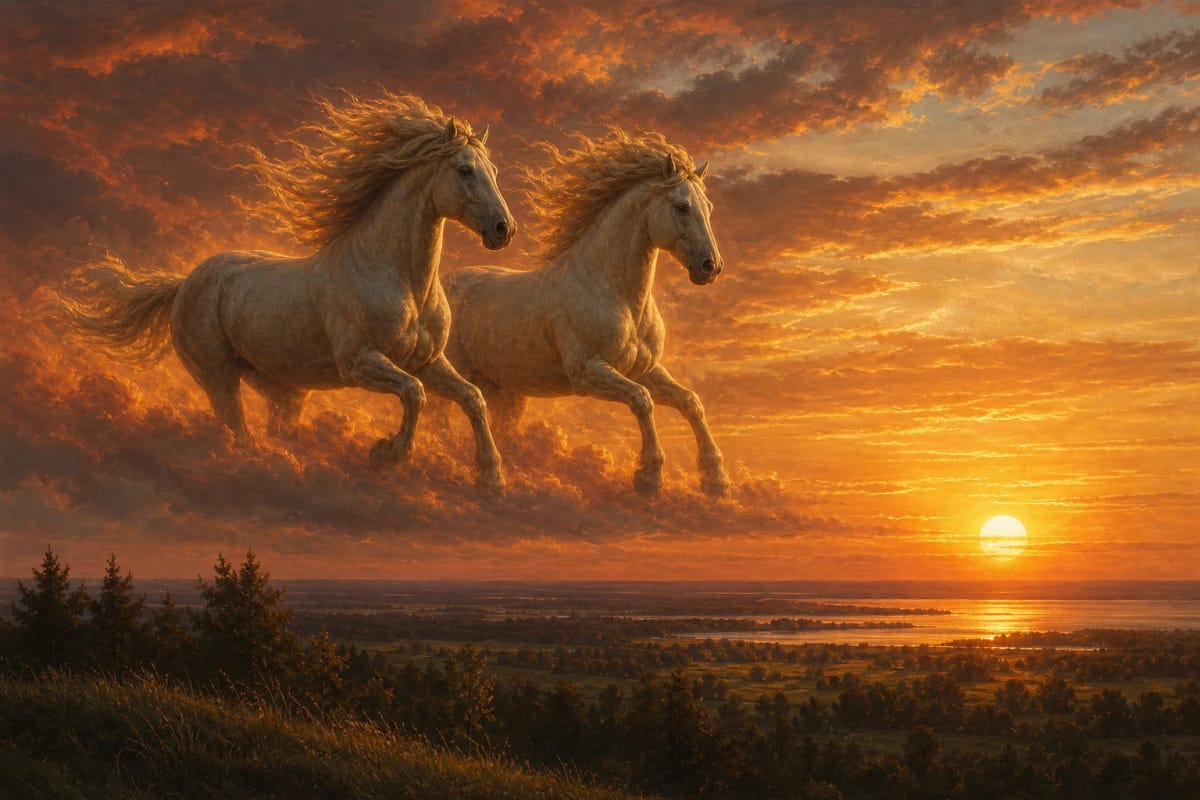
Ašvieniai is the scholarly name for the Baltic divine twins, imagined as two heavenly horses who draw the Sun's wheels and protect the Sun's daughters. They belong to the broad Indo-European image of divine twins, which also includes the Vedic Aśvins and the Greek Dioscuri.
The name Ašvieniai requires one qualification: it is a twentieth-century scholarly reconstruction, rather than an old name recorded in folklore. The Ašvieniai are best understood not as a securely attested named pair of gods, but as a scholarly way to name a real phenomenon called differently in folklore: Dievo sūneliai, the sons of God.
Is Ašvieniai an old name?
No. The name Ašvieniai is not mentioned in old chronicles, Jan Łasicki's list of gods, Teodor Narbutt's writings, or folklore records. It is also absent from the Visuotinė Lietuvių enciklopedija. It is a name proposed and spread by comparative-mythology scholars.
The name is formed from the old Lithuanian word ašva, mare, related to Sanskrit aśva, horse, both from an Indo-European word meaning horse. It was deliberately created as a Lithuanian counterpart to the Vedic divine name Aśvins, horsemen or horse lords. For that reason, Ašvieniai should be treated as a useful scholarly name, not as a traditional divine name transmitted by folklore.
Dievo sūneliai: what is actually attested
The real folklore name behind the Ašvieniai is Dievo sūneliai, or Dievo sūnūs, the sons of God. They are mentioned only sparsely in Lithuanian songs, and much more abundantly in Latvian songs as Dieva dēli. The Latvian material preserves the image of the divine twins most fully.
This distinction should be stated directly: the richest testimony is Latvian, while the Lithuanian image of Dievo sūneliai is a fainter echo. Much of what we know about the Baltic twins comes from Latvian folklore and comparative mythology, not from abundant Lithuanian evidence.
The twins in solar myths
The twins appear most clearly in the cycle of heavenly wedding or solar myths. According to the VLE article on the Sun's daughters, those daughters dance alone or with a son or sons of God, Latvian Dieva dēli; the sons of God secretly watch the Sun's daughters dressing, help them adorn themselves, forge wreaths, and court them.
A rescue motif is also linked with the twins: when the Sun's daughters wade into or sink in the sea at sunset, they are rescued by the goddess Laima or by the sons of God. Jaan Puhvel considered the courtship of the Sun's daughters possibly the oldest part of the divine-twin myths. Lithuanian tradition also has the image that the Sun was courted by her brothers, the Morning and Evening glows, a black and a white horse, linking the twins with horse imagery and the morning-evening pair.
Indo-European divine twins
The Baltic twins belong to an old Indo-European image that comparative-mythology scholars such as Donald Ward, Martin West, and Jaan Puhvel call the divine twins. Recurrent traits include youth, connection with horses, rescue from danger, especially at sea, healing, and an astral nature.
The most important connecting thread is the epithet sons of the sky god: Lithuanian Dievo sūneliai, Latvian Dieva dēli, Vedic Aśvins as divó nápātā, sons or descendants of the sky, and Greek Dioscuri, children of Zeus, Castor and Polydeuces. The fact that different peoples name the divine twins in similar ways is what allows them to be seen as a reflection of shared Indo-European heritage.
Roof horses and heavenly horses
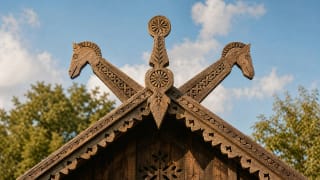
In material culture the twins are often associated with paired roof horses, lėkiai, mirrored horse heads placed at the ends of a house ridge. The custom of decorating roofs with horse figures and the belief that they protect the home from evil are well attested, especially in Lithuania Minor and the coastal region.
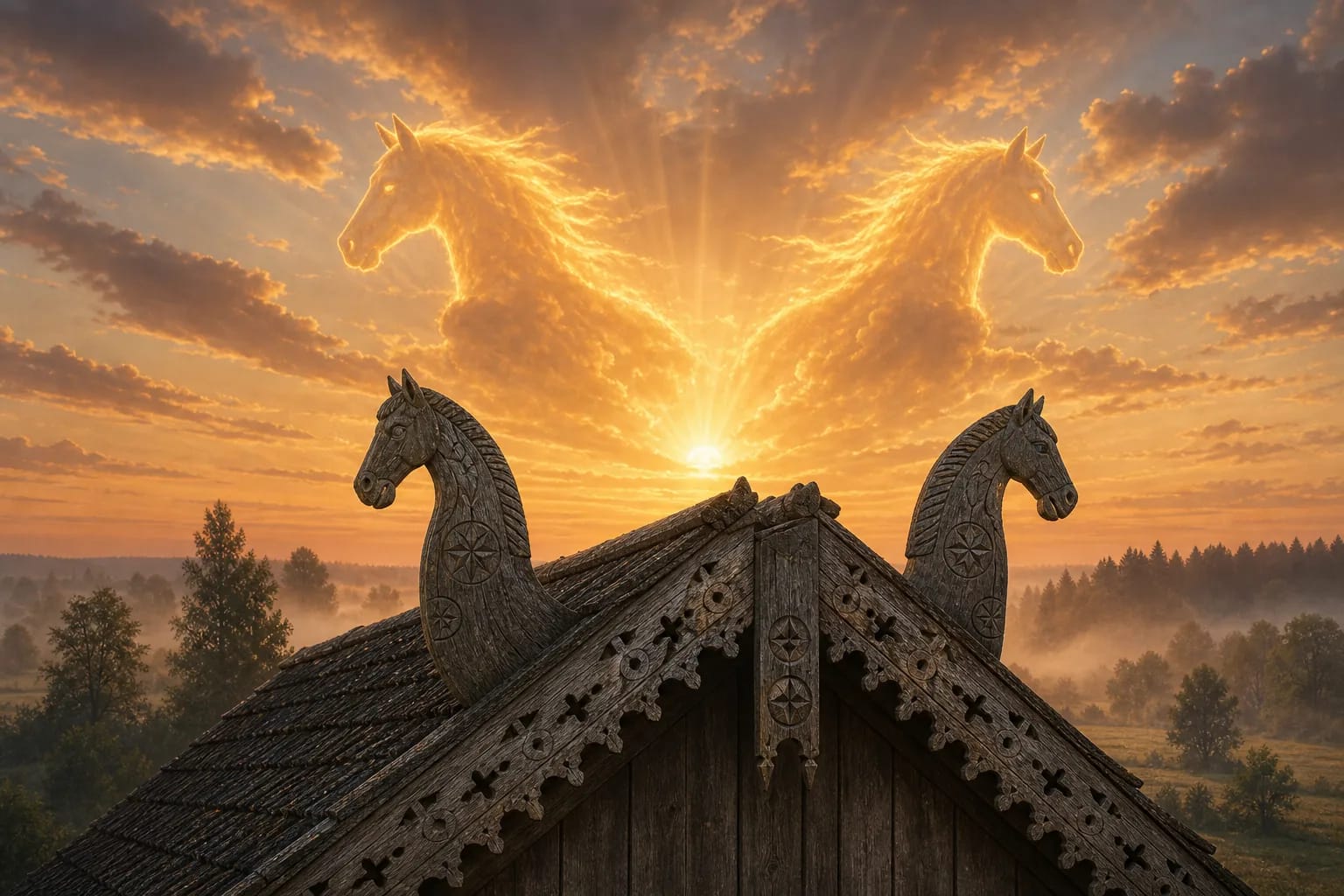
The interpretation that these paired horses specifically represent the heavenly twins or solar horses is a scholarly interpretation, not a folklore statement. Roof horses should therefore be presented as a possible and fitting reflection of the twin image, without claiming that every roof horse is certainly a sign of the Ašvieniai.
Aušrinė, Vakarinė, and the twin question
Another interpretation links the Baltic divine twins with Aušrinė, the Morning Star, and Vakarinė, the Evening Star. Since both are the same planet, Venus, seen in morning and evening, they fit twin symbolism well. Marija Gimbutas connected the Sun's daughters with the Morning and Evening Star.
This interpretation has a difficulty: Aušrinė and Vakarinė are usually female in folklore, as Sun daughters or maidservants, while Dievo sūneliai are male. Folklore also varies in the number of Sun daughters or sons, giving one, two, or three. The twin, horse, and morning-evening-star interpretations therefore overlap, but do not coincide, and none should be presented as the only correct explanation.
What is attested and what is reconstructed
An honest reading must clearly separate what is firmly attested from what is scholarly reconstruction. Attested folklore material includes Dievo sūneliai in Lithuanian and, more abundantly, Latvian songs; their link with the Sun's daughters through courtship and rescue; paired roof horses and the belief that they protect homes; and the pair Aušrinė and Vakarinė.
Reconstruction or scholarly interpretation includes the name Ašvieniai itself, the claim that Dievo sūneliai form a separate pair of divine twins with clear divine status, and the explanation of roof horses as images of the twins. Comparative mythology supports these points with Indo-European parallels, but also notes that the divine twins are not directly attested in written or archaeological sources. They are reconstructed by comparing traditions. Because of this mixed character, the page marks the field as disputed.