- Type
- Goddess
- Domain
- Sun, light, warmth, life, heavenly cycles, motherly protection
- Source status
- folkloric
Saulutė, Motinėlė Saulė, Saulė motina
Who is Saulė in Lithuanian mythology?
Saulė is the Lithuanian goddess of heavenly light, warmth, life, and the daily cycle. She is strongly preserved in folklore: songs, legends, riddles, tales, calendar customs, and everyday speech.
Unlike names from late god lists, the image of Saulė rests on a broad folklore layer. In Lithuanian tradition the Sun is often personified: she travels, rises, sets, rests, weeps, adorns herself, rides, warms, and protects.
Saulė is therefore not only an astronomical body. Mythologically she is a life-sustaining being who orders the day, the rhythm of the year, plant growth, and the human relationship with light.
Saulė's name and motherly image
In Lithuanian, Saulė is grammatically feminine, and folklore often addresses her with affectionate and motherly names: Saulutė, Motinėlė Saulė, Saulė motina. These forms show a close, warm, protective relationship.
The motherly image of Saulė is especially important in songs. The Sun can be compared with a mother who warms, cares, sees human suffering, and takes part in the order of the world. This is not a sentimental detail, but one of the main features of her folklore character.
The Sun's path: Saulė rises, rides, and sets
In Lithuanian folklore Saulė is always moving. She rises in the morning, travels across the sky, sets in the evening, and returns again. This movement explains the rhythm of the day and lets time be understood mythologically as a repeating cycle.
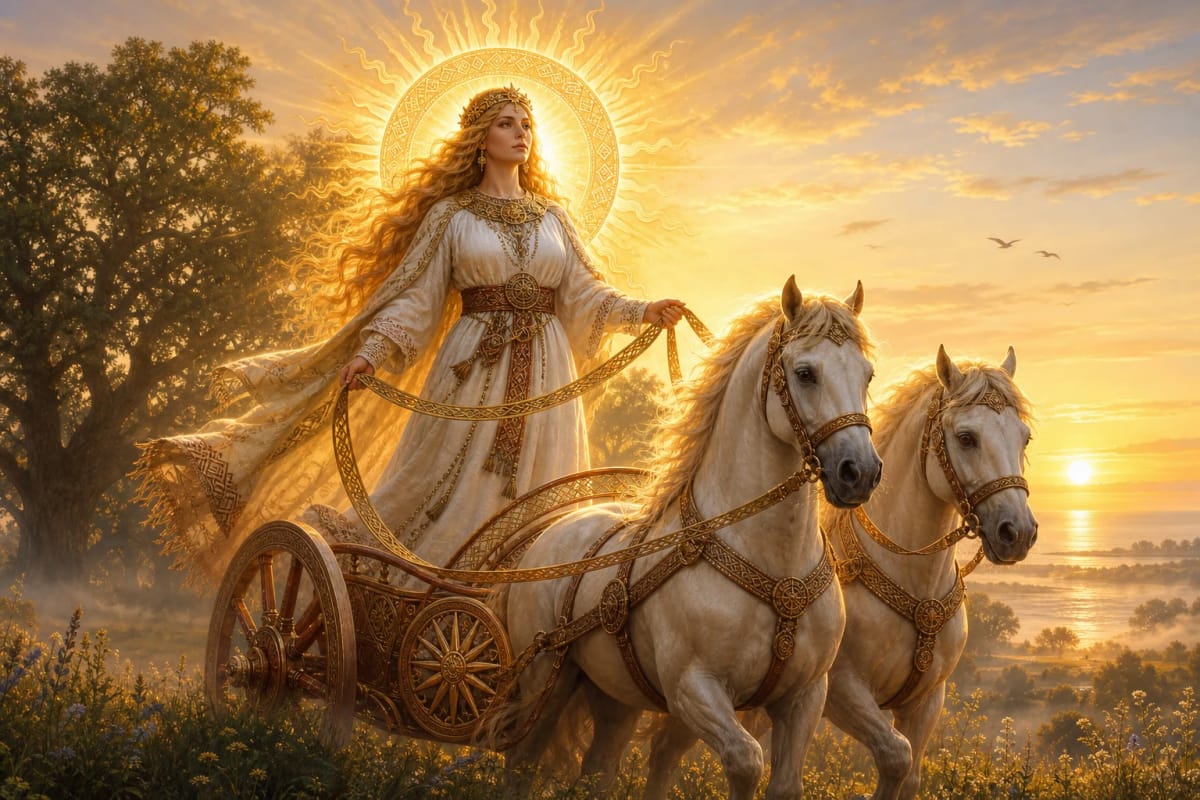
In songs and riddles Saulė may ride in a carriage and be linked with horses, gold, wheels, and shining objects. These images help explain why the solar wheel and carriage are such strong symbols of Saulė.
The Sun's path is not only a beautiful poetic image. It shows world order: light arrives, reaches its height, withdraws, and after darkness returns again.
Saulė, Mėnuo, and the heavenly family
One of the best-known layers of Lithuanian sky mythology is the relationship between Saulė and Mėnuo, the Moon. In folklore they may appear as members of a heavenly family, spouses, or actors in cosmic order.
Legends and songs include motifs involving Saulė, Mėnuo, Aušrinė, and other heavenly bodies. These narratives do not have one canonical version, so they should be read as a network of folklore motifs rather than a single mythology manual.
Still, the general picture is clear: in the Lithuanian worldview Saulė belongs to a living heavenly system where luminaries can act like persons, have relationships, and participate in the rhythm of the world.
Saulė and Aušrinė in Lithuanian folklore
Aušrinė, the Morning Star, is often tied to the beginning of the Sun's path and the family of heavenly bodies. In Lithuanian songs and legends she may appear beside Saulė, Mėnuo, and other sky images.
The link between Saulė and Aušrinė shows how folklore connects astronomical phenomena with family, beauty, travel, and daily time. Dawn is not only a brightening sky; it can become a mythic person.
Symbols of Saulė: solar wheel, horses, gold, and dew
The main symbols of Saulė are the solar wheel, light, warmth, gold, horses, carriage, wreath, dew, and day. They recur in folklore, folk art, and calendar customs.
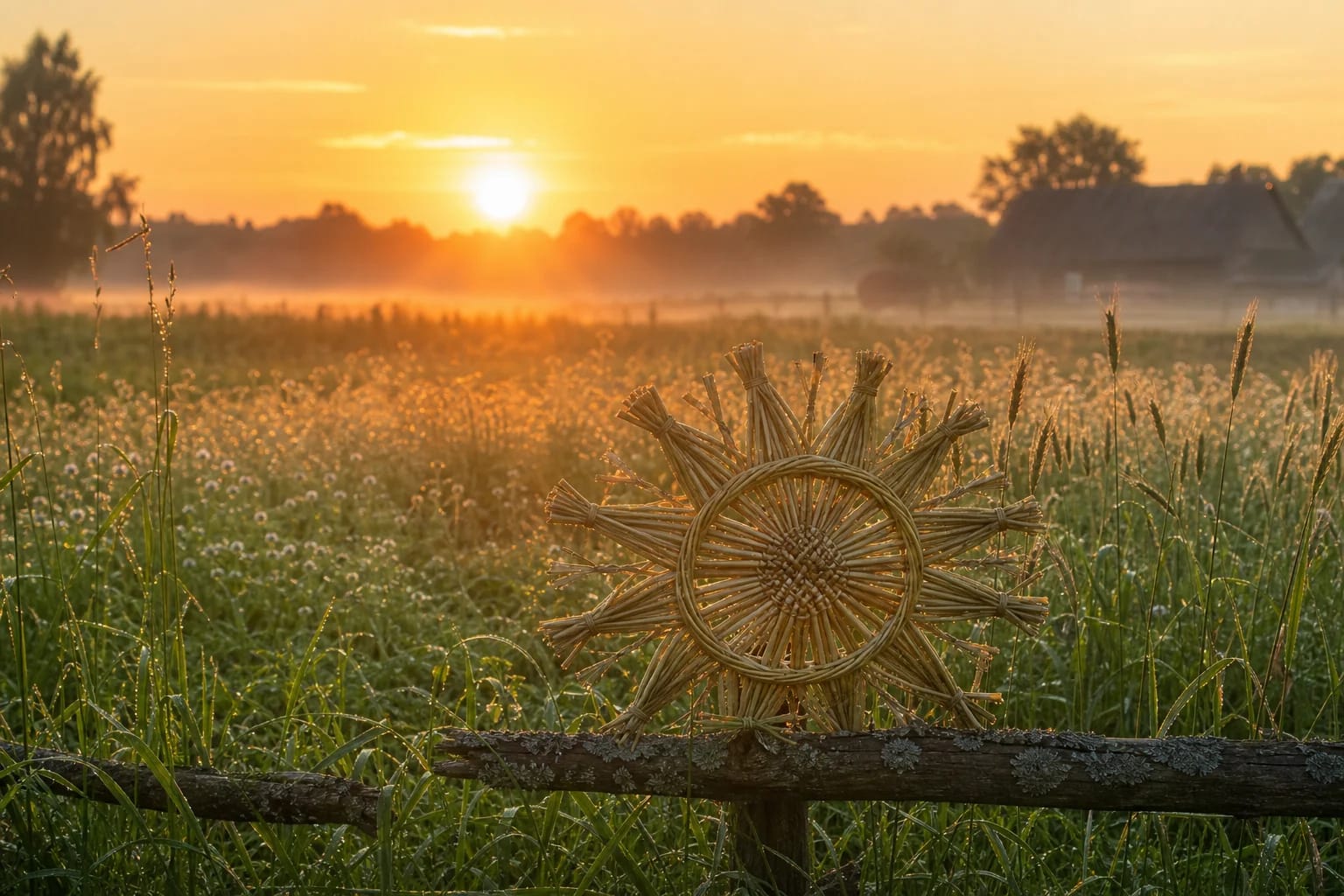
The solar wheel is one of the most recognizable signs. It can mean light, the yearly cycle, the movement of life, and the repetition of time. Horses and the carriage express the Sun's journey across the sky.
Dew is especially important in solar symbolism during summer solstice customs. It links morning, plant vitality, purity, and the brief magical time when light and nature seem especially powerful.
Saulė in Lithuanian festivals: Rasos, Kalėdos, and Velykos
The image of Saulė is closely tied to the yearly cycle. At Rasos, the summer solstice, the longest day, bonfires, dew, wreaths, and plant vitality are central. It is one of the clearest settings where solar symbolism can be seen in practice.
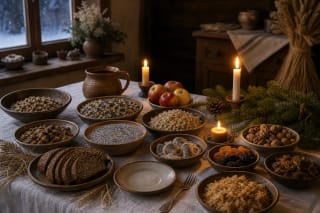
In the Kalėdos and Kūčios cycle, the return of light is important. After the darkest part of the year, the days begin to lengthen, so signs of waiting, renewal, and a new cycle appear in the holidays.
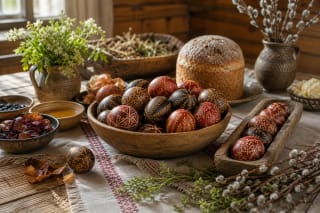
At Velykos, the symbolism of Sun and life meets spring, dyed eggs, colors, and the awakening of nature. Different layers overlap, but the logic of light and renewal remains clear.
The cult of the Sun: what can be said cautiously?
The cult of the Sun should be discussed cautiously. The VLE describes a broader sun cult and its traces in various cultures, but Lithuanian old religion is reconstructed from data of different kinds: folklore, customs, language, archaeological interpretation, and written sources.
The strongest claim is what folklore clearly supports: in Lithuanian tradition Saulė was personified, respected, and linked with life, light, the yearly cycle, and motherly protection. Specific cult forms need to be distinguished from later reconstruction.
This caution does not make Saulė unimportant. On the contrary, her image is so broad that it appears in songs, riddles, customs, and folk art even without a simple single story of a Sun temple.
Saulė today: why the image still matters
Today Saulė matters as a symbolic center of Lithuanian culture. She helps explain the language of songs, the Rasos festival, the waiting for light at Kalėdos, egg ornamentation, folk-art sunbursts, and everyday wishes of light.
Saulė also speaks about cycle, hope, and the continuity of life. She returns every day, so in folklore she becomes not only a natural phenomenon but also a sign of trust in world order.