- Category
- Practical craft lessons
- Reading time
- 7 min.
- Sources
- Source-based lesson with original teaching diagrams
What you will compare
Diamonds, colours and fringes alone do not identify a sash technique. The main question is how the yarn travels. Prepare photographs of at least two sashes showing their centre, edge and reverse, or use your own teaching samples. If you have only the decorated face, expect some answers to remain unverified. That is preferable to assigning a technique by intuition.
Give each sample a separate record: source title, object number if supplied, photographed side and whether a scale is present. Replace vague descriptions such as “ancient” with the source’s actual dating. The national culture centre names plaited and pick-up sashes in its account of Aukštaitija costume, but a technique name does not establish the origin of an individual sash.
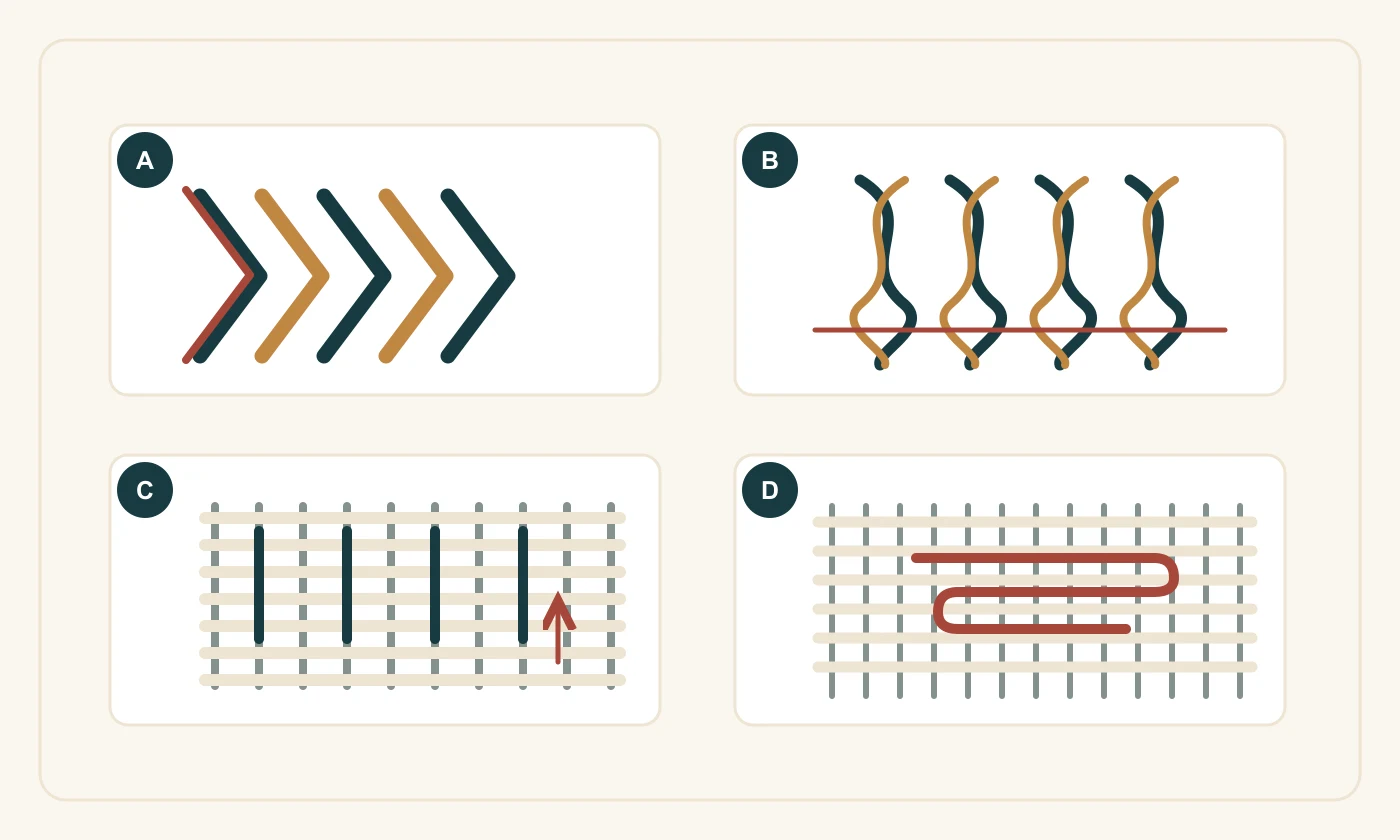
Diagram A isolates a diagonal yarn path, B twisting lengthwise groups, C selected longer floats and D a supplementary pattern yarn confined to one area. These are individual observation clues, not complete making drafts or copies of specific historic sashes.
Plaiting: trace the diagonal paths
Start examining a plaited sash at its edge. Look for a yarn group travelling diagonally, reaching the edge and changing direction. Do not judge solely from a diagonal decorative design: you are following yarn movement rather than the image it creates. Compare neighbouring paths and check whether the photograph actually resolves individual yarns.
A loose three-cord braid is enough for an initial experiment: watch one cord change position. This braid does not reproduce the structure of a broad traditional plaited sash and is not a making pattern for one. It simply helps separate the yarn path from a patch of colour. Note what the experiment explains and what cannot be transferred directly to the object.
Tablet weaving: look for structure, not just tools
Tablet weaving uses cards to control groups of warp yarns; the LTFai glossary describes it as warp-faced weaving. Examine lengthwise groups and places where their twist direction changes. A clear process image may confirm that tablets were used, but cards placed beside an object do not establish that this particular piece was made with them.
This exercise does not reconstruct tablet counts or threading from a photograph. That requires a separate verified draft, yarn specification and tested sample. To continue practically, choose a beginner draft from a maker that specifies initial card orientation and turning sequence. An identification record and a weaving instruction are different outcomes.
Pick-up and supplementary weft: locate the pattern
Pick-up patterning selects yarns to make the design. Look for longer pattern floats and find their counterparts on the reverse. Colour reversal alone is not a final verdict: different structures can produce similar appearances. A terminology glossary helps formulate the question; the particular museum record or maker’s explanation helps answer it.
For a supplementary-weft pattern, look for an extra pattern yarn and its beginning, ending or return within a limited area. The reverse and motif boundary are particularly useful. These are investigative clues, not a universal identification test. Failure to see an extra yarn does not prove its absence: a dense ground or insufficient magnification may conceal it.
Check your conclusion
Hide the title and catalogue description only during your first observation. Record a provisional technique and two supporting features. Then read the description and mark agreements or contradictions. If the catalogue names another technique, check terminology, photographed side, object identity and whether different fragments have been confused before trying to explain the discrepancy.
Your final comparison should show whether each claim is visible, supplied by the source or inferred. Name one missing view: edge, reverse or working process. You will then have a useful learning record without turning a tentative visual guess into an established description.