- Place
- Rusnė town, Rusnė Eldership, Šilutė District Municipality
- Region
- Pamarys
- Type
- historic Lithuania Minor Lutheran church
- Address
- Neringos g. 10, Rusnės mstl., Šilutės r.
- Coordinates
- 55.29760, 21.37580
Rusnė Lutheran Church
Lutheran church on Rusnė Island
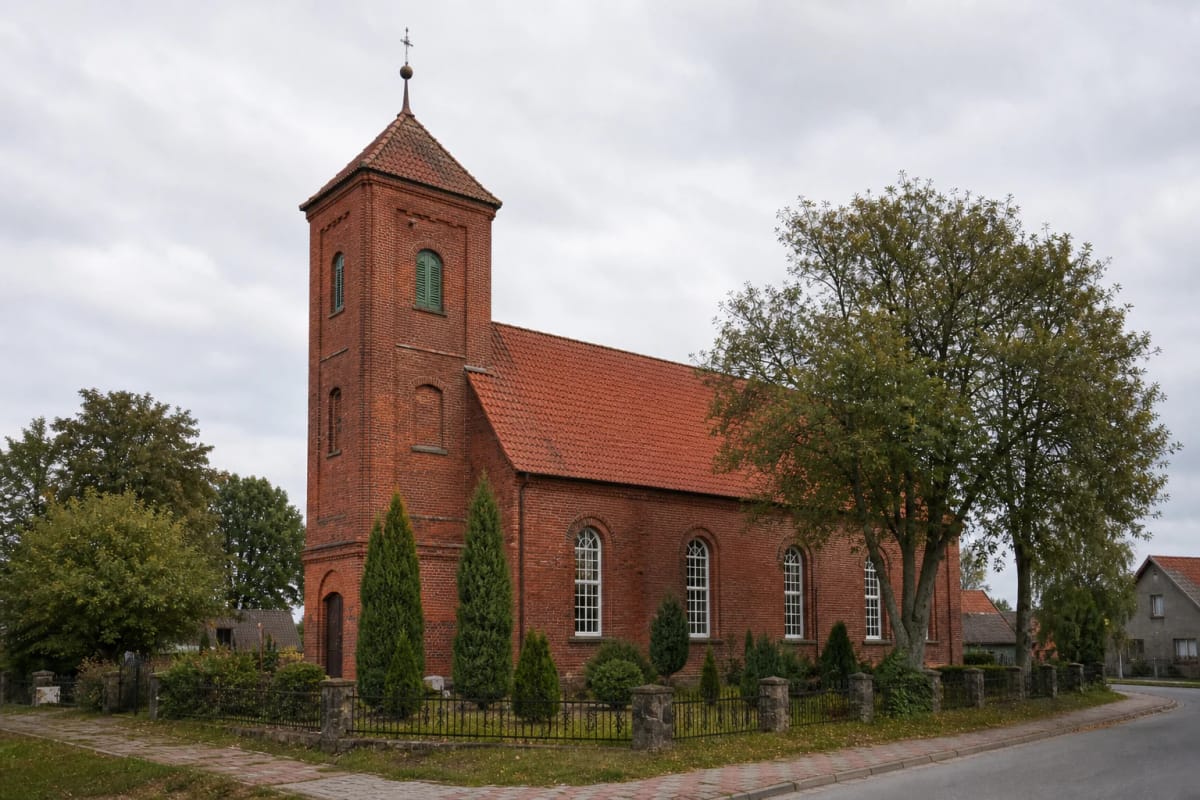
Rusnė Evangelical Lutheran Church is one of the most important places in the island's historic centre. It speaks of Lithuania Minor confessional heritage, red-brick architecture, and the cultural layer of Nemunas Delta towns. Rusnė parish is considered one of the oldest in Lithuania and may have been founded around 1419, still in the time of the Teutonic Order.
In the Register of Cultural Values, the church is listed at Neringos g. 10 in Rusnė town; its code is 1644, and the object is state protected and of regional significance. It is a single-nave red-brick sanctuary with a square western bell tower and an octagonal eastern apse, recognizable as part of the Pamarys sacred landscape.
Three fires and the 1809 brick church
According to sources, earlier Rusnė prayer houses burned three times over about 50 years: in 1739, 1774, and 1789. The present brick church was consecrated in 1809; an octagonal confirmands' hall was added on the eastern side, and the massive western tower with a pyramidal roof spire rose somewhat later, in 1827. KVR therefore gives a broader construction period, 1809-1854, including later works.
The church has an elongated rectangular plan, about 29 m long and 11 m wide according to sources. The organ was acquired in 1827 and had 11 stops, while the two bells dated from 1783. In the twentieth century the building was partly reconstructed, around the 1950s, so on site it is important to see not only old masonry but later history too.
The 1419 date and older parish tradition
The church tower weather vane carries the date 1419. It is linked with the early Rusnė parish tradition, but it is not the construction date of the present brick building. The first wooden church at this place probably stood before 1583, and a parish school operated here from 1553.
This distinction matters for visitors: Rusnė church has a deep layer of parish memory, also connected with Lithuanian writing. Hymn writers Mykolas Gaidys-Gallus and Johann Jacob Sperber served here, and in the nineteenth century W. T. Schimmelpfennig, a collaborator of Liudvikas Rėza, collected songs in Rusnė. The building visible today is the result of nineteenth-century construction and twentieth-century restoration.
1994 restoration and the 575th anniversary
In 1994, after restoration and during the 575th anniversary of the parish's founding, Rusnė church was reconsecrated. This date helps show that the present appearance is the result of both nineteenth-century brickwork and late twentieth-century restoration, and that the community preserved the sanctuary through very different periods.
Look at the red-brick masonry, tower proportions, octagonal apse, the church's position in the town, and the churchyard's relationship with Neringos Street. It is not an isolated object but one node in Rusnė's historic fabric.
Opening access and a Rusnė Island route
The church remains an active house of worship of the Evangelical Lutheran Church in Lithuania, so interior access depends on services and events. Before planning an interior visit, check parish or community information; no permanent tourist opening hours or tickets are listed.
Rusnė church usually takes 20-45 minutes. Continue the same trip in the Nemunas Delta, Uostadvaris, Mingė, or toward Ventė Cape.