- Place
- Švėkšna town, Švėkšna Eldership, Šilutė District Municipality
- Region
- Pamarys
- Type
- Neo-Gothic Catholic church
- Address
- Bažnyčios g. 1, Švėkšnos mstl., Šilutės r.
- Coordinates
- 55.51710, 21.61960
Švėkšna Church, Švėkšna St James Church
Švėkšna's Neo-Gothic vertical
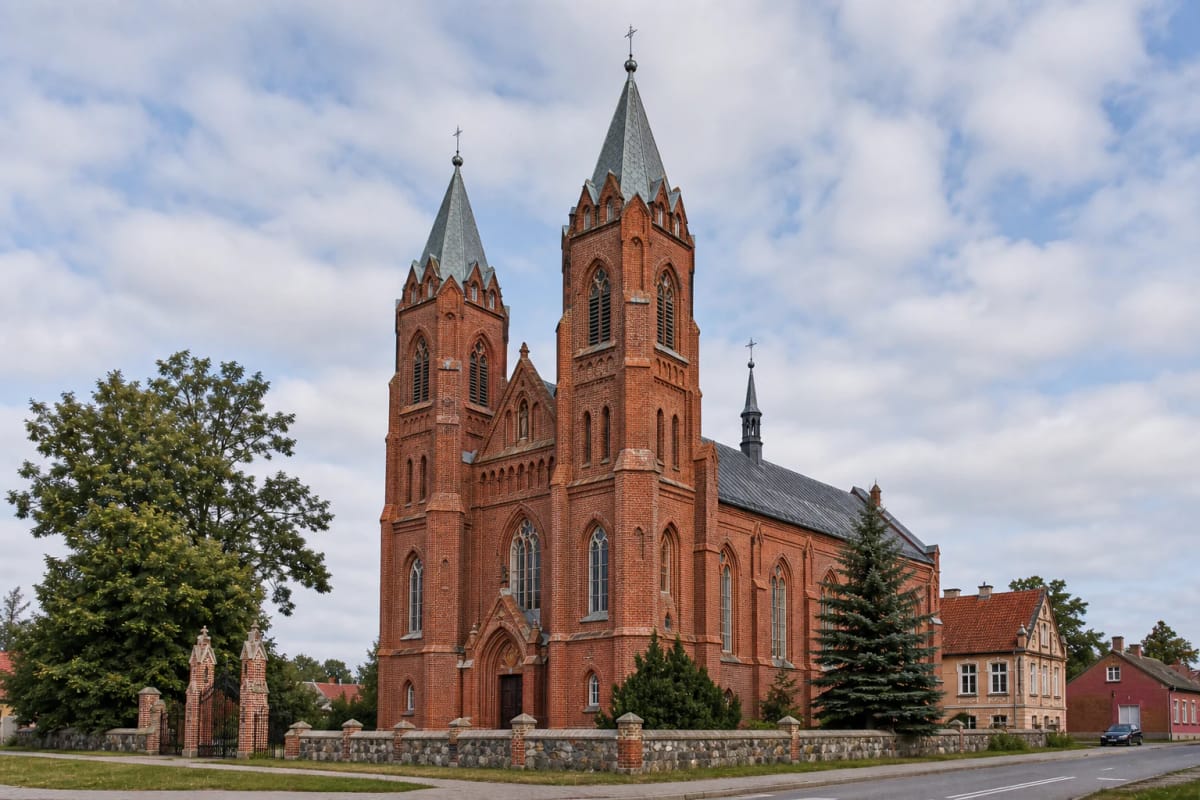
Švėkšna St James the Apostle Church is the town's clearest landmark. In radial-plan Švėkšna, where a square opens at the intersection of four main streets, the church appears as a tall Neo-Gothic vertical and works as an architectural answer to Švėkšna Manor Park and the historic town space.
In the Register of Cultural Values, the church is listed at Bažnyčios g. 1 in Švėkšna, KVR code 1648; it is state protected and of national significance. Švėkšna itself is mentioned already in a 1509 church donation act by Stanislovas Kęsgaila, elder of Samogitia, and from 1766 to 1940 the manor belonged to the counts Plater, under whose patronage the present church rose.
Strandmann Neo-Gothic, 1900-1905
According to sources, the brick church was built in 1900-1905 to a design by architect Karl Eduard Strandmann; VLE and KVR give 1905 as the completion date. Construction is linked with Plater patronage, and the chosen red ceramic brick and Gothic-inspired forms were popular in sacred architecture of the late nineteenth and early twentieth centuries.
The church has a Latin-cross plan, a three-nave basilica form, and two towers ending in octagonal spires with metal crosses. At town scale this composition gives it a very strong, far-visible silhouette, while the walls are strengthened with buttresses characteristic of Gothic building logic.
Altars, Goebel organ, and tower clock
The church is valuable not only outside but inside. KVR information mentions eight altars, while the main altar is linked with the Purger workshop in Tyrol. VLE also notes three eighteenth-century bells and eighteenth- to nineteenth-century chasubles and dalmatics inherited from the earlier parish.
Among the technical interior elements, Bruno Goebel's 1906 organ and the 1914 tower clock stand out. These specific dates show that the newly built church was gradually filled with liturgical and technical equipment throughout the first decade of the twentieth century.
Red-brick viaduct and link with the manor park
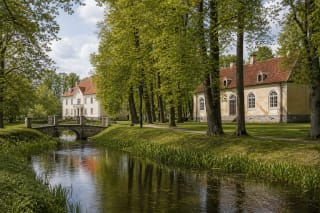
One of Švėkšna's most interesting features is the church's relationship with the manor environment. VLE and KVR mention a red-brick viaduct, built around 1885, linking the churchyard with the manor park; it allowed the estate owners to reach the church without entering the town streets.
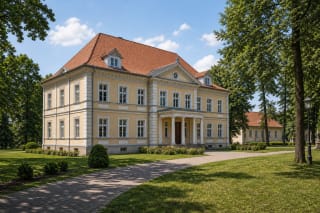
For that reason Švėkšna is best visited not as a list of separate objects. The church, manor park with the Genovaitė villa and sculptures, alleys, and town centre form one spatial story about representation, faith, and manor influence in a Pamarys town.
How to view Švėkšna Church
Allow at least 30 minutes for the exterior: walk around the churchyard with its fence and gates, look at the tower silhouette, facade proportions, and the church's relationship with town streets and the viaduct toward the park.
The church is an active parish sanctuary, so there are no permanent museum-style opening hours or tickets. If you want to enter, coordinate with service times and local parish information, and combine the visit with the manor park and town.