- Place
- Zarasai, Zarasai District Municipality
- Region
- Aukštaitija
- Type
- white-plastered masonry, Neo-Baroque, twin-towered rectangular parish church
- Address
- 3 Bažnyčios Street, Zarasai
- Coordinates
- 55.73044, 26.24562
- Visit duration
- 30-60 minutes; longer if the interior and churchyard gates can be examined quietly
- Best time
- in daylight before or after officially listed Masses; the parish publishes no separate tourist schedule
Zarasai Church, Zarasai Sanctuary of the Assumption, Zarasai Town Church
A central Zarasai sanctuary, not the Orthodox church or observation wheel
The church stands in central Zarasai on Bažnyčios Street, on one of the town's higher sites. The current official address used by the parish and Diocese of Panevėžys is 3 Bažnyčios Street, while a tourism publication still gives 1 Bažnyčios Street. This is a genuine address discrepancy, not two different Catholic churches. The coordinates 55.730444, 26.245623 mark the church site and do not promise a particular doorway.
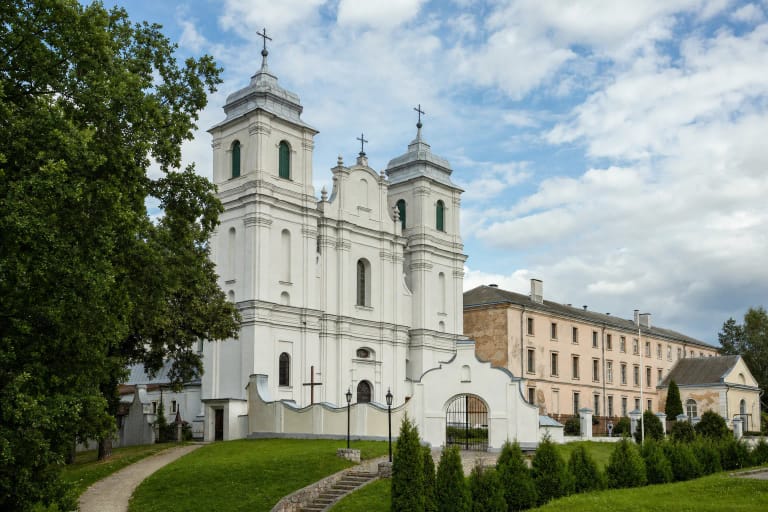
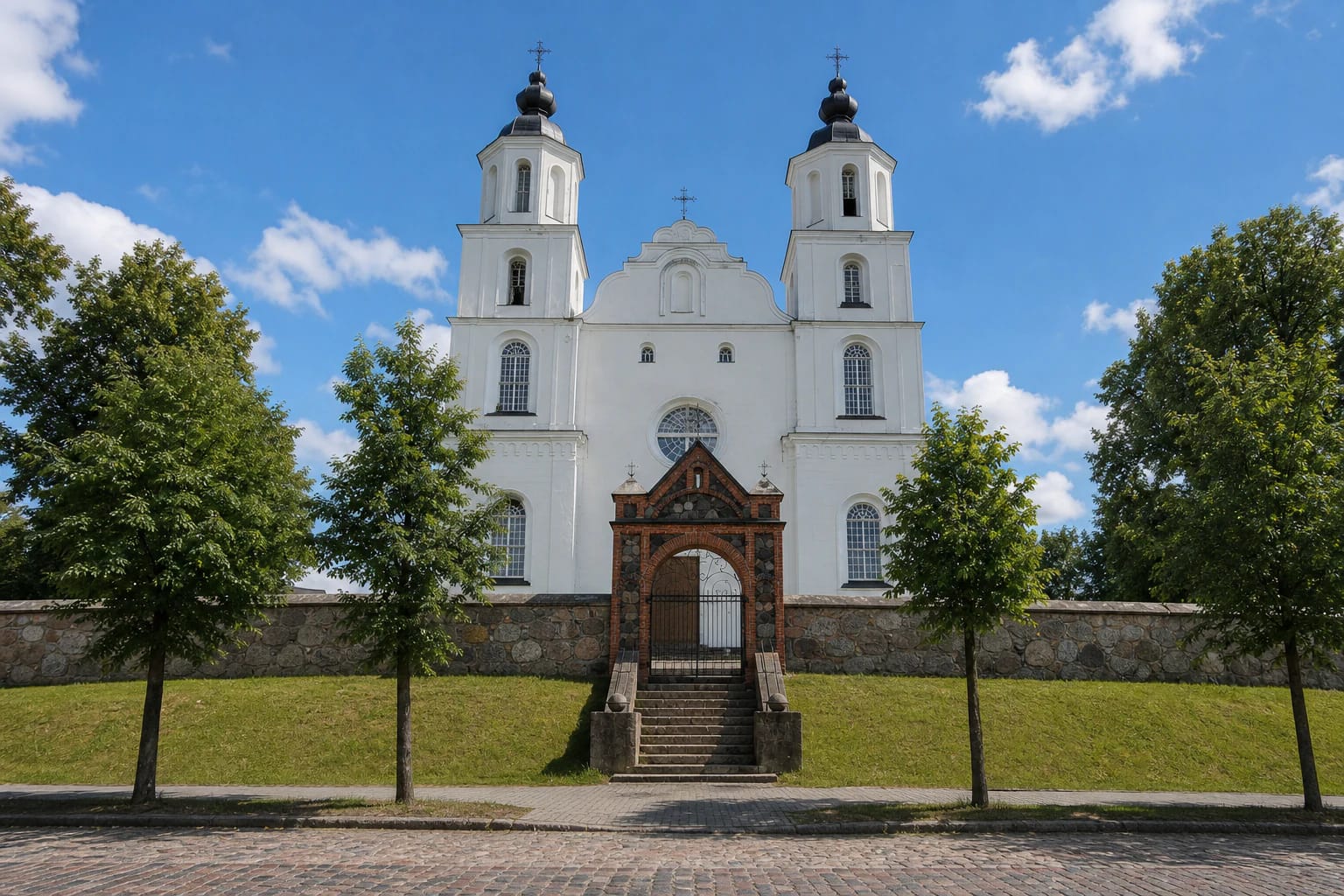
From the town side, the building is identified by white-plastered masonry, two towers, and a broad wavy pediment. It is a Roman Catholic parish sanctuary. Zarasai's Orthodox Church of All Saints is a different building and a different religious tradition, so their architecture, history, and addresses should not be combined.
The church is not the Lake Zarasas observation wheel, a museum, or a lakeside attraction. It belongs to the historic town fabric, while the Lake Zarasas landscape begins beyond the streets and squares rather than at the church doors. The observation wheel and Zarasai Regional Museum are useful separate route stops, not parts of this plot.
The parish before the present church: island, monastery, and timber predecessors
The exact date of the first Catholic church in Zarasai is unknown. Sources mention a church from 1508, while a Lithuanian State Historical Archives notice records a confirmed altar foundation in 1522 and a parish founded in 1528. The official parish history dates the parish's establishment to 1536. These are best presented as different surviving dates for the parish's beginnings, not forced into one supposedly certain year.
The official parish history says that, before the clearer documentary record, a Barefoot Carmelite monastery and church may have stood on Great Island in Lake Zarasas, after which the sanctuary was moved to the lakeshore where the town developed. This is an important local historical hypothesis, but the sources reviewed do not establish every detail archaeologically beyond doubt.
A new timber church was built in 1610 and is associated with the care of Grand Duke Sigismund Vasa. It burned during the wars and was rebuilt by 1674. In 1702 the rectory and church archive burned. As the old timber church deteriorated, worship was prohibited there in 1837, and a temporary fifth timber church was built in 1851. These fires and temporary buildings belong to earlier stages, not to the present masonry church.
Construction in 1862, late-1870s rebuilding, and the 1906 consecration
A plan for a new masonry church was being prepared from 1837, but the first project was not approved and construction dragged on. After preparations begun in 1842 and a succession of temporary worship spaces, the first masonry version of the present church was completed in 1862 under a project approved in 1851. It was built in plastered masonry and soon showed serious structural problems.
Sources mark the later work differently. The Diocese of Panevėžys says that in 1878, under parish priest Pranas Stašauskas, timber foundations were replaced with masonry, the walls and towers were tied together, and cracks were repaired. The municipal special plan describes a late-1870s rebuilding in which the towers were raised to four stages and an attractive inter-tower front was added. Thus 1862 marks the rise of the present building, while 1878 marks its major strengthening and visual formation.
In 1906 Bishop Gasparas Cirtautas consecrated the church and gave it the title of the Assumption of the Blessed Virgin Mary. The reliable sources reviewed do not securely establish the name of the original architect. Ustinas Golinevičius appears in connection with the investigation of wall cracks and structural problems in 1874, but that is not enough to call him the proven designer of the whole present building.
White-plastered Neo-Baroque, two towers, and a disputed plan description
Zarasai Church is a rectangular white-plastered masonry volume with a gabled roof and a flat rear wall. The facade has strong Neo-Baroque features, while sources note forms closer to Classicism inside. Descriptions give an approximate length of 38 metres and width of 24 metres, but these figures are not presented as a current geodetic survey.
There are exactly two towers. They stand on the sides of the facade, each has four stages, and their tops end in Baroque-form helmets, globes, and openwork crosses. The broad wavy pediment between them is one of the building's most recognizable features. The nineteenth-century churchyard gate with an ornamental cross belongs to the wider church setting, not to the main volume itself.
Sources disagree about the plan: Zarasai Regional Museum calls the church a rectangular three-nave place of worship, while a tourism brochure describes it as single-nave. That difference should not be hidden beneath one apparently precise term. The safest common description is a rectangular plastered masonry volume with two towers, while the number of naves remains a source conflict.
The Marian image, three altars, the organ, and two bells
The high altar holds an image of the Virgin and Child Jesus, long venerated as a source of grace. Parish and municipal accounts preserve a legend connecting it with Vytautas, a Byzantine gift around 1425, and miraculous survival in the Vilnius fire. More recent restoration research dates the painting to the late sixteenth or early seventeenth century, relates its iconography to a Roman image, and leaves its author unknown. The legend should be distinguished from the research, not erased by it.
The church has three Baroque altars with matching artificial-marble columns. The principal part of the high altar survives, while the wartime history of its damaged side elements is not the same as the construction history of the present building. The side altars are described with an Ecce Homo and St Anthony sculpture, and paintings of the Sacred Heart of Jesus and St George.
The organ case is Neo-Gothic, and the instrument has two manuals, pedals, and a 16-stop mechanical action. Its origin is not fully established: the parish history raises the possibility that the organ or parts of it were moved from the former Kaunas Bernardine Church, but this is unconfirmed. Shelling in 1941 badly damaged it; priest Antanas Gobis rebuilt it in 1943, and it was enlarged and repaired in 1965.
During the First World War the earlier bells were confiscated and melted for guns. Two bells with Russian inscriptions and images were brought from Russia in 1926. A source cautiously connects them with an Orthodox church, but presents that as a possibility rather than a proven specific origin. Both bells remain in the towers.
War damage, an active parish, and a realistic visit
The First World War damaged Zarasai; the rectory and farm buildings burned, and the church also needed repairs. In 1935 Canon Juozas Mazūras repaired and repainted it. On 24 June 1941 Soviet tank shells badly damaged the present building: ceilings and floors were torn open, an altar was smashed, and walls, towers, and doors were hit. German soldiers later held Soviet prisoners in the church and briefly used it as a bakery. These war layers belong to the present 1862 sanctuary, not to its timber predecessors.
This is an active parish of the Diocese of Panevėžys, with chapels in Zarasai Hospital and a social care home. The diocesan page lists Mass at 10:00 and 12:00 on Sundays, 18:00 on Saturdays, 18:00 on Mondays, and 08:00 and 18:00 from Tuesday to Friday. The schedule is mutable, so verify it with the parish before travelling at +370 385 52290 or +370 698 79834.
A 2024 municipal notice says the church is open to visitors and worshippers, and that an interior security system helps keep it open beyond Mass times. This is not a guarantee of fixed daily door hours or a guided tour: no separate tourist schedule, ticket price, confirmed parking and accessibility plan, or photography rules were found. Enter quietly, do not disturb worship, and arrange in advance if a group, organ viewing, or photography matters. On 15 July 2026, the exact Google Maps card with Place ID ChIJt9wNyIm6wkYRKsuvqV7fma0 showed 4.6/5. That is a mutable visitor average, not a heritage assessment.