- Place
- Zarasai District Municipality
- Region
- Aukštaitija
- Type
- wooden manor church and church-art museum
- Address
- Ąžuolo g. 14, Stelmužė, Zarasai District
- Coordinates
- 55.83005, 26.21729
Stelmužė Church, Stelmužė Church Art Museum
The oldest wooden church in Lithuania
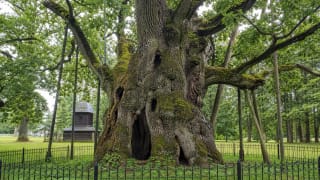
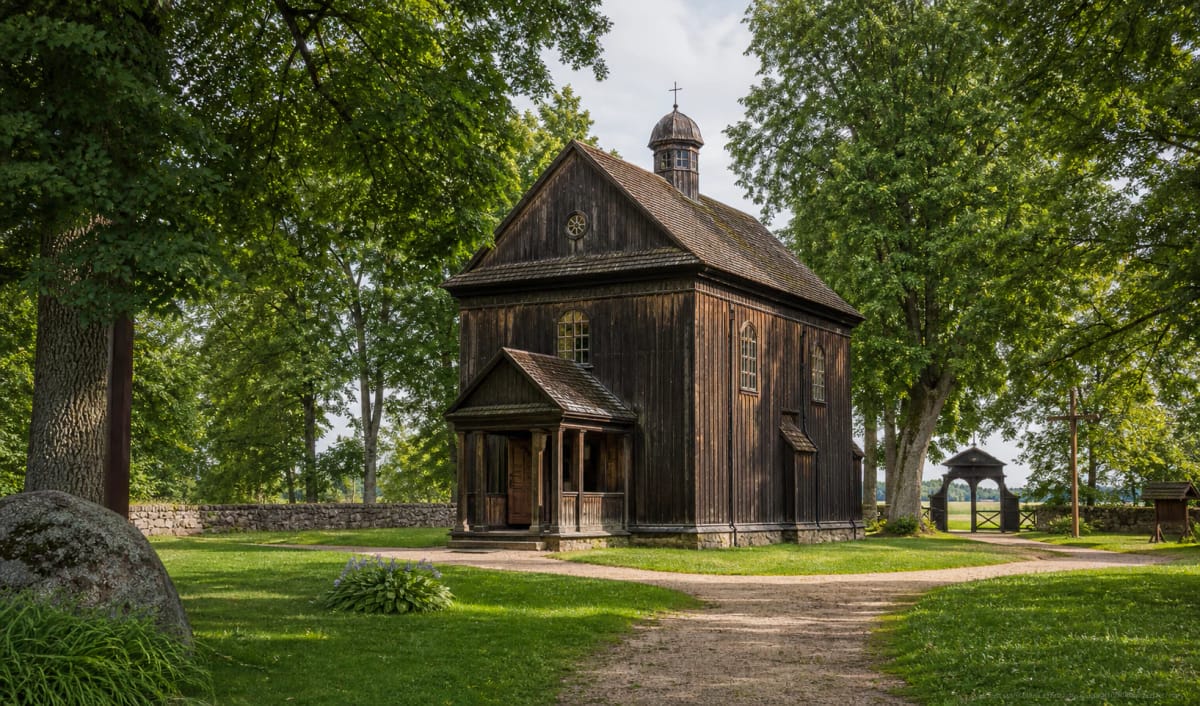
Stelmužė Church of the Cross of the Lord Jesus belongs to the heritage of Stelmužė Manor, mentioned in sources from the second half of the sixteenth century. The Cultural Heritage Register identifies it as the manor estate's filial Church of the Cross of the Lord Jesus and gives 1650 as its construction date. According to VLE, it is the oldest wooden church in Lithuania and one of the oldest wooden churches in Europe. It stands in the park on a high hill beside the legendary Stelmužė Oak.
Today the church functions as the Zarasai Regional Museum's church-art museum space. It should therefore be understood in two ways: as a historic sacred place and as a museum exhibition preserving church-art objects.
Architecture: 12-column portico and cellar under the nave
The Cultural Heritage Register describes it as a hall-type, single-nave, rectangular church with a narrower three-sided apse. On the main west facade, a portico wraps around three sides, with a triangular pediment supported by wooden posts. VLE states that the portico has 12 columns. This is folk architecture with Classical features.
The walls are built of hewn logs, the building stands on split-stone masonry foundations, and under the nave is a red-brick cellar with barrel vaults. In one cellar room, the remains of the Valujevas family were reburied in the second half of the twentieth century, after earlier lying in a mausoleum that stood near the church. The churchyard contains a wooden two-stage bell tower, seventeenth century and reconstructed in 1873, with bells cast in 1613, and a stone structure known as the slave tower from the nineteenth century.
Baroque altar, pulpit, and Stations of the Cross reliefs
The most important interior layer is the wooden Baroque altar and pulpit, both dated 1650 and decorated with bas-reliefs, high reliefs, and freestanding sculptures. VLE calls them unique woodcarving works in Lithuania, worth viewing slowly. The church was reconstructed in 1713 and 1880, so some interior details were later added or altered.
The Cultural Heritage Register also mentions an unfinished late nineteenth-century cycle of eight Stations of the Cross reliefs, whose authorship is linked with Józef Szpetkowski. It is important to stress the unfinished nature of this cycle and the restoration history, rather than presenting the interior as completely unchanged.
Restorations and Stelmužė Manor park
The church was reconstructed in 1713 and 1880, repaired in 1957-1959 and 1990-1991, restored in 1980-1981 by architect Ž. Mačionienė and in 2008 by project author S. Domanskienė. This history shows that the present appearance is the result of long care, repair, and restoration. The Cultural Heritage Register treats it as architecturally rare and important for sacred heritage.
The church is part of the seventeenth- and eighteenth-century manor estate. It is surrounded by an approximately 10 ha mixed-composition park, formerly French-style in the eighteenth century, where Stelmužė Oak grows. During the First World War the manor house was destroyed and the park declined; part of the park, 4 ha, was restored in 1980 according to a design by architect Ž. A. Mačionienė.
Opening hours and tickets
During research, Zarasai Regional Museum stated that on Monday-Tuesday excursions take place by prior arrangement, while Wednesday-Sunday the exhibition is open 10:00-18:00.
During research, Zarasai Regional Museum ticket rules applied: adult ticket 2.50 EUR, discounted ticket 1.50 EUR, with photography charged separately. Check the official museum page before travelling.